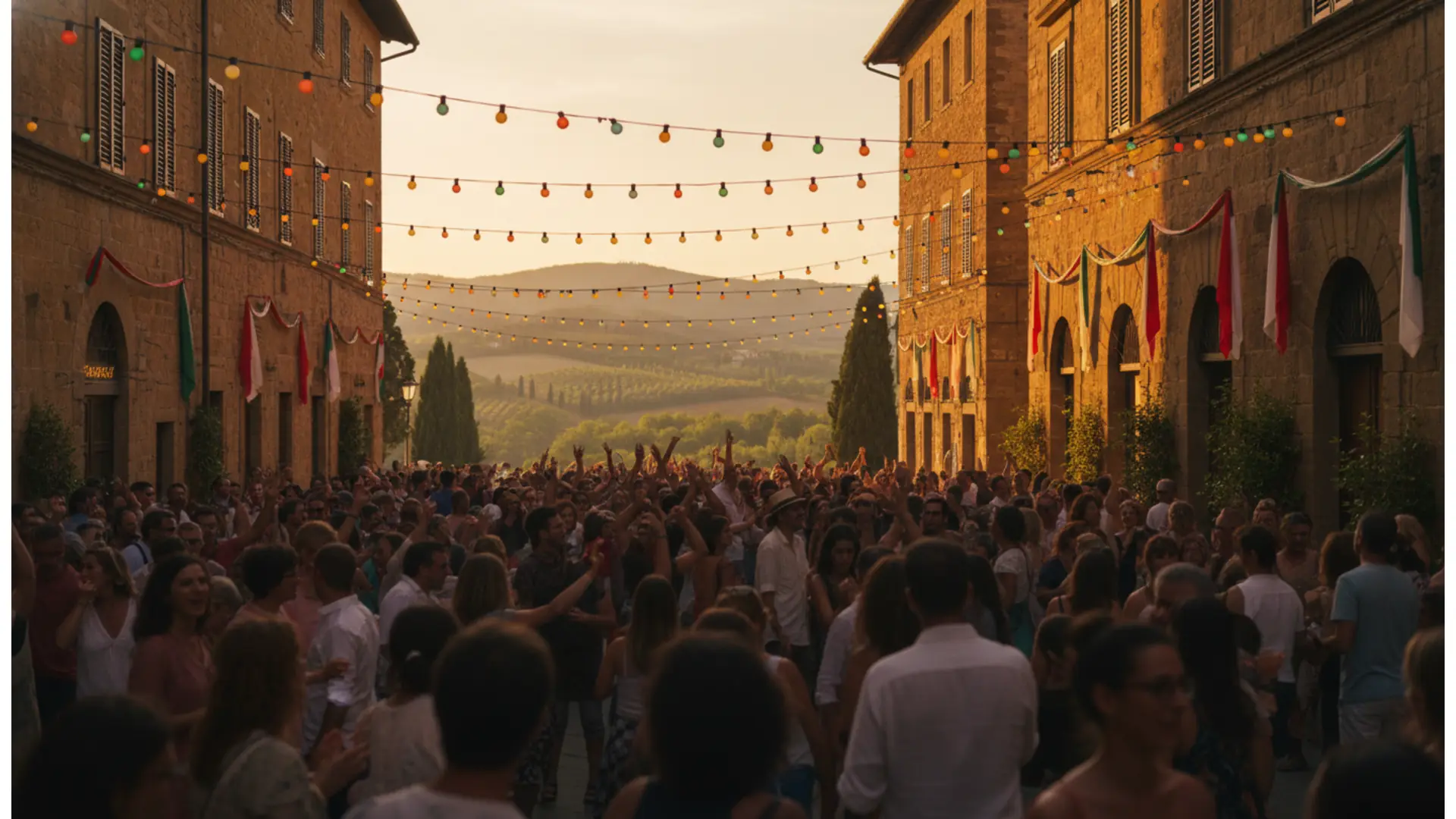
Patronal Feast of Saint Helena
The urn of the hermit saint travels through the streets of Laurino on an ox-drawn cart
About Saint Helena of Laurino
Saint Helena, the hermit of Cilento
The Patronal Feast of Saint Helena is the heart of the religious identity of Laurino, a village of just over a thousand inhabitants perched at an altitude of 531 meters in the Cilento hinterland, in the province of Salerno, in the heart of Campania and the Cilento, Vallo di Diano and Alburni National Park. Tradition tells of a young woman from Laurino of humble origins who, guided by an angel according to legend, left the village to live as an anchorite in a cave on Monte Pruno, where she spent years in prayer and charity before dying at a very young age.
Popular tales passed down from generation to generation have layered around her figure: the miracle of the roses, when bread stolen to give to the poor turned into flowers, and the miraculous intervention of 1799, which local memory links to the defense of the village during the French troops' incursion. These are stories that, more than historical records, explain why the saint is not a distant figure in Laurino, but a daily presence.
The relics and the legend of the oxen
The relics of Saint Helena arrived in Laurino in 1882, transferred from Ariano Irpino by the will of Bishop Francesco Trotta, and have since been kept in the crypt of the Collegiate Church of Santa Maria Maggiore. The most anticipated moment of the feast is the procession on May 22nd, when the wooden urn containing the saint's remains leaves the church and is carried through the village streets on a cart pulled by two oxen: a rare sight, as the urn leaves the crypt only on a few occasions during the year.
This act is not merely theatrical. It evokes the legend of the dispute between Laurino and the ancient Piaggine Sottane, now Valle dell'Angelo, over the possession of the saint's body: to settle the dispute, the remains were placed on a cart left to roam freely, and upon reaching the crossroads, the oxen spontaneously took the road to Laurino. That sign, interpreted as the will of the saint herself, ended the dispute between the two communities and is reenacted every year with the same ritual seriousness.
The program for May 22nd
The day of the solemnity is marked by liturgical celebrations. It begins early in the morning in the Chapel of Saint Helena, continuing in the Collegiate Church with masses in the late morning and an evening mass, followed by the procession that winds through the historic center. This is the moment when the village truly comes to a standstill: families stand in their doorways, the alleys fill up, and the slow pace of the oxen sets the rhythm for the entire community.
A cult that returns throughout the year
In Laurino, Saint Helena is not celebrated just once. The devotional calendar includes several appointments, each with its own character:
- May 22nd — the main solemnity, with the procession of the urn on the ox-drawn cart;
- Late June — the pilgrimage to the cave on Monte Pruno, where the saint lived as a hermit and where a small sanctuary with an 18th-century altar remains;
- August 18th — the summer feast, the most popular one, which draws many emigrants and faithful from neighboring towns back to the village;
- October 10th — another anniversary linked to the saint's cult;
- Last Sunday of January — the commemoration of the miraculous intervention of 1799.
Fanoie, cente, and community
Customs that reveal much about Cilento's popular culture survive around these celebrations. Every Sunday in May, fanoie (devotional bonfires) are lit in the village districts, accompanied by songs in honor of the saint. For the August feast, the cente return—large structures of decorated candles carried as ex-votos—and the village experiences a few days of great bustle, between relatives returning from abroad and visitors drawn by the fame of the cult.
Laurino and the Cilento hinterland
Visiting Laurino during the feast days also means discovering one of the best-preserved villages in the Cilento hinterland: the medieval fabric of alleys and arches, stone portals, the Collegiate Church with its 16th-century wooden choir, and gilded altars. Surrounding it are the trails of the National Park, the course of the Calore Salernitano river, and the villages of the upper valley, in a territory of Campania where the religious and landscape dimensions remain closely intertwined.
Saint Helena of Laurino — edition 2026
Saint Helena of May 2026
The 2026 edition of the feast took place on Friday, May 22nd in Laurino, in the province of Salerno, following the pattern passed down for generations. The celebrations began at 8:30 AM in the Chapel of Saint Helena and continued in the Collegiate Church of Santa Maria Maggiore with masses at 10:00 AM and 11:30 AM, concluding with the evening celebration at 6:30 PM.
At the end of the last mass, the procession took place through the streets of the historic center, with the wooden urn containing the saint's relics transported on the cart pulled by two oxen, in memory of the legend that claims the animals themselves chose Laurino as the guardian of Saint Helena's body. As every year, the day drew faithful from neighboring towns and Laurino natives residing elsewhere back to the village.
The devotional calendar then continues with the other anniversaries of the year: the pilgrimage in late June to the cave on Monte Pruno, the highly popular feast on August 18th, and the anniversary on October 10th.
Programme Saint Helena of Laurino 2026
Friday, May 22nd, 2026 — Solemnity of Saint Helena
- 8:30 AM — Holy Mass in the Chapel of Saint Helena
- 10:00 AM — Holy Mass in the Collegiate Church of Santa Maria Maggiore
- 11:30 AM — Holy Mass in the Collegiate Church
- 6:30 PM — Holy Mass in the Collegiate Church, followed by the traditional procession with the relic urn on the ox-drawn cart
Throughout the year, the cult of Saint Helena is also renewed with the pilgrimage in late June to the cave on Monte Pruno and the anniversaries on August 18th and October 10th.
Highlights Saint Helena of Laurino 2026
- The evening procession on May 22nd with the wooden relic urn
- The cart pulled by two oxen that evokes the legend of the dispute with Valle dell'Angelo
- The masses in the Chapel of Saint Helena and the Collegiate Church of Santa Maria Maggiore
- The fanoie, devotional bonfires lit in the districts on the Sundays of May
- The return of the cult on August 18th, with the cente and the many emigrants returning to the village
Prices Saint Helena of Laurino 2026
Practical information — Saint Helena of Laurino
How to get there
By car: from the A2 del Mediterraneo motorway, take the exit for Sicignano degli Alburni or Atena Lucana and continue along the provincial roads of the Cilento hinterland to Laurino. The most convenient train station is Vallo della Lucania-Castelnuovo, on the Tyrrhenian line, from where you can continue by car or local bus lines. The reference airports are Salerno-Costa d'Amalfi and Naples-Capodichino.
Admission
The celebrations and the procession are free and open to the public.
Tips
The historic center is made up of narrow alleys: it is advisable to leave your car in the parking lots above the village and continue on foot. For the procession, it is best to arrive a little early, as the streets fill up quickly. Mass times may vary from year to year: it is always useful to check them at the Collegiate Church of Santa Maria Maggiore or with the Municipality of Laurino.
Festival-goer photos
No photos yet. Share yours!
Share your photos
5 photos max, 5 MB per photo (JPG, PNG, WebP)
Noticed an error or missing information?
Help us keep this listing up to date. Every proposal is verified by our team before publication.
Festival-goer reviews
No rating yet — be the first!
No comments yet. Be the first!
Were you there?
Share your experience with the community.
Published by Valentin Contard, festival listings writer. Reviewed, corrected and approved by Christophe Contard, editor-in-chief. .
Where does it take place — Saint Helena of Laurino
Collegiata di Santa Maria Maggiore e centro storico