Il Brigante Tittariello - Bannita Tittariello, the People's Leader
The 17th-century historical re-enactment of the bandit Tittariello in the Borgo Serrone of Sant'Arsenio
Edition 2026 not confirmed to date
This edition has not been confirmed by the organiser to date. We recommend checking before going.
About Il Brigante Tittariello
Sant'Arsenio returns to the 17th century
In the town of Sant'Arsenio, in the province of Salerno, at the foot of the Alburni mountains and at the gateway to the Vallo di Diano, mid-August has marked the appointment with "Bannita Tittariello, the People's Leader"—better known as Il Brigante Tittariello—for over twenty years. The event is organized by the Pro Loco of Sant'Arsenio and takes place entirely within the Borgo Serrone, the oldest part of the village, and the streets of the historic center. In 2025, the re-enactment reached its 24th edition, confirming its status as one of the defining events for this part of inland Campania.
Who was Tittariello
Behind the local nickname lies Giovan Battista Verricelli (also recorded as Verricella), born in Sant'Arsenio in 1611. Local sources describe him as one of the most feared bandits in the region: he commanded a band of about three hundred men, and his actions—ranging from simple theft to raids on settlements—extended far beyond the Vallo di Diano. His figure has been the subject of studies and publications by local historians, and the community has even dedicated a mural to him in the village. The re-enactment is therefore not just a show, but the way Sant'Arsenio reconstructs and recounts a complex chapter of its history: that of brigandage in the Kingdom of Naples.
The Borgo Serrone, a natural stage
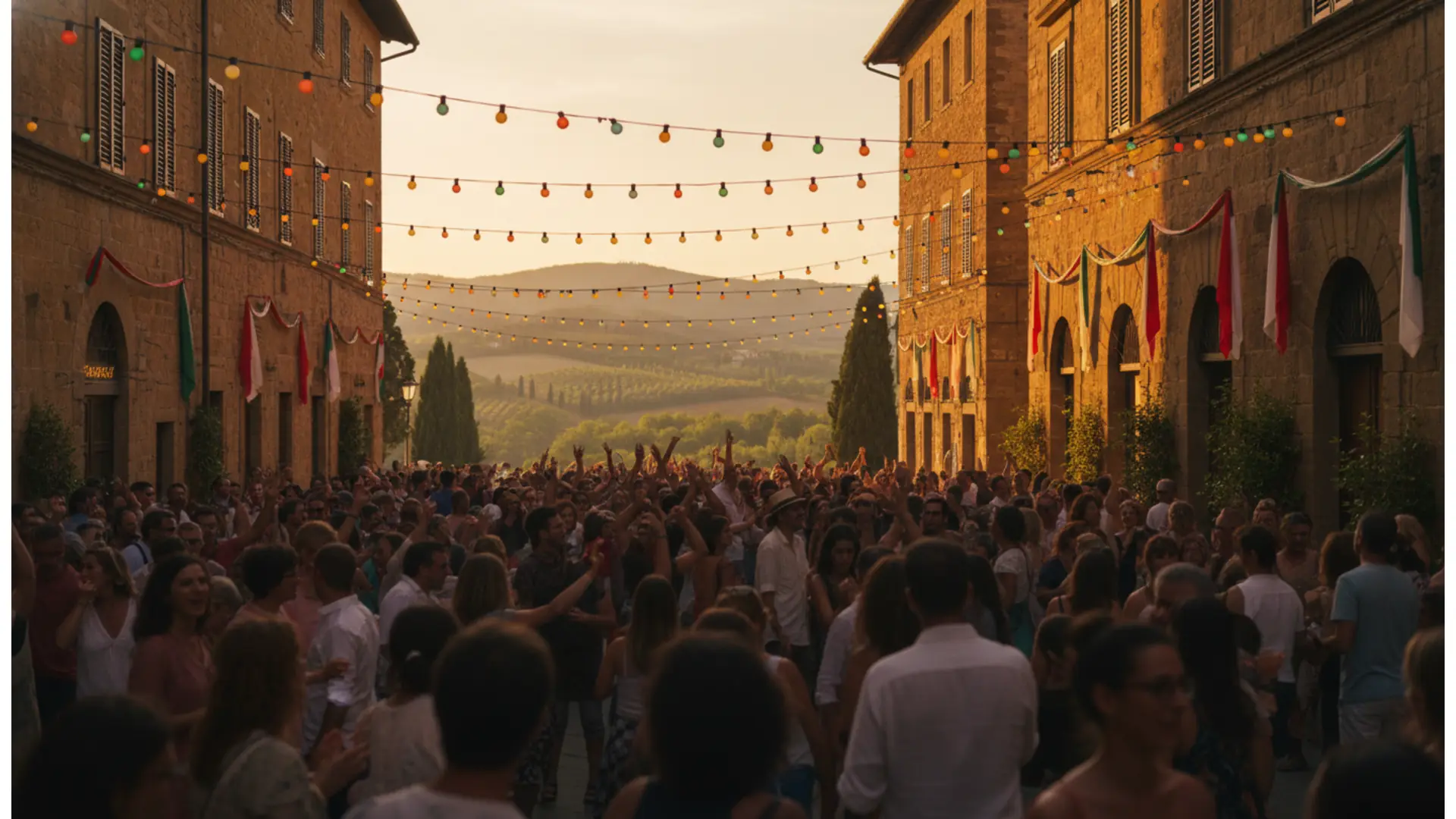
The Serrone is the upper district of Sant'Arsenio, a maze of alleys, arches, staircases, carved stone portals, and noble palaces dating mostly to the 17th and 18th centuries. For two days, the village is transformed into a 17th-century settlement: no modern lights, but torches and lanterns, artisan workshops reopened for the occasion, stalls with local products, and performers in period costumes occupying every corner. The village's own setting, which has remained largely intact, makes the reconstruction particularly authentic.
Processions, taverns, and skirmishes
The structure of the event, consolidated over time, includes several recurring highlights:
- Historical procession in 17th-century costumes along the village streets, accompanied by clarions, drummers, and flag-wavers
- Taverns, inns, and encampments reconstructed according to the era, where one can taste traditional Vallo di Diano peasant dishes
- Workshops and ancient trades, with local artisans presenting traditional products in the village alleys
- Palace raids and skirmishes between the bandit band and the Italo-Spanish soldiers
- The nocturnal escape to the countryside, which concludes the re-enactment around midnight
The artistic direction is entrusted to Nicola Piccolo, who introduces new elements to the staging each year without altering the core narrative. The involvement of the village is total: dozens of volunteers and performers, almost all residents, take care of costumes, sets, and choreography.
An event for the entire Vallo di Diano
Although deeply rooted in Sant'Arsenio, the re-enactment attracts audiences from across the Vallo di Diano, the Cilento, and the Alburni, and regularly involves neighboring towns. The Cilento, Vallo di Diano and Alburni National Park includes it among the events that define the identity of the inland Salerno area, alongside summer food festivals and patronal feasts. For those visiting the area, it is also an opportunity to discover the heritage of Sant'Arsenio: the Church of Santa Maria Maggiore, the Church of the Annunziata with its valuable 16th-century Flemish panel, and the regular urban layout of the village, which developed between the 16th and 19th centuries.
When it takes place
Il Brigante Tittariello is traditionally held on August 17th and 18th, following the Ferragosto celebrations, starting in the late afternoon and ending late at night. Dates and programs are announced by the Pro Loco of Sant'Arsenio in the days prior, through the association's website and official social media channels.
Il Brigante Tittariello — edition 2026
2026 Edition: dates not yet official
For 2026, the Pro Loco of Sant'Arsenio has not yet released the calendar for the "Bannita Tittariello, the People's Leader" re-enactment: at the time this entry was written, neither a confirmed date nor a detailed program is available.
However, the event is a fixed and consolidated appointment in the summer calendar of Sant'Arsenio, in the province of Salerno: in documented editions, it has taken place on August 17th and 18th in the Borgo Serrone, featuring a historical procession in 17th-century costumes, clarions and flag-wavers, period taverns and encampments, palace raids, and skirmishes between bandits and Italo-Spanish soldiers, ending with the nocturnal escape to the countryside.
Updates on the 2026 edition, including any changes to the artistic direction, are published by the Pro Loco of Sant'Arsenio on its website and official social media pages, usually in the weeks immediately preceding Ferragosto.
Highlights Il Brigante Tittariello 2026
Prices Il Brigante Tittariello 2026
Practical information — Il Brigante Tittariello
How to get there
Sant'Arsenio is located in the Vallo di Diano, in the province of Salerno. By car, it can be reached from the A2 del Mediterraneo motorway (Salerno-Reggio Calabria), taking the Polla or Atena Lucana exit, then continuing on local roads; the village is just a few kilometers from Polla and Sala Consilina. By train, the most convenient stations are Sicignano degli Alburni or Sapri, both connected by bus lines. During the re-enactment, the Borgo Serrone is closed to traffic: it is best to leave your car in the parking lots on the outskirts of the center and walk up.
Hours and admission
The event takes place in the late afternoon and evening, ending with the final scene of the escape to the countryside around midnight. Access to the festive village is traditionally free; taverns, inns, and food stalls operate on a pay-as-you-go basis. For the current edition, it is always advisable to check times and details with the organizers.
Tips
The Serrone is the upper district of the village: the streets are uphill, cobbled, and partly stepped, so comfortable shoes are essential. August evenings in the Vallo di Diano can be cool once the sun sets. To get a good view of the procession and the skirmishes, it is best to arrive early and find a spot along the main route.
Contacts
Associazione Pro Loco Sant'Arsenio, Piazza Domenico Pica 80 - 84037 Sant'Arsenio (SA), tel. +39 333 4882552. Program and updates on the website prolocosantarsenio.it and on the association's Facebook and Instagram pages.
Festival-goer photos
No photos yet. Share yours!
Share your photos
5 photos max, 5 MB per photo (JPG, PNG, WebP)
Noticed an error or missing information?
Help us keep this listing up to date. Every proposal is verified by our team before publication.
Festival-goer reviews
No rating yet — be the first!
No comments yet. Be the first!
Were you there?
Share your experience with the community.
Published by Valentin Contard, festival listings writer. Reviewed, corrected and approved by Christophe Contard, editor-in-chief. .
Where does it take place — Il Brigante Tittariello
Borgo Serrone, centro storico di Sant'Arsenio
Borgo Serrone, 84037 Sant'Arsenio