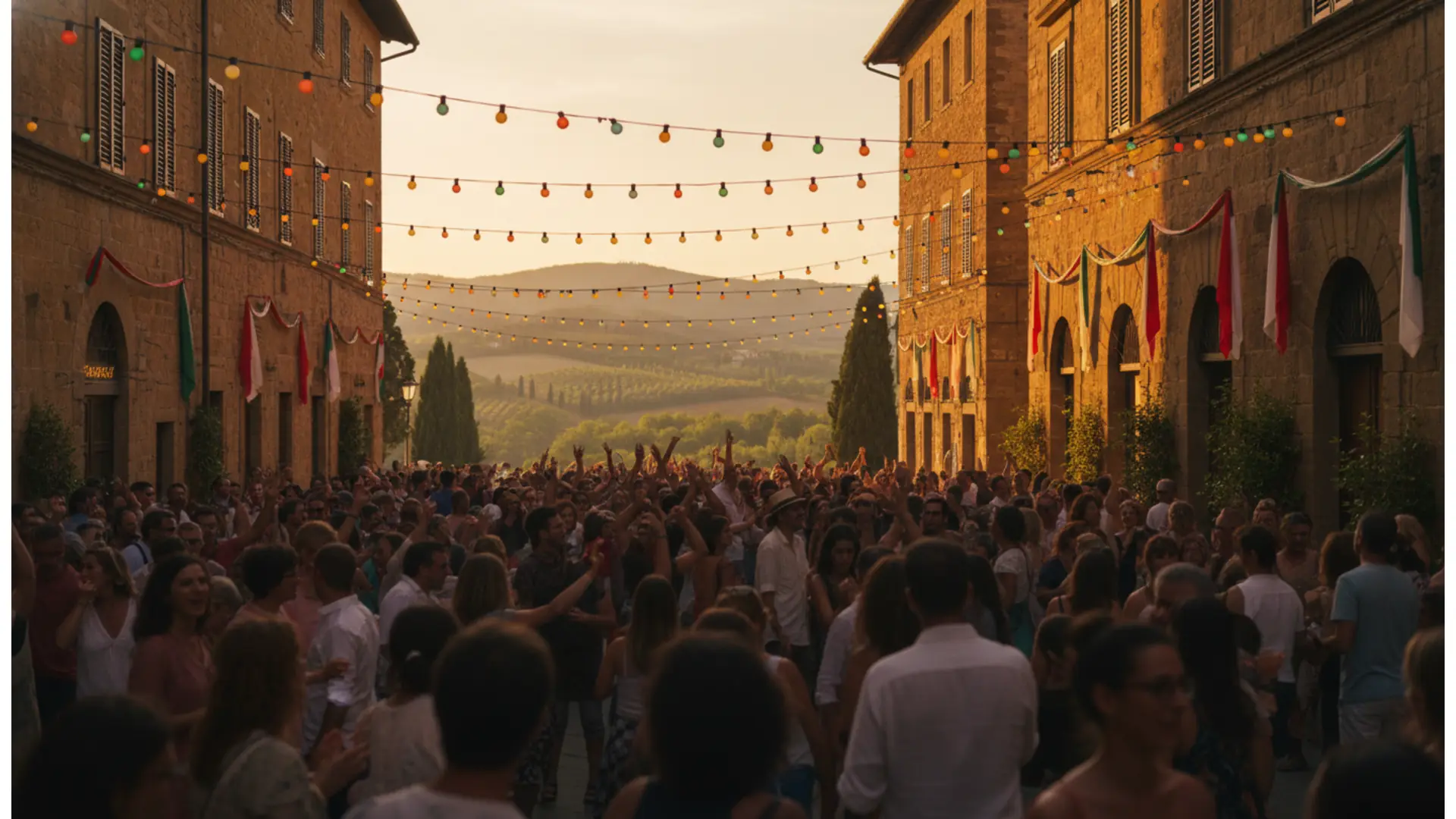
I Mazzaroni — Historical Carnival of Schiavi di Abruzzo
The historical carnival of the Alto Vastese region, featuring ritual begging, the Cimiero, and the spallata dance
About I Mazzaroni
The historical Mazzaroni Carnival
In Schiavi di Abruzzo, a small village in the Alto Vastese perched on the slopes of Monte Pizzuto in the Trigno valley, the Mazzaroni Carnival is much more than a masquerade: it is a community ritual with centuries-old roots, preserved and passed down through generations. In the local dialect, the protagonists are l'mazzaroun, young men from the village who wear a ceremonial headdress known as the Cimiero (C'mir), covered in colorful paper flowers and ribbons called zagarelle.
The procession and the ritual begging
The Mazzaroni group is led by the Pulcinella, the central figure of the Schiavi carnival, recognizable by his staff (the sagliocca), a symbol of power, semi-divinity, and the renewal of nature. During the festivities, the procession travels through the village and its numerous hamlets, visiting homes in a ritual quest: in exchange for songs and dances, the Mazzaroni receive sweets, wine, and cured meats, following an ancient pact of reciprocity that binds the community together.
The spallata, a propitiatory dance
The heart of the ritual is the spallata, a propitiatory dance of ancient origins. The dance features a complex structure with exchanges and approaches between couples arranged in parallel lines, facing each other, or in a circle, characterized by rhythmic movements of the hips, shoulders, and feet. According to some anthropological interpretations, its movements evoke the ancient paths taken by shepherds to lead their flocks from the mountains to the sea. An allusive song, which preserves a sort of orally transmitted code, accompanies the dance, marking verses and choruses like choreographic commands.
A village between history and archaeology
The charm of the Mazzaroni Carnival is intertwined with the identity of Schiavi di Abruzzo, in the province of Chieti, a town that tradition says was founded by Slavic populations who arrived from the other side of the Adriatic around the year 1000. Here, you can also find the Sacred Area of the Italic Temples, one of the most important archaeological sites in Abruzzo, testifying to a continuity of ritual practices from the pre-Roman age to the present day.
A heritage of inland Abruzzo
Immersed in the landscape of the Alto Vastese, on the border with Molise, the Mazzaroni Carnival represents one of the most vibrant expressions of Abruzzese folklore. Organized with the collaboration of the Associazione Schiavi della Musica, it attracts residents, returning emigrants, and curious visitors eager to rediscover an authentic festival, far from the clamor of more tourist-oriented carnivals, where ritual gestures, music, and conviviality maintain their deepest meaning.
I Mazzaroni — edition 2026
The 2026 program
The historical Mazzaroni Carnival took place over two dates. Saturday, February 14, the gathering of the Mazzaroni started at 9:00 AM from Piazza Purgatorio, followed by visits to the hamlets: Valli (10:15 AM), Casali (11:00 AM), Salce (11:45 AM), Cannavina (1:00 PM), Taverna (2:00 PM), Cupello (3:00 PM), Badia (4:30 PM), and San Martino (6:00 PM).
Tuesday, February 17, gathering in Piazza Purgatorio at 11:30 AM, departure for the Valloni hamlet at 12:00 PM, and the grand parade through the village at 3:30 PM, with the ritual quest and the spallata closing the festivities.
Programme I Mazzaroni 2026
Saturday, February 14, 2026
- 9:00 AM — Gathering and departure from Piazza Purgatorio
- 10:15 AM — Valli hamlet
- 11:00 AM — Casali hamlet
- 11:45 AM — Salce hamlet
- 1:00 PM — Cannavina hamlet
- 2:00 PM — Taverna hamlet
- 3:00 PM — Cupello hamlet
- 4:30 PM — Badia hamlet
- 6:00 PM — San Martino hamlet
Tuesday, February 17, 2026
- 11:30 AM — Gathering in Piazza Purgatorio
- 12:00 PM — Departure for the Valloni hamlet
- 3:30 PM — Parade through the village
Highlights I Mazzaroni 2026
- The ritual quest from house to house through the village and hamlets
- The flower-covered Cimiero and the Pulcinella figure with his staff
- The propitiatory spallata dance
Prices I Mazzaroni 2026
Practical information — I Mazzaroni
How to get there
Schiavi di Abruzzo is located in the Alto Vastese, in the province of Chieti, on the border with Molise. By car, it can be reached from the A14 motorway (Vasto Sud exit) by traveling up the Trigno valley, or via the SS650 Trignina road. The nearest train station is Vasto-San Salvo, from where you can continue by car.
Admission
The event takes place along the streets of the village and its hamlets and is free to attend.
Information
Associazione Schiavi della Musica — contact person Giuliano, tel. +39 347 6583635. Updates are available on the association's Facebook page.
Festival-goer photos
No photos yet. Share yours!
Share your photos
5 photos max, 5 MB per photo (JPG, PNG, WebP)
Noticed an error or missing information?
Help us keep this listing up to date. Every proposal is verified by our team before publication.
Festival-goer reviews
No rating yet — be the first!
No comments yet. Be the first!
Were you there?
Share your experience with the community.
Published by Valentin Contard, festival listings writer. Reviewed, corrected and approved by Christophe Contard, editor-in-chief. .