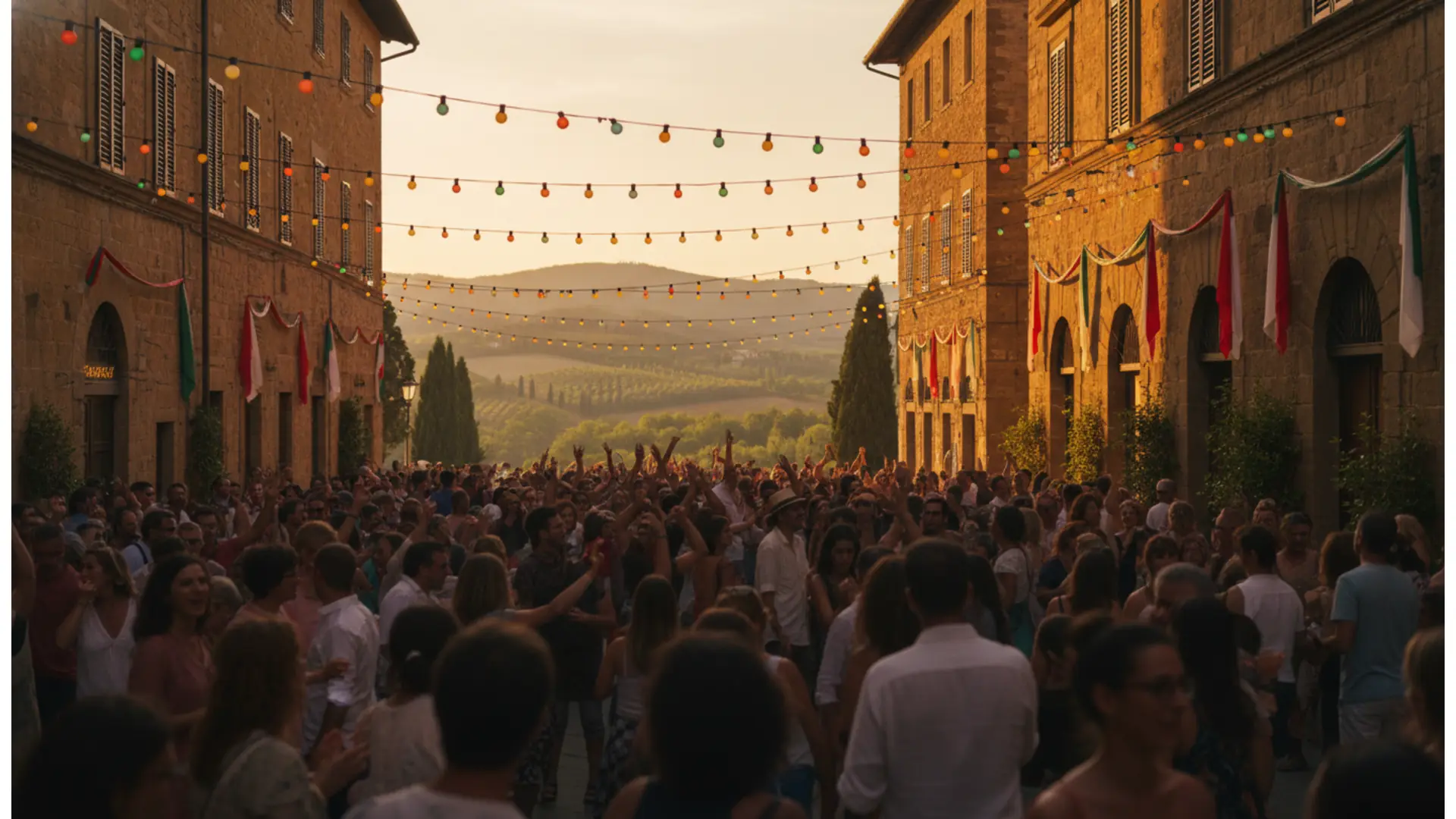
Holy Week of Aragona (I Sanpauluna)
The rites of the Aragonese Holy Week, from the singing of the Vere Filius to the Incontru with the giant puppets of Saint Peter and Saint Paul
About I Sanpauluna
The Holy Week of Aragona
In the heart of the province of Agrigento, the town of Aragona preserves one of the most intense and identity-defining Easter rites in Sicily. The Aragonese Holy Week weaves together Christian liturgy, popular devotion, and secular folklore, transforming the historic center into an open-air stage where brotherhoods, brass bands, and the entire community relive the drama of the Passion and the joy of the Resurrection.
From the Palms to Calvary
The celebrations begin on Palm Sunday, with the traditional blessing of the palms in Piazza Umberto I and the procession of the faithful toward the Mother Church. The most solemn moment arrives on Good Friday: in the morning, the Brotherhood of the Most Holy Crucifix leaves the Mother Church for the Church of the Rosary, marking the start of the procession of the Nazarene carrying the cross to Calvary for the crucifixion. The statue of Jesus remains on the cross throughout the afternoon, amidst vigils and prayers.
The Nocturnal Procession and the Vere Filius
At nightfall, the urn containing the statue of the dead Jesus travels along the so-called Strada dei Santi (Street of the Saints) in a moving nocturnal procession that concludes at the Church of the Carmine for the burial. The procession is punctuated by funeral chants performed a cappella by the faithful, most notably the famous Vere Filius, along with the ancient lament Ah sì versate lacrime: an oral musical heritage that has accompanied the community's grief for generations.
The Incontru and the Sanpauluna
The climax of the festival is Easter Sunday, with the highly anticipated Incontru. At exactly noon, in Piazza Umberto I, to the sound of the brass band, the Madonna drops her black mourning mantle and approaches the Risen Christ three times. Animating the scene are the Sanpauluna, the giant puppets of Saint Peter and Saint Paul: enormous figures with wooden heads and a lightweight structure, carried on the shoulders of a single man who makes them dance and sway among the crowd. Their origin dates back to the processional giants of the Spanish tradition, a result of the intense cultural ties between Sicily and Spain, and in Aragona, this custom has been documented since the early 18th century.
The Sundays of the Madonna del Rosario
The celebrations do not end with Easter: on the two following Sundays, services are renewed in the Mother Church, accompanied by band parades and processions of the Madonna del Rosario, the patron saint of Aragona, once again accompanied by Saints Peter and Paul. A finale that links the Easter festival to the town's Marian devotion in a single, great communal liturgy that spans the entire spring.
A Heritage to Experience
Visiting Aragona during Holy Week means connecting with an authentic Sicily, built on faith, memory, and hospitality. To top off the experience, there is the local gastronomy: during this period, the tagano (or taganu) is prepared, an ancient baked dish made of pasta, meat, and tuma cheese, cooked in the characteristic terracotta pot that gives it its name.
I Sanpauluna — edition 2026
The 2026 Holy Week of Aragona followed the traditional calendar of rites, from the palms to the Resurrection.
Program of the 2026 celebrations:
Programme I Sanpauluna 2026
Palm Sunday — March 29, 2026
- Blessing of the palms in Piazza Umberto I
- Procession of the faithful toward the Mother Church and religious services
Good Friday — April 3, 2026
- Morning: The Brotherhood of the Most Holy Crucifix leaves the Mother Church for the Church of the Rosary
- Procession of the Nazarene with the cross to Calvary for the crucifixion; the statue remains on the cross throughout the afternoon
- Evening: Nocturnal procession of the urn of the dead Jesus along the Strada dei Santi to the Church of the Carmine, marked by the funeral chants Vere Filius and Ah sì versate lacrime
Easter Sunday — April 5, 2026
- Noon, Piazza Umberto I: The Incontru — the Madonna drops her black mantle and approaches the Risen Christ three times
- Parade of the Sanpauluna, the giant puppets of Saint Peter and Saint Paul carried on shoulders
Sundays of April 12 and 19, 2026
- Services in the Mother Church, brass band parades
- Processions of the Madonna del Rosario, patron saint of Aragona, with Saints Peter and Paul
Highlights I Sanpauluna 2026
Prices I Sanpauluna 2026
Practical information — I Sanpauluna
Getting There
Aragona is located in the province of Agrigento, about 15 km from the provincial capital. By car, it can be reached via the SS189 (Agrigento–Palermo). The Aragona-Caldare railway station is served by the Agrigento–Caltanissetta line; the nearest airports are Palermo (Punta Raisi) and Catania (Fontanarossa).
When
The rites take place during Holy Week and on the two Sundays following Easter. The Incontru is held on Easter Sunday at noon in Piazza Umberto I.
Admission
All celebrations and processions are free and open to the public in the streets and squares of the historic center.
Tips
For the nocturnal procession on Good Friday, we recommend clothing suitable for spring evenings. It is advisable to arrive early to witness the Incontru in Piazza Umberto I.
Festival-goer photos
No photos yet. Share yours!
Share your photos
5 photos max, 5 MB per photo (JPG, PNG, WebP)
Noticed an error or missing information?
Help us keep this listing up to date. Every proposal is verified by our team before publication.
Festival-goer reviews
No rating yet — be the first!
No comments yet. Be the first!
Were you there?
Share your experience with the community.
Published by Valentin Contard, festival listings writer. Reviewed, corrected and approved by Christophe Contard, editor-in-chief. .
Where does it take place — I Sanpauluna
Centro storico di Aragona
Piazza Umberto I, 92021 Aragona