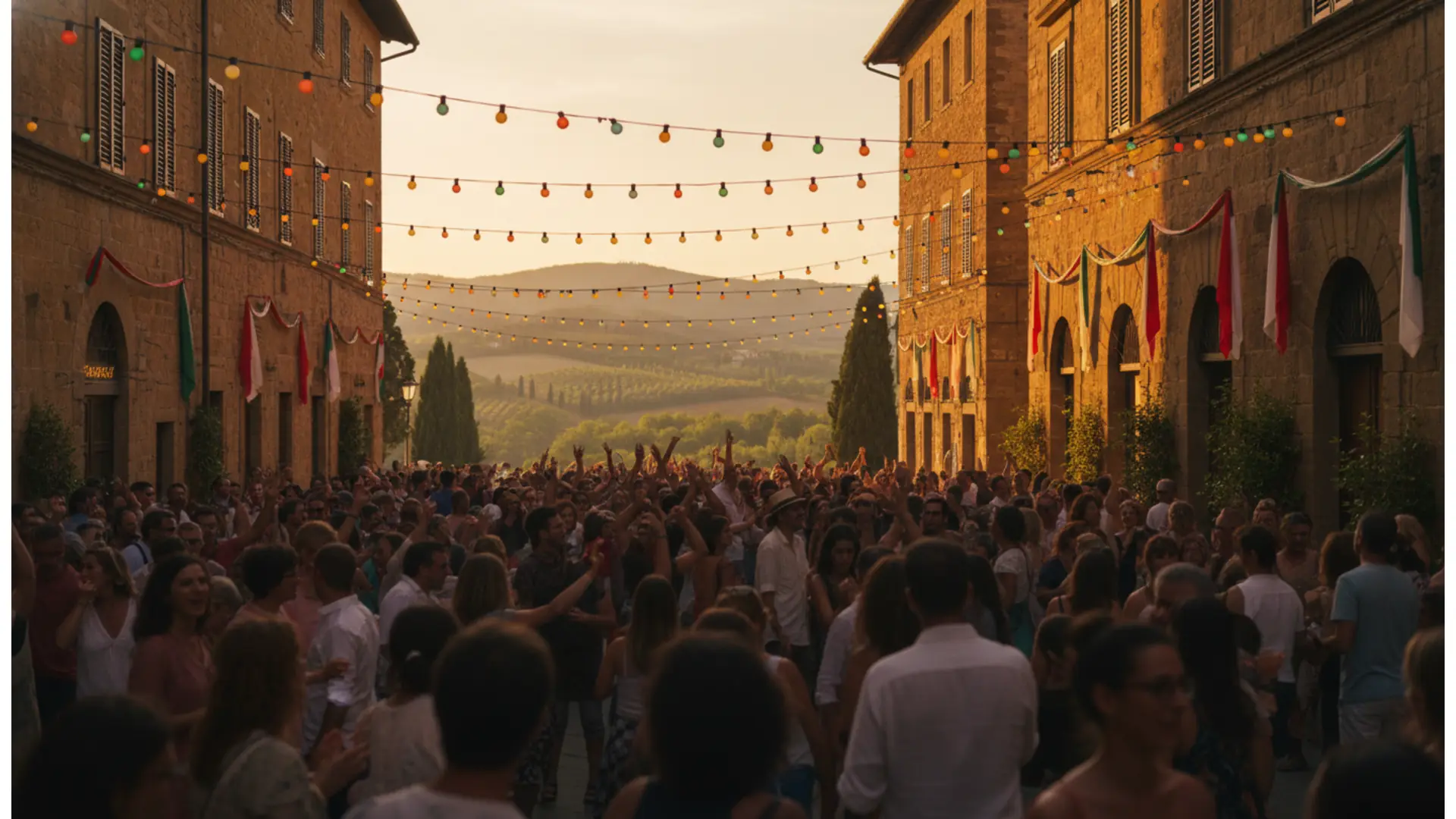
Holy Week in Cattolica Eraclea
Secular Easter rites featuring lamenti, Cappe, and the Calvary of Monte San Calogero
About Holy Week Cattolica Eraclea
A tradition spanning centuries
The Holy Week in Cattolica Eraclea, in the heart of the Agrigento province, is among the oldest and most well-attended religious observances in inland Sicily. Although the village was founded in 1612 by Philip IV of Spain, Cattolica Eraclea preserves rites with deep popular roots, passed down from generation to generation. For one week, the entire town transforms into a grand living representation of the Passion, where faith, memory, and community identity merge into a single collective emotion.
Maundy Thursday and the lamenti
Following the Mass of the Lord's Supper on Maundy Thursday afternoon, the procession of the Madonna Addolorata (Our Lady of Sorrows) begins, carried on the shoulders of the confraternity women through all the village churches. The altars are adorned with "lavureddu", pots of wheat germinated in the dark as a symbol of rebirth. The entry of the statue into each church is greeted by "lamenti", ancient four-line funeral choral verses sung in the Sicilian dialect, which create the most poignant moments of the entire week.
Good Friday and the Calvary of Monte San Calogero
Good Friday is the central day of the celebrations. The procession carrying the urn of the Dead Christ and the statue of the Madonna Addolorata reaches the hill of Monte San Calogero along a path marked by the fourteen stations of the Via Crucis, built in local white stone, in a setting reminiscent of the Golgotha in Jerusalem. At noon, on the Calvary, the Crucifixion is renewed. The urn and the Madonna are accompanied by the "Cappe" confraternity, whose members wear white tunics and hoods with a small cape of a different color depending on their parish.
Easter and the "incontru"
The final and most joyful moment arrives on Easter Sunday, when the traditional "incontru" is celebrated in Piazza Roma: the meeting between the Risen Christ and the Madonna, announced by the statue of Saint Michael, which runs several times toward the Virgin to bring her the news of the Resurrection. It is an explosion of joy that concludes a week of intense popular participation.
A defining appointment for the community
- Rites involving confraternities, parishes, and the entire population of the municipality
- The "lamenti" in dialect, an oral heritage passed down for centuries
- The unique setting of the Calvary on Monte San Calogero
- A draw for visitors and tourists interested in the traditions of Sicilian Holy Week
For Cattolica Eraclea, Holy Week represents much more than a religious celebration: it is the moment when the community finds its roots and renews a deep bond with its history, within the rich heritage of Easter rites in the province of Agrigento and all of Sicily.
Holy Week Cattolica Eraclea — edition 2026
The 2026 Holy Week in Cattolica Eraclea opens on Palm Sunday, March 29, with the blessing of olive and palm branches, and concludes on Easter Sunday, April 5.
On Maundy Thursday (April 2), after the Mass of the Lord's Supper, the Madonna Addolorata is carried in procession by the confraternity women through the village churches, adorned with "lavureddu" and animated by "lamenti" sung in dialect. On Good Friday (April 3), the central day, the procession reaches the Calvary of Monte San Calogero where the Crucifixion is renewed at noon, with the Cappe confraternity accompanying the urn of the Dead Christ. On Easter Sunday (April 5), in the afternoon in Piazza Roma, the "incontru" between the Risen Christ and the Madonna is celebrated.
Programme Holy Week Cattolica Eraclea 2026
- Palm Sunday (March 29): blessing of palms and olives, procession and Holy Mass
- Maundy Thursday (April 2): Mass of the Lord's Supper and, in the afternoon, procession of the Madonna Addolorata through the village churches with lamenti
- Good Friday (April 3): procession of the urn of the Dead Christ towards Monte San Calogero, Crucifixion at noon on the Calvary with the Cappe; in the evening, procession of the urn through the village
- Easter Sunday (April 5): in the afternoon in Piazza Roma, the "incontru" between the Risen Christ and the Madonna
Highlights Holy Week Cattolica Eraclea 2026
Prices Holy Week Cattolica Eraclea 2026
Practical information — Holy Week Cattolica Eraclea
How to get there
Cattolica Eraclea is located in the province of Agrigento, in southwestern Sicily. By car, it can be reached from the SS115 with a detour inland; the nearest airports are Palermo (Punta Raisi) or Catania-Fontanarossa. The reference train station is Agrigento, from where you can continue by bus or car.
When
The rites take place throughout Holy Week, from Palm Sunday to Easter Sunday. The main processions are on Maundy Thursday (afternoon), Good Friday (morning and evening), and Easter Sunday (afternoon in Piazza Roma).
Tips
Admission to the rites and processions is free. Respectful clothing and behavior appropriate to the religious nature of the event are recommended, as well as comfortable shoes for the climb to the Calvary of Monte San Calogero.
Festival-goer photos
No photos yet. Share yours!
Share your photos
5 photos max, 5 MB per photo (JPG, PNG, WebP)
Noticed an error or missing information?
Help us keep this listing up to date. Every proposal is verified by our team before publication.
Festival-goer reviews
No rating yet — be the first!
No comments yet. Be the first!
Were you there?
Share your experience with the community.
Published by Valentin Contard, festival listings writer. Reviewed, corrected and approved by Christophe Contard, editor-in-chief. .
Where does it take place — Holy Week Cattolica Eraclea
Centro storico, Piazza Roma e Monte San Calogero