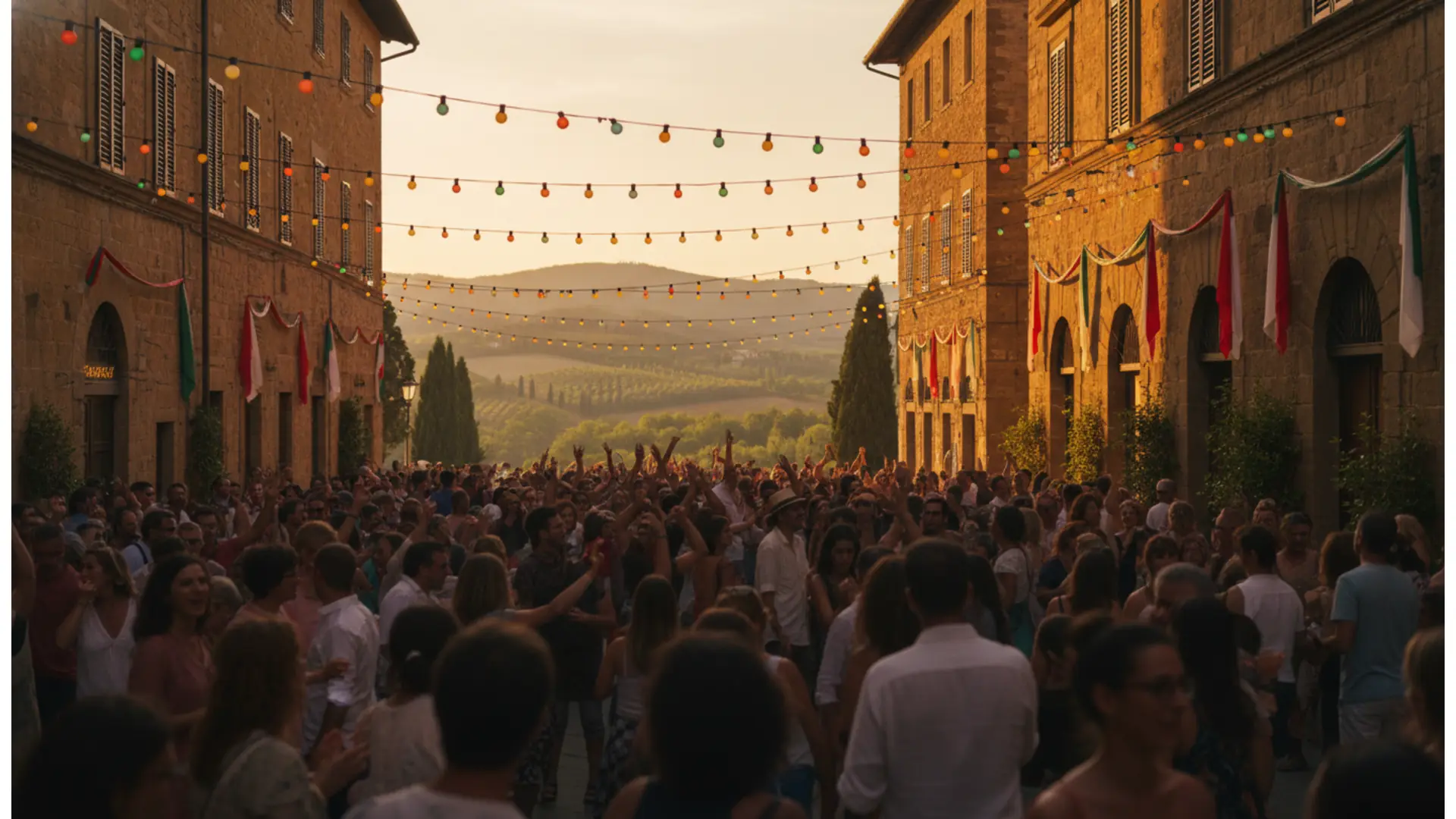
Four Altars Festival
Faith, ephemeral art, and the memory of the Baronial Ransom during the octave of Corpus Christi
About Four Altars
A festival born from faith and freedom
The Four Altars Festival is the most iconic event in Torre del Greco, the 'city of coral' overlooking the Gulf of Naples, in the Metropolitan City of Naples, Campania. Celebrated during the octave of Corpus Christi—hence its popular name, 'Uttava'—it traces its roots back to the 17th century, when Viceroy Don Pedro Fernández de Castro established that the faithful could receive the Eucharistic blessing from four altars placed at the cardinal points of the city.
In Torre del Greco, however, the festival takes on a deeper civic meaning: since 1699, it has commemorated the Baronial Ransom, the act by which the local people, at the cost of enormous financial sacrifice, freed themselves from feudal rule and reclaimed their territory. Faith and freedom thus intertwine in a celebration that is simultaneously religious, artistic, and civic, and which the community feels deeply as its own.
Altars and carpets: ephemeral neighborhood art
The visual heart of the festival consists of the four monumental altars: large, scenographic, hand-painted structures decorated with floral compositions and set up in four locations within the historic center. Each altar bears a title and a theme and is signed by a master decorator. Alongside the altars, artistic carpets made of colored sawdust transform church parvises and palace courtyards into immense horizontal canvases, destined by their very nature to last only a few days.
- Altars set up in Piazza Luigi Palomba, at the Palazzo Baronale, at Largo Costantinopoli, and on Corso Garibaldi
- Sawdust carpets at the MAC3 Museum, Palazzo Baronale, the former Library, and the Church of Santa Maria di Portosalvo
- Gardens and artistic compositions of plants and flowers along the city routes
- Art and photography exhibitions in historic palaces and churches in the center
The return after sixteen years
After a long silence lasting about sixteen years, the festival was brought back to life in 2024 by the municipal administration led by Mayor Luigi Mennella. The 2026 edition, scheduled from June 12 to 14, is the third consecutive one since the revival and confirms a now-consolidated model: over forty events spread over three days, with the city center, the Fronte beach, the port, and the Villa Comunale transformed into one large, widespread stage.
Music, street theater, and entertainment
The main stage is in Piazza Santa Croce, in front of the Pontifical Basilica, where a free concert by a nationally renowned artist is held every evening. Throughout the rest of the city, local theater companies, marching bands, folk music groups, and dance performances take the stage in a 'widespread theater' format that brings art to the squares, the beach, and repurposed spaces like the former fish market. The MAC3 Museum hosts the section dedicated to younger audiences, featuring live street art, stand-up comedy, and Neapolitan singer-songwriter music, and opens its halls for demonstrations of coral and cameo carving, the craftsmanship that has made Torre del Greco famous worldwide.
Fireworks over the sea and the Village of Flavors
The closing is entrusted to the most anticipated tradition: at the stroke of midnight on the final day, local pyrotechnic masters ignite the fireworks display over the sea in the port area, a ritual that has always been called 'botte a mare' in the city and which gathers thousands of people along the coastline. On the gastronomic side, the Villa Comunale V. Ciaravolo hosts the Village of Flavors, with typical products and Campanian wines at market prices, while stalls and hobbyists enliven Via Vittorio Veneto and Via Comizi.
Why it's worth the trip
Attending the Four Altars means seeing an entire community at work: parishes, associations, artisans, schools, and amateur companies that spend weeks preparing altars, carpets, and shows. It is one of the few opportunities to admire ephemeral Neapolitan-style art live, just a few kilometers from Herculaneum, Pompeii, and Mount Vesuvius: one more reason to include Torre del Greco in a June itinerary along the Vesuvius Golden Mile.
Four Altars — edition 2026
An edition with over forty events
The 2026 edition of the Four Altars Festival was held in Torre del Greco from Friday, June 12, to Sunday, June 14, during the octave of Corpus Christi, with a program presented at the Palazzo Baronale by the municipal administration. As the third consecutive edition since the event's return in 2024, it involved the entire historic center, the Fronte beach, the MAC3 Museum, the Villa Comunale V. Ciaravolo, and the port area.
The four monumental altars were set up in Piazza Luigi Palomba, at the Palazzo Baronale, at Largo Costantinopoli, and on Corso Garibaldi, accompanied by four artistic carpets made of colored sawdust. Every evening at 10:00 PM in Piazza Santa Croce, a major free-entry concert took place, preceded by a warm-up by Radio Marte starting at 9:15 PM. In the Villa Comunale, the Village of Flavors offered typical Campanian products from 5:30 PM to 11:30 PM, while the MAC3 Museum hosted the 'Youth at the Festival' section.
Programme Four Altars 2026
Friday, June 12
- 4:00 PM — MAC3 Museum: live street art writing
- 6:00 PM — Piazza Santa Croce: festival opening with the Jubilate Deo Choir and the E. De Bellis Band
- 6:30 PM — Historic center: marching band parade by the E. De Bellis Band
- 7:00 PM — Palazzo Baronale: Gazebo Rosa Association in 'The Odyssey'
- 7:30 PM — Fronte Beach: Dancing Stars, 'Vesuvius Soul: the four elements in dance'
- 7:30 PM — MAC3 Museum: Tony Tammaro, 'Tammaro acoustic show'
- 8:30 PM — Fronte Beach: Margy Ballivo in 'Ngopp 'a rena nera'
- 9:15 PM — Piazza Santa Croce: Radio Marte warm-up, followed at 10:00 PM by a concert by Neri per Caso (free entry)
Saturday, June 13
- 6:00 PM — Villa Comunale V. Ciaravolo: children's entertainment
- 6:30 PM — Largo Costantinopoli: 'A Compagnia 'e Zazzà in 'San Carlino… forever yes!'
- 7:00 PM — Via Comizi: Teatro Donna Peppa in 'Tavernara 'e Porta Capuana'
- 7:00 PM — Fronte Beach: Gli Esuli with 'Popular Variety'
- 7:30 PM — Former fish market: Ladri di copione in 'Malanova'
- 7:30 PM — MAC3 Museum: DEDDÈ, 'Bocca del Vesuvio Summer Tour'
- 8:00 PM — Corso Vittorio Emanuele: Elvis and Friends, '50s-60s Rock and Roll'
- 8:00 PM — Piazza Luigi Palomba: Luna Janara, 'Songs and Sounds of Southern Italy'
- 8:30 PM — Fronte Beach: The Dreamers, 'Seven Colors, Thousand Emotions'
- 9:15 PM — Piazza Santa Croce: Radio Marte warm-up, followed at 10:00 PM by a concert by Clementino (free entry)
Sunday, June 14
- 6:00 PM — Via Comizi: Gianni Pernice Company in 'Lysistrata'
- 6:00 PM — GIL Gym: book presentation 'T'aggia cuntato u fatto'
- 6:30 PM — Corso Vittorio Emanuele: giant piano
- 6:30 PM — Former Library: La Tofa in 'Artisans of Hope'
- 6:30 PM — Former fish market: Teatro Club Gino Roma in 'House Keys'
- 7:00 PM — Largo Costantinopoli: Balagancik Company in 'A Curious Village'
- 7:30 PM — MAC3 Museum: Vincenzo Comunale, stand-up comedy
- 8:00 PM — Piazza Luigi Palomba: ACMT Marching Band parade
- 8:30 PM — Fronte Beach: Magma, 'Neapolitan Heritage'
- 9:15 PM — Piazza Santa Croce: Radio Marte warm-up, followed at 10:00 PM by a concert by Noemi (free entry)
- 12:00 AM — Port area: fireworks display over the sea
Altars (daily)
- Piazza Luigi Palomba — 'Stay with us, for it is evening…', master Alfonso Raiola
- Palazzo Baronale — 'God's Construction Site, I help you', master Antonino Ammendola
- Largo Costantinopoli — 'Fractio Panis', master Salvatore Seme
- Corso Garibaldi — 'Courage, get up, He is calling you', master Francesco Scognamiglio
Artistic carpets (daily)
- MAC3 Museum — 'The communion of mercy', master Raffaele Panariello
- Palazzo Baronale — 'The gift of life', master Sergio Eco
- Former Library — 'From the altar to the streets: Eucharist…', master Antonio Caso
- Church of Santa Maria di Portosalvo — 'Eucharist, Source of light and salvation', master Vincenzo Borrelli
Exhibitions and other initiatives
- Palazzo Baronale: exhibition 'Art and culture in the shadow of Vesuvius'
- San Michele Church: photography vernissage by Carlo Falanga
- Villa Comunale: toy and electric train exhibition
- MAC3 Museum: open from 6:00 PM to 9:00 PM with demonstrations of coral and cameo carving
- Village of Flavors: Villa Comunale V. Ciaravolo, from 5:30 PM to 11:30 PM; stalls on Via Vittorio Veneto and hobbyists on Via Comizi
Highlights Four Altars 2026
- Three free concerts in Piazza Santa Croce at 10:00 PM: Neri per Caso (June 12), Clementino (June 13), Noemi (June 14)
- Four monumental altars and four colored sawdust carpets signed by local master decorators
- 'Youth at the Festival' at the MAC3 Museum with Tony Tammaro, DEDDÈ, and stand-up comedy by Vincenzo Comunale
- Widespread theater and popular variety shows in the squares, on the Fronte beach, and in the former fish market
- Village of Flavors at the Villa Comunale V. Ciaravolo, from 5:30 PM to 11:30 PM
- Fireworks display over the sea at midnight on June 14 in the port area
Prices Four Altars 2026
Practical information — Four Altars
How to get there
By train: the Torre del Greco station on the EAV Circumvesuviana line (Naples–Sorrento) is a few minutes' walk from the historic center; the city is also served by the Trenitalia station on the Naples–Salerno line. By car: A3 Naples–Salerno motorway, exit Torre del Greco, then follow signs for the center. By plane: Naples Capodichino Airport, approximately 20 km away.
Getting around during the festival
During the three days, the historic center is largely pedestrianized and traffic is diverted: it is advisable to leave your car in the peripheral areas and walk to Piazza Santa Croce, the Palazzo Baronale, and the Villa Comunale. The altars and carpets can be visited along a continuous walking route.
Admission and costs
The event is free and open to the public, including the concerts in Piazza Santa Croce. You only pay for what you consume at the Village of Flavors and at commercial establishments.
Tips
The evenings are concentrated between 6:00 PM and midnight: arriving in the late afternoon allows you to see the altars and carpets in daylight and find a spot near the stage. For the final fireworks, the port area and the seafront are the best viewing points. Wear comfortable shoes and light clothing: in June, the Vesuvius evenings are mild, but the walking distances are significant.
Festival-goer photos
No photos yet. Share yours!
Share your photos
5 photos max, 5 MB per photo (JPG, PNG, WebP)
Noticed an error or missing information?
Help us keep this listing up to date. Every proposal is verified by our team before publication.
Festival-goer reviews
No rating yet — be the first!
No comments yet. Be the first!
Were you there?
Share your experience with the community.
Published by Valentin Contard, festival listings writer. Reviewed, corrected and approved by Christophe Contard, editor-in-chief. .
Where does it take place — Four Altars
Centro storico: Piazza Santa Croce, Palazzo Baronale, Villa Comunale V. Ciaravolo, Museo MAC3, zona porto
Piazza Santa Croce, 80059 Torre del Greco