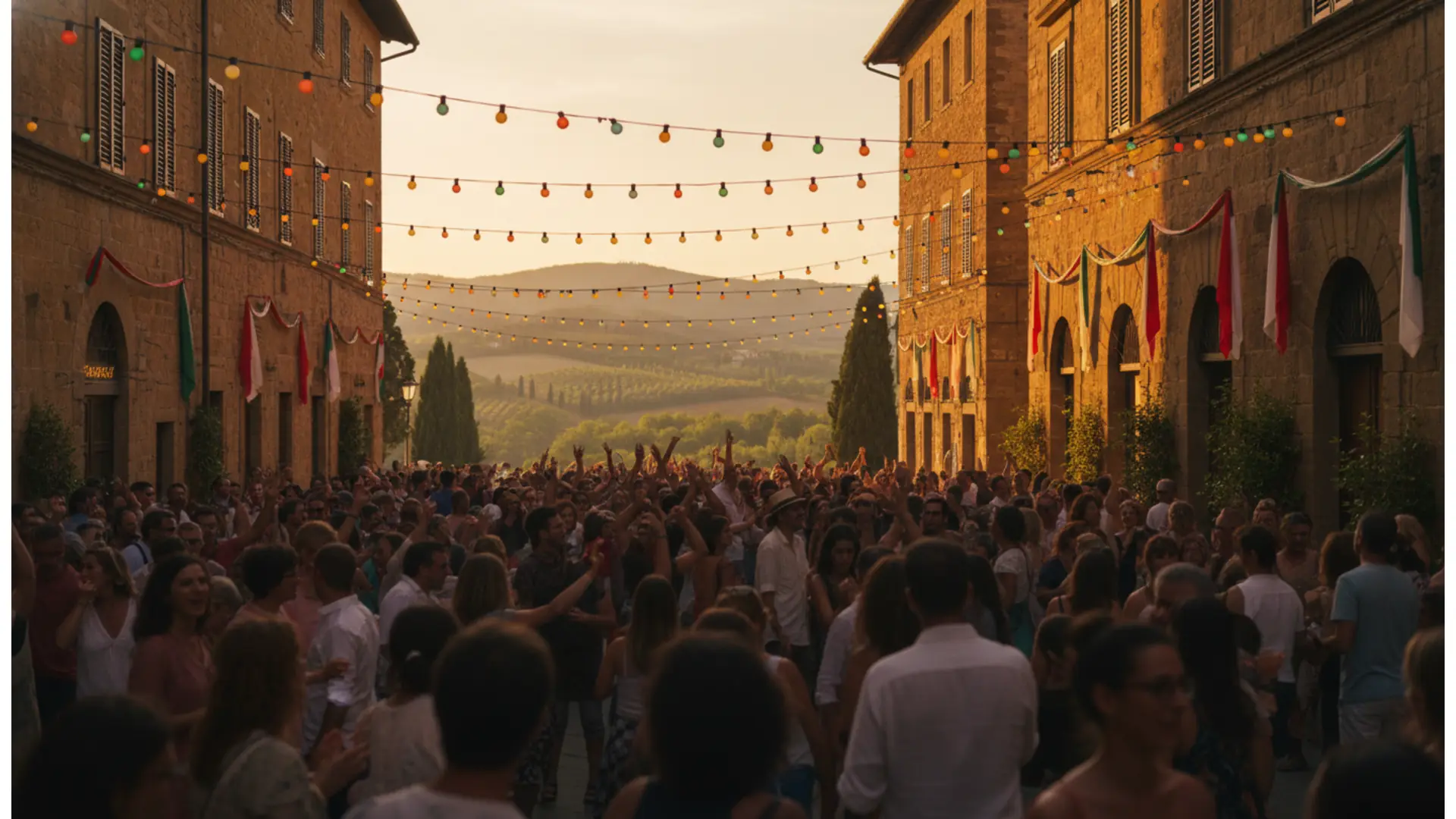
Festa della Tammorra
Two days of traditional drum singing and dancing on the slopes of Mount Somma
Edition 2026 not confirmed to date
This edition has not been confirmed by the organiser to date. We recommend checking before going.
About Festa della Tammorra
The drum that calls the village
On the slopes of Mount Somma, in the province of Naples, the Festa della Tammorra is much more than a music festival: it is the moment when Somma Vesuviana rediscovers the most ancient voice of its community. For two days, the deep, insistent sound of the 'tammorra' marks the time, calling musicians from the Vesuvian towns and transforming a daily space into a place of shared celebration, where anyone can join the circle and try their hand at dancing. Born from the initiative of local singer Pino Iove (Giuseppe Iovino), the event has established itself over the years as a key reference point for oral tradition music in Campania.
The tammurriata, soul of the Vesuvian tradition
At the heart of everything is the tammurriata, understood not as a performance but as a living practice: sound, song, and dance on the drum. The 'tammorra' is a very simple percussion instrument—an animal skin membrane stretched over a circular wooden frame, often adorned with jingles; around it revolve castanets, tambourines, 'triccheballacche', double flutes, and various percussion instruments. The repertoire is not a fixed program but a shared heritage, passed down from generation to generation in the courtyards and sanctuaries of the territory.
- Canti a figliola and canti sulla tammorra, performed with full voice and without forced amplification
- Canti distesa — in the style of the carters or 'a fronna' — which have had dedicated evenings in past editions
- Couples' dances, with castanets marking the dialogue between the dancers
- Spontaneous performances, left to the free initiative of the musicians present
The paranze, protagonists of the festival
The structure of the event mirrors that of ancient patronal feasts: there are no big stars, only the paranze—the groups arriving from the Vesuvian municipalities and the Nola area, alternating one after another, often until late at night. Each 'paranza' has its own leader, its own songs, and its own way of beating the drum: this is how the styles of the different villages are recognized. In larger editions, the organization has claimed over thirty hours of total live music, a figure that well reflects the almost uninterrupted nature of the event.
The churchyard of the Sanctuary of Santa Maria a Castello
The connection to the sacred is not a decorative detail. The Vesuvian 'tammurriata' was born as devotional music, linked to pilgrimages toward the Marian sanctuaries of Vesuvius and Mount Somma. For this reason, the edition hosted on the churchyard of the Sanctuary of Santa Maria a Castello, the 'Mamma Schiavone' so dear to the people of Somma, was perceived as a homecoming: the festival took place exactly where pilgrims had gathered with their drums for centuries. Other editions have instead enlivened the square and the central streets of the town, confirming the popular and widespread nature of the event.
The Ethnohistorical Museum of the Campanian People
Alongside the music, the Festa della Tammorra has always offered a path of discovery. The Ethnohistorical Museum of the Campanian People, on Via Santa Maria a Castello, remains open for the duration of the event, allowing visitors to place 'tammorre' and songs in their context: the objects of rural labor, the 'ex-voto' offerings, and the material culture of a territory marked by the volcano. The involvement of the Vesuvian Academy of Ethnohistorical Traditions gives the festival a documentary edge, far from mere folkloric reenactment.
Flavors and crafts of the Vesuvian land
The gastronomic side features typical Campanian products, from the 'pomodorini del piennolo' of Vesuvius to the wines of the slopes, and traditional local sweets. There is no shortage of craft stalls, with 'tammorra' makers showing the work on the frame and skin: for many visitors, it is an opportunity to understand how the instrument is born even before hearing it.
Why it's worth the trip
Those who arrive in Somma Vesuviana for the Festa della Tammorra do not attend a concert: they enter a celebration. It is an experience that requires a bit of flexibility—you stand, you are in a crowd, you stay late—and it gives back a great deal in terms of authenticity. In a Campania often portrayed as a postcard, this event shows a tradition still practiced daily, not reconstructed for tourists.
Festa della Tammorra — edition 2026
2026 Edition: awaiting announcement
As of the publication of this page, there are no official communications from the organization or the Municipality of Somma Vesuviana regarding the dates of the 2026 Festa della Tammorra. The reference to the month of June is based on the usual timing of the event in previous editions and should be considered indicative.
Those wishing to attend can follow the festival's Facebook page and the channels of the Municipality of Somma Vesuviana, where the evening program and the list of participating paranze were published in previous years. We will update this page as soon as verified information on dates, location, and program becomes available.
Prices Festa della Tammorra 2026
Practical information — Festa della Tammorra
How to get there
Somma Vesuviana is located about twenty kilometers from Naples, on the northern side of the Somma-Vesuvius complex. By car, take the A16 or A30 motorway and continue along the state road towards Nola-Somma Vesuviana. By public transport, use the EAV Naples-Baiano line (getting off at Pomigliano d'Arco or Casalnuovo) and continue by bus, or take the bus connections from the Naples central station. The Sanctuary of Santa Maria a Castello can be reached from the town center along Via Santa Maria a Castello, with a scenic climb towards Mount Somma.
Hours and access
In past editions, the festival has started in the late afternoon and continued until late at night, with almost uninterrupted music. Access to outdoor spaces is traditionally free; for updated dates, times, and programs, it is always best to check the channels of the organization and the Municipality of Somma Vesuviana.
Tips
- Comfortable shoes: you will be dancing and standing for a long time, often on uneven pavement.
- Cool evenings even in June on the slopes of Mount Somma: bring a light jacket.
- Limited parking near the sanctuary: it is better to leave the car in town and walk up.
- To combine: a visit to the Ethnohistorical Museum of the Campanian People and a walk in the ancient village of Casamale.
Festival-goer photos
No photos yet. Share yours!
Share your photos
5 photos max, 5 MB per photo (JPG, PNG, WebP)
Noticed an error or missing information?
Help us keep this listing up to date. Every proposal is verified by our team before publication.
Festival-goer reviews
No rating yet — be the first!
No comments yet. Be the first!
Were you there?
Share your experience with the community.
Published by Valentin Contard, festival listings writer. Reviewed, corrected and approved by Christophe Contard, editor-in-chief. .
Where does it take place — Festa della Tammorra
Sacrato del Santuario di Santa Maria a Castello
Via Santa Maria a Castello, 80049 Somma Vesuviana