Sant'Antuono Festival - Floats, Rhythms (Cippi) and Pastellessa
Floats, bottari and pastellessa: the town of the drummers celebrates Saint Anthony the Abbot
About Sant'Antuono Festival in Portico
The town of the bottari
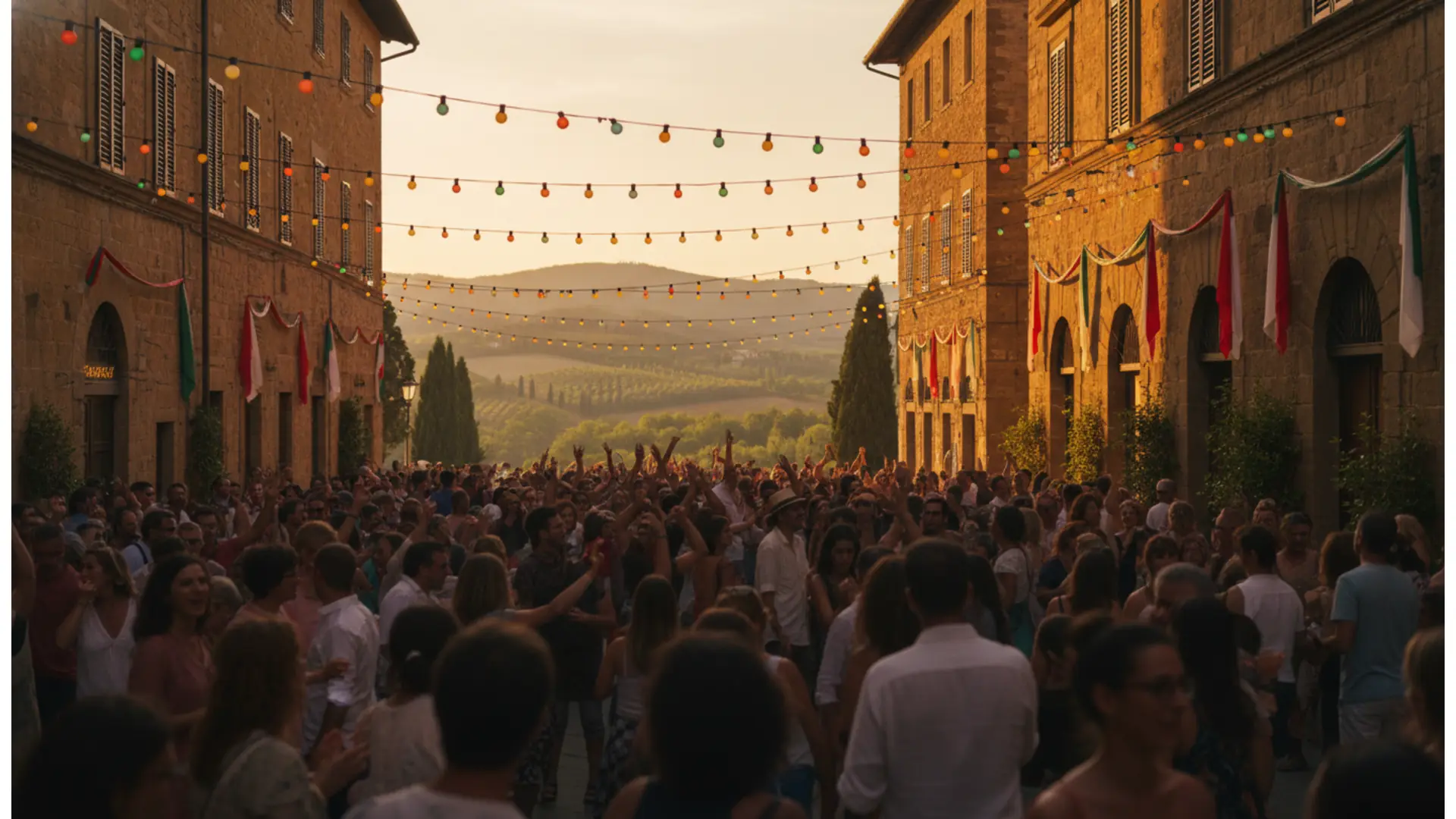
There is a time of year when Portico di Caserta, a small town in the province of Caserta, Campania, stops being just another urban center and becomes a massive, open-air musical instrument. It happens between late January and early February, when the Sant'Antuono Festival — the popular name for Saint Anthony the Abbot in this area — fills the streets with floats, rhythm, and crowds. The event, titled Floats, Rhythms (Cippi) and Pastellessa, is now one of the most recognizable highlights of the Campanian folkloric calendar.
Barrels, vats, and scythes: the sound of pastellessa
The heart of the festival lies with the bottari, percussionists who use not conventional instruments, but traditional farming tools: barrels, vats, and scythes. Struck according to rhythmic patterns passed down through generations, these objects produce a deep, hypnotic sound known as pastellessa. Tradition holds that this clamor was meant to ward off evil spirits and ensure a good harvest; today, it remains an intangible heritage that unites entire families and neighborhoods.
Each float can carry up to sixty bottari, who play together for hours, standing, as the vehicle slowly advances through the cheering crowds. It is not just a show: it is a collective test of endurance, coordination, and community belonging.
The floats: sixteen crews on parade
The Sant'Antuono floats are imposing structures, reaching up to sixteen meters in length and over three meters in width and height. They are prepared for weeks in local warehouses and courtyards, decorated with elaborate sets, lights, and devotional symbols. Each float belongs to a troupe with its own name, often tied to a neighborhood, a group of friends, or a generation of float-builders.
- In the 2026 edition, sixteen floats and several hundred bottari took part in the parade.
- The parade order is determined by a public draw at the start of the festival.
- The floats are accompanied by marching bands and majorettes, who lead the parade days.
- A competition dedicated to miniature floats involves the local youth and schools.
Faith, the cippo, and devotion
Alongside the spectacle, the religious dimension remains strong. The festival opens with the lighting of the cippo, the large propitiatory bonfire that symbolically marks the beginning of the Sant'Antuono period, and continues with the Float-builders' Mass and the blessing of the animals, a typical gesture of the cult of Saint Anthony the Abbot, protector of domestic animals and livestock. The Parish of San Pietro Apostolo oversees the entire calendar, which traditionally concludes with fireworks at noon.
Pasta e less and the flavors of the festival
The signature dish is pastellessa, or pasta e less: pasta seasoned with boiled chestnuts, a humble, ancient recipe cooked specifically for this occasion. During the festival, food stands and street food areas are set up along the parade route, with evening tastings accompanying the performances. There are also auctions of products collected during the alms-gathering, traditional games, and social gatherings with visiting campers.
Who organizes
The event is promoted by the Associazione Riforma del Pensiero together with the Pro Loco and the Club Napoli of Portico di Caserta, with the collaboration of the Municipality of Portico di Caserta and the Parish of San Pietro Apostolo, and supported by local entities and associations. The involvement is widespread: float-builders, volunteers, schools, and merchants work for months to ensure the event's success.
When to go
The calendar spans several days between late January and the first weekend of February, with a presentation prologue followed by three days of actual parades along different routes in the town. The most intense moment is the Saturday evening parade, followed by thousands of people, and the final day on Sunday, which combines Mass, fireworks, and the final passage of the floats in Piazza Rimembranza.
Sant'Antuono Festival in Portico — edition 2026
An edition with sixteen floats
The 2026 Sant'Antuono Festival in Portico di Caserta confirmed the growth of the event: sixteen crews in the parade, hundreds of bottari, and an expanded calendar that kicked off on Saturday, January 24, with the presentation conference, traditional games, and the lighting of the cippo.
The big news was the relocation of the Saturday evening parade: moving from the Scampia district to Via Diaz, in front of Piazza don Umberto, a larger space that allowed about 1,500 people to watch the show in more comfortable and orderly conditions. A choice defended by the organizers of the Associazione Riforma del Pensiero, who explained that the floats, having grown larger over the years, required more suitable routes and squares.
The food stands saw a great turnout, with some specialties selling out, while the final Sunday combined the Holy Mass with the blessing of the animals, the noon fireworks, and the final parade in Piazza Rimembranza.
Programme Sant'Antuono Festival in Portico 2026
Saturday, January 24
- 16:30 — Presentation conference of the 2026 edition
- 18:30 — Traditional games and lighting of the cippo
- 19:00 — Public draw for the float parade order
Sunday, January 25
- 18:00 — Float-builders' Mass
Tuesday, January 27
- Day included in the festival calendar
Thursday, January 29
- Night of the Floats, prologue to the official parades
Friday, January 30 — Route A
- 10:00 — Exhibition of traditional tools
- 17:00 — Departure of the floats from the industrial area
- 19:00 — Performance in Piazza Rimembranza
Saturday, January 31 — Route B
- From 10:00 — Exhibition and awards ceremony for the miniature floats competition (ceremony at 11:00)
- 12:00 — Aperitif with campers and bottaro rehearsal
- 16:30 — Departure of the floats
- 19:30 — Tasting of the traditional pasta e less dish and street food area
- 20:00 — Performance in Via Diaz, in front of Piazza don Umberto
Sunday, February 1 — Routes C and D
- 09:00 — Bellona City Band and majorettes
- 09:30 — Departure of the floats (Route C)
- 10:00 — Exhibition of agricultural tools
- 11:00 — Holy Mass and blessing of the animals
- 12:15 — Fireworks and float parade
- 16:30 — Performance by the Portecnica group
- 17:30 — Final departure (Route D)
- 18:00 — Final parade in Piazza Rimembranza
Highlights Sant'Antuono Festival in Portico 2026
- Sixteen floats in competition: Gli amici della tradizione, O' rione e Sant'Antuono, Sant'Antuono ora e sempre, Gli amici dell'osteria, A Compagnia del 2019, I guaglioni di via Trento, Ritmi e tradizione, I guerrieri e Sant'Antuono, L'emozion nov, A tradizion e Sant'Antuon, La compagnia de i punto e capo, I guagliun e Sant'Antuono, Suoni fantasia, U carr ra Scampia, A' music nov, Tarantella sound.
- Lighting of the cippo and public draw for parade numbers.
- New location for the Saturday evening parade in Via Diaz, in front of Piazza don Umberto, with about 1,500 spectators.
- Blessing of the animals and fireworks on the final day.
- Tasting of pasta e less and street food area along the route.
- Participation of the Bellona City Band and majorettes.
Prices Sant'Antuono Festival in Portico 2026
Practical information — Sant'Antuono Festival in Portico
How to get there
Portico di Caserta is located a few kilometers from Caserta, south of the provincial capital. By car: take the Caserta Sud exit on the A1 (Autostrada del Sole) or the Asse Mediano, then follow signs for Portico di Caserta. By train: Caserta station (Rome-Naples line via Cassino), connected by local buses; alternatively, stations on the Naples-Caserta line.
Parking and traffic
During the parade days, streets along the route are closed to traffic. It is advisable to arrive well in advance and park in the outskirts of the town, then walk to Piazza Rimembranza or Piazza don Umberto.
Admission
Admission to all parades and events is free and open to the public. Tastings and food stands are paid, with affordable prices.
Tips
- Dress warmly: the evening parades take place outdoors in mid-winter and last for several hours.
- The volume of the percussion is high: ear protection is recommended for small children.
- For accommodation, the widest range of options is in Caserta, just a few minutes away by car, which is also convenient for visiting the Royal Palace.
Festival-goer photos
No photos yet. Share yours!
Share your photos
5 photos max, 5 MB per photo (JPG, PNG, WebP)
Noticed an error or missing information?
Help us keep this listing up to date. Every proposal is verified by our team before publication.
Festival-goer reviews
No rating yet — be the first!
No comments yet. Be the first!
Were you there?
Share your experience with the community.
Published by Valentin Contard, festival listings writer. Reviewed, corrected and approved by Christophe Contard, editor-in-chief. .
Where does it take place — Sant'Antuono Festival in Portico
Piazza Rimembranza, piazza don Umberto e vie del centro