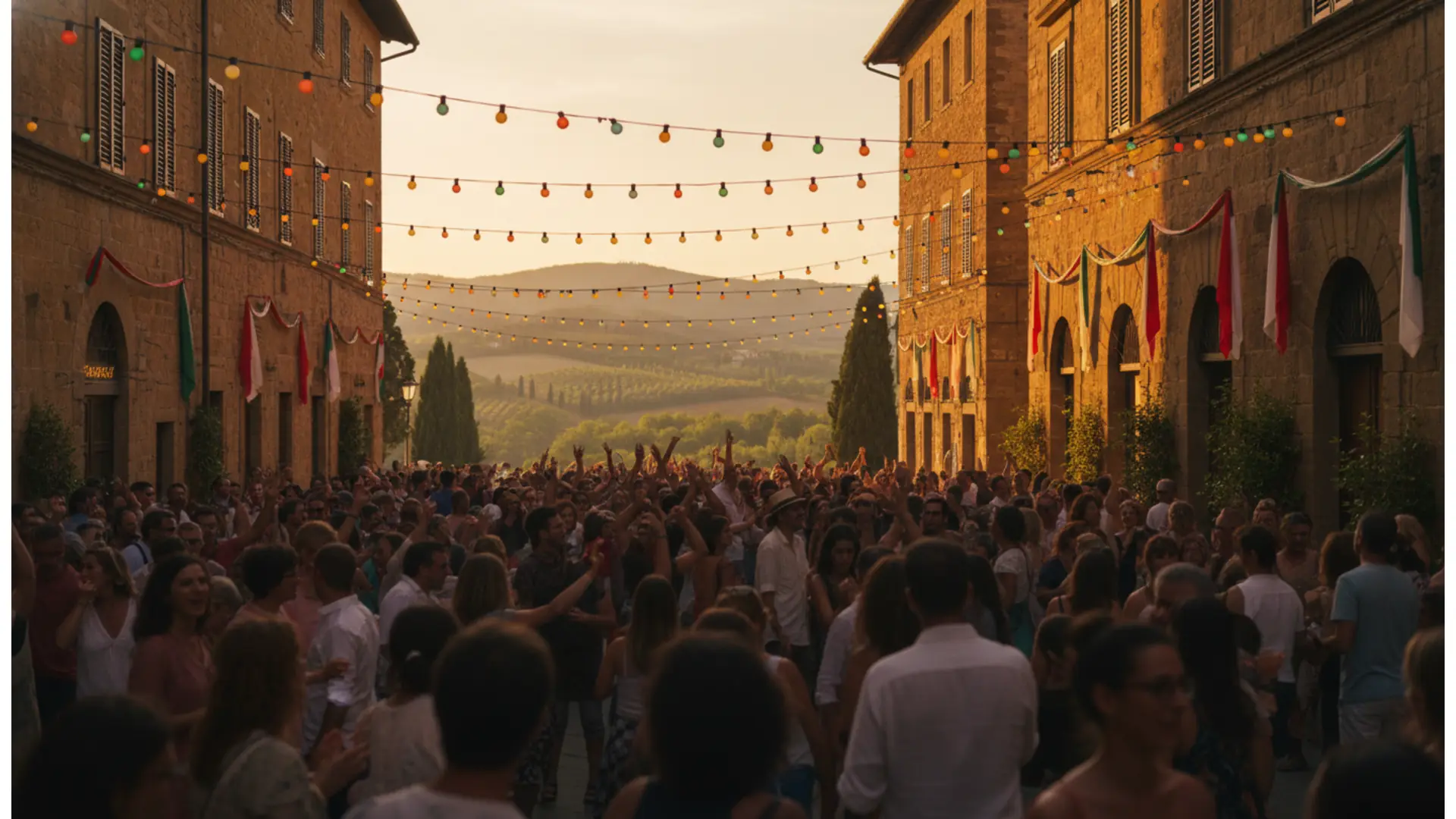
Saint Egidio Abate Festival (Patron Saint of Rocca di Cave)
On September 1st, the procession of the eight 'incollatori' in the highest village of the Prenestini Mountains
About Saint Egidio Abate Festival
A patronal festival in the highest village of the Prenestini Mountains
The Saint Egidio Abate Festival is the most heartfelt tradition in Rocca di Cave, one of Italy's smallest municipalities—with just over two hundred inhabitants—perched at 933 meters in the Prenestini Mountains, within the Metropolitan City of Rome Capital, in the Lazio region. Every year, on September 1st, the village pauses to honor its patron saint with a day that blends religious rites, community gatherings, and the return of many emigrants and vacationers who choose this specific date to visit the village.
The procession of the eight 'incollatori'
The most anticipated moment is the solemn procession. Eight local men, traditionally called incollatori, carry the statue of Saint Egidio on their shoulders from the small church of Saint Egidio, located just outside the town near the cemetery, to the parish church of San Nicola, in the heart of the historic center. The route is about one kilometer long, uphill, and is retraced to bring the Saint back to his small church. It is a strenuous, collective effort, accompanied by the sound of bells, hymns, and the participation of the entire community: those watching from windows, those walking behind the statue, and those waiting at the arrival on the church square.
Saint Egidio, the Colonna family, and local devotion
Saint Egidio Abate, a hermit who lived between the 7th and 8th centuries in southern France, is among the most popular saints of the European Middle Ages: his most famous legend tells of him being nourished in the forest by the milk of a doe sent by the Lord. In Rocca di Cave, his cult took root in the modern era, favored by the Colonna family, who were the feudal lords of the castle and the entire territory starting from the 14th century. Curiously, the titular saint of the parish church is Saint Nicholas of Bari—the church, built between 1750 and 1777 based on Roman models, houses a large canvas by the Viterbo-born artist Domenico Corvi (1795)—while the town's patronage remains firmly with Saint Egidio, celebrated on September 1st according to the liturgical calendar.
What to expect during the day
- Solemn Eucharistic celebration in honor of the patron saint, in the church of San Nicola
- Procession with the statue carried on the shoulders of the eight 'incollatori', there and back
- Festive ringing of bells and decorations along the streets of the historic center
- Convivial village moments, with the participation of families and local associations
This is not a large festival for thousands of visitors, but an authentic celebration, scaled to the size of the village: those arriving from outside are welcomed without filters and witness a tradition that the town guards with pride.
A village to discover, beyond the festival
A visit to Rocca di Cave is worth extending by a few hours. The medieval fortress, built around the 10th century and long a stronghold of the Colonna family, now houses the "Ardito Desio" Geopaleontological Museum, featuring fossils from a tropical sea of about one hundred million years ago, and an astronomical observatory with a planetarium, popular for evening stargazing sessions. From the viewpoint, the gaze sweeps over the Sacco Valley, the Prenestini Mountains, and, on clear days, as far as Rome. The altitude and position make the village a cool and scenic stop even in the heart of summer, just over forty kilometers from the capital.
The meaning of a small festival
In a municipality of a few hundred inhabitants, the patronal festival is not folklore for tourists: it is the moment when the community recognizes itself, renews a commitment passed down from generation to generation—first and foremost that of the 'incollatori'—and brings those who have moved away back to the village. For the attentive visitor, September 1st in Rocca di Cave is an opportunity to see the Lazio of the highlands as it truly is, far from mass tourism circuits.
Saint Egidio Abate Festival — edition 2026
Saint Egidio Abate Festival 2026
On September 1st, 2026, Rocca di Cave renews its appointment with its patron saint. The date is confirmed by the official events calendar of the Municipality, which registers the festival as a fixed annual recurrence. As every year, the program revolves around the solemn mass and the procession that crosses the village, with the statue of Saint Egidio carried on the shoulders of the eight 'incollatori' from the small church near the cemetery to the parish church of San Nicola and back.
The exact times of the celebrations and any collateral initiatives for the evening are usually released in the weeks preceding the event through the channels of the Municipality and the Pro Loco. Participation is free.
Programme Saint Egidio Abate Festival 2026
Highlights Saint Egidio Abate Festival 2026
- Procession with the eight 'incollatori': about 1 km on shoulders, there and back
- Solemn mass in the 18th-century church of San Nicola
- The highest village of the Prenestini Mountains at 933 meters, with views as far as Rome
- Possibility to visit the "Ardito Desio" Geopaleontological Museum and the planetarium
Prices Saint Egidio Abate Festival 2026
Practical information — Saint Egidio Abate Festival
How to get there
By car from Rome: A1 motorway, Valmontone exit, or via Casilina/Prenestina roads to Palestrina, then the provincial road to Genazzano and Rocca di Cave (about 45-60 minutes from the capital). From Palestrina, the village is about 12 km away via a scenic mountain road.
Public transport
FL5 train or Cotral bus to Palestrina/Zagarolo, then the Cotral bus line to Rocca di Cave; service is reduced on public holidays, it is advisable to check schedules in advance.
Parking and accessibility
Free parking at the entrance to the village; the historic center is on a slope with cobbled sections, comfortable footwear is recommended. The procession route takes place on an uphill road.
Costs
Participation in the festival and the procession is free. Only the entrance to the Geopaleontological Museum and the planetarium evenings require a fee.
Information
Municipality of Rocca di Cave (official events calendar) and Pro Loco Rocca di Cave.
Festival-goer photos
No photos yet. Share yours!
Share your photos
5 photos max, 5 MB per photo (JPG, PNG, WebP)
Noticed an error or missing information?
Help us keep this listing up to date. Every proposal is verified by our team before publication.
Festival-goer reviews
No rating yet — be the first!
No comments yet. Be the first!
Were you there?
Share your experience with the community.
Published by Valentin Contard, festival listings writer. Reviewed, corrected and approved by Christophe Contard, editor-in-chief. .
Where does it take place — Saint Egidio Abate Festival
Centro storico e Chiesa di San Nicola