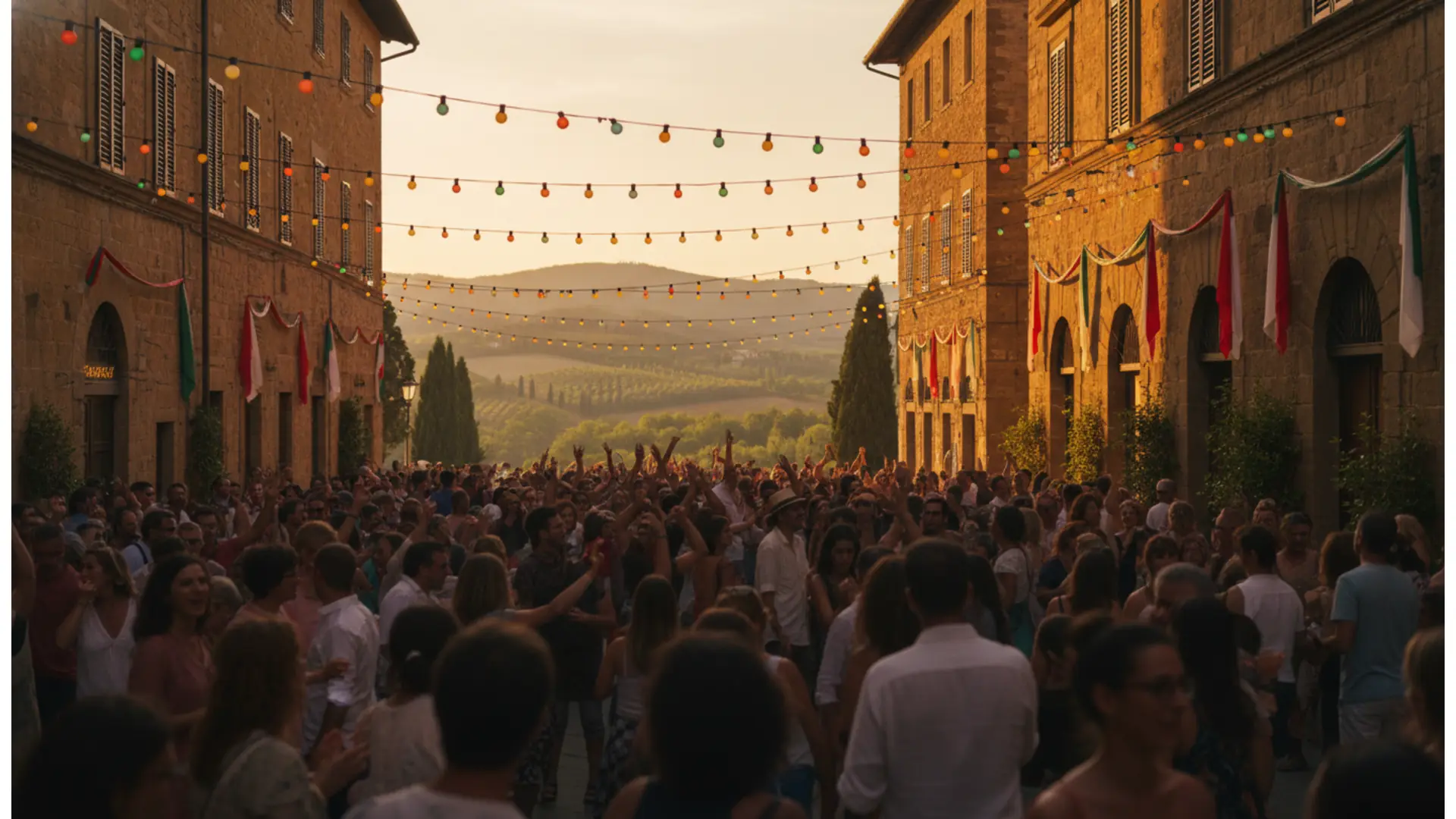
Saint Costanzo Festival and Lou Bal di Bran
The patronal feast of Meana di Susa and the ancient dance of the Bran in the Susa Valley
About Lou Bal di Bran
A unique Alpine tradition in the Susa Valley
The Saint Costanzo Festival is the patronal feast of Meana di Susa, a small town in the Susa Valley, within the Metropolitan City of Turin, Piedmont. Held annually on the Sunday closest to September 18th, it is one of the community's most cherished identity-defining events. Its uniqueness lies in the fusion of Christian religious tradition with ancient pre-Christian ritual elements linked to the fertility of the land and the renewal of life.
Lou Bal di Bran: the dance of the tree of life
The most anticipated moment is Lou Bal di Bran, which takes place after vespers on the church parvis. The bran are two large, tapered structures, several meters high, built on a frame covered in fabric and paper, and adorned with flowers, fruits, and ribbons. Their elongated shape evokes the tree of life: in the local dialect, branc means branch, and scholars link the ritual to the tradition of the Maypole, a symbol of spring festivals. The bran are danced by the most exuberant young men with precise choreography—starting with steady movements and becoming increasingly vigorous—while lucky flowers and fruits fall to be collected by children as amulets.
The Priore and the rite of passage
The stars of the festival are the Priore, two young women from the village wearing the traditional Coustum: a white Dauphiné-style cap, a large gold cross, a bodice, a lace-trimmed petticoat, a dark high-waisted dress, a fringed silk shawl, and a matching apron. Presented to the community, they symbolize the transition to adulthood for the village girls. During the festival, the current year's Priore choose their successors in a ritual of continuity passed down through generations, accompanied by branquët, small wooden replicas representing the passing of the torch.
The day's program
- Morning: Gathering on the church parvis and solemn procession accompanied by the marching band, followed by Holy Mass in honor of Saint Costanzo.
- Afternoon: Celebration of vespers followed by the Lou Bal di Bran on the parvis, the highlight of the festival.
- Evening: Public dances in the Salone Polivalente to conclude the day in a convivial atmosphere.
A heritage to discover
The Saint Costanzo Festival in Meana di Susa is included among the Alpine Rites of the Susa Valley and is considered one of the most precious ethnographic testimonies of the western Alps. For those visiting the Susa Valley, witnessing the Bal di Bran means connecting with a millennial collective memory where the sacred and the profane, faith and nature, continue to dialogue in a village overlooking the Colle delle Finestre.
Lou Bal di Bran — edition 2026
For 2026, the Saint Costanzo Festival in Meana di Susa is expected on Sunday, September 20th, in accordance with the traditional rule that sets the celebration on the Sunday closest to September 18th. The patronal feast will return with its historic moments: the morning procession with the marching band and Holy Mass, the afternoon vespers followed by the highly anticipated Lou Bal di Bran on the church parvis, with the bran danced by the village youth, and evening dances open to all in the Salone Polivalente. The Priore in traditional dress will lead the rite of passage. The detailed schedule will be announced by the municipal organization closer to the event.
Highlights Lou Bal di Bran 2026
Prices Lou Bal di Bran 2026
Practical information — Lou Bal di Bran
How to get there
Meana di Susa is located in the upper Susa Valley, along the route to the Fréjus tunnel. By car: A32 Turin-Bardonecchia motorway, Susa exit, then provincial road. By train: Meana station on the Turin-Bardonecchia line. The festival takes place at the parish church and its parvis, on Via Travot, and in the village's Salone Polivalente.
Information and contacts
Admission is free. For exact dates and updated schedules, please contact the Municipality of Meana di Susa at +39 0122 39161 or via email at [email protected].
Festival-goer photos
No photos yet. Share yours!
Share your photos
5 photos max, 5 MB per photo (JPG, PNG, WebP)
Noticed an error or missing information?
Help us keep this listing up to date. Every proposal is verified by our team before publication.
Festival-goer reviews
No rating yet — be the first!
No comments yet. Be the first!
Were you there?
Share your experience with the community.
Where does it take place — Lou Bal di Bran
Chiesa parrocchiale e sagrato di Meana di Susa
Via Travot, 10050 Meana di Susa