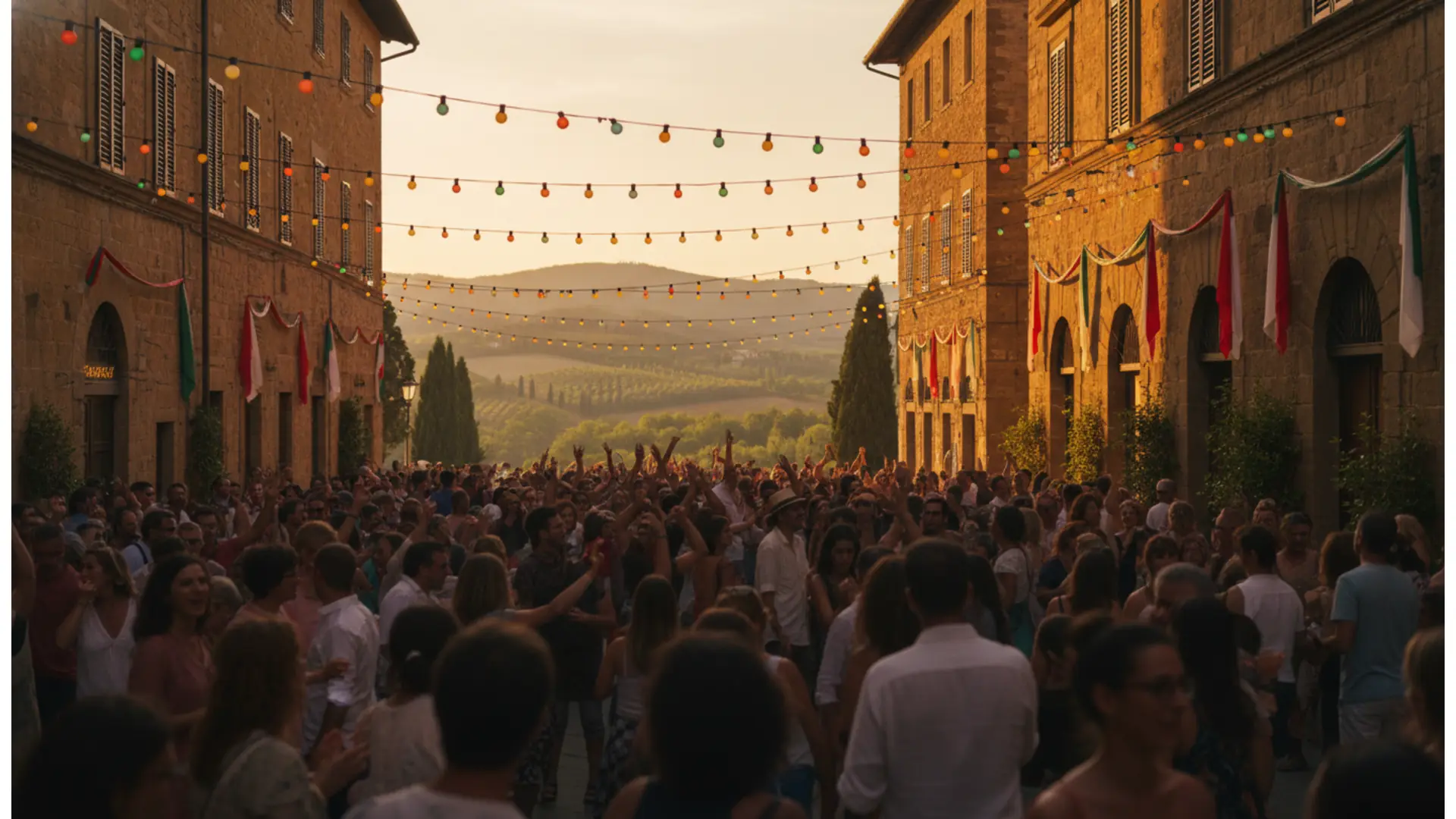
Patron Saint Festival of San Massimo Martire
The patronal feast of Roccasecca dei Volsci, featuring a solemn mass, procession, and brass band through the village alleys.
Edition 2026 not confirmed to date
This edition has not been confirmed by the organiser to date. We recommend checking before going.
About San Massimo Festival
A patronal feast in the heart of the Lepini Mountains
The Patron Saint Festival of San Massimo Martire is the most anticipated annual event in Roccasecca dei Volsci, a small town in the province of Latina, Lazio, perched on a spur of Monte Curio just over a hundred kilometers from Rome. Tucked between the Lepini Mountains and the Ausoni Mountains, overlooking the Amaseno River Valley, the village fills with lights and music for a few days in August, welcoming back those who return to their hometown for the occasion. As is often the case in the small towns of southern Lazio, the patronal feast is the moment when the community truly comes together.
San Massimo, the patron saint from Rome
San Massimo is remembered as a martyr of the early Christian centuries, killed during Roman persecutions for refusing to renounce his faith and sacrifice to pagan gods. His relics were moved to Roccasecca dei Volsci in the late 17th century by the will of Cardinal Carlo Camillo Massimo, whose family was tied to the fiefdom. They are now preserved under the high altar of the Collegiate Church of Santa Maria Assunta in Cielo, which overlooks Piazza Umberto I, opposite the 17th-century Palazzo Massimo. The saint is celebrated twice a year: the summer recurrence, which is the town's main festival, and the memorial on October 20th.
Devotion, procession, and brass band
The heart of the festival remains strictly religious. The solemn Holy Mass in honor of the Patron Saint is celebrated in the Church of Santa Maria Assunta in Cielo; this is followed by a procession that winds through the streets and alleys of the historic center, carrying the statue of the saint. It is accompanied by a brass band—in recent years, the "Ponchielli" Band of Latina has performed—marking the path with traditional marches. The sight of the procession passing between the stone houses, with decorated balconies and residents at their doorsteps, is the most iconic image of the festival.
Evenings in the square
Surrounding the liturgical core is the traditional secular side of the celebrations: musical evenings in the square, food stalls featuring local products, and a fireworks display to close the event. The local cuisine is worth noting: Roccasecca dei Volsci is a land of extra virgin olive oil, goat and sheep farming, fresh cheeses—the famous caciottelle—and goat-based dishes, which are the stars of two other popular local food festivals, the Goat Festival and the Caciottelle Festival.
What to see while visiting
Those who climb up to the village for the patronal feast can combine the visit with a heritage that is surprising for a town of this size:
- Collegiate Church of Santa Maria Assunta in Cielo, rebuilt in the 17th century on the remains of an older building, where the relics of San Massimo rest;
- Palazzo Massimo on Piazza Umberto I, which houses the Museum of Oil and Local Traditions;
- Tempietto di San Raffaele (1659), with frescoes attributed to the school of Domenichino;
- Tempietto of Santa Maria della Pace, a circular building in the Bramante style, a destination for pilgrimages;
- The Roman remains of the San Lorenzo Aqueduct and the hiking trails of the Ausoni Mountains.
When it takes place
The date of the festival is traditionally set for the second half of August: local sources indicate the third Sunday of August, while others point to the penultimate Sunday of the month—dates that coincide in years when August has four Sundays. The festivities generally focus on the weekend, starting on Friday evening. It is always advisable to check the final calendar on the channels of the Pro Loco of Roccasecca dei Volsci and the parish in the weeks leading up to the event.
San Massimo Festival — edition 2026
San Massimo Festival 2026 in Roccasecca dei Volsci
In 2026, the village of Roccasecca dei Volsci, in the province of Latina, will once again pay homage to its patron saint, San Massimo Martire. As per tradition, the program revolves around the solemn Holy Mass in the Collegiate Church of Santa Maria Assunta in Cielo and the procession through the streets of the historic center, accompanied by a brass band, alongside evening entertainment in the square.
At the moment, the detailed program for the 2026 edition—celebration times, musical guests, and gastronomic events—has not yet been published, and the exact date is not officially confirmed. It is recommended to follow the channels of the Pro Loco of Roccasecca dei Volsci and parish notices in the weeks leading up to the event.
Programme San Massimo Festival 2026
Highlights San Massimo Festival 2026
Prices San Massimo Festival 2026
Practical information — San Massimo Festival
How to get there
By car: from Rome, take the SS7 Appia or the A1 motorway, exiting at Frosinone and continuing towards the Amaseno Valley; from Latina, you can reach the village in about an hour via Priverno. The nearest train station is Priverno-Fossanova, on the Rome-Naples line via Formia, from where you can continue by car or local bus.
Parking and access
The historic center consists of narrow alleys and stairways: it is recommended to leave your car in the parking lots at the foot of the village and walk up, especially on festival evenings when the main streets are closed to traffic for the procession.
Costs
Religious celebrations, the procession, and performances in the square are free to attend. Any purchases at food stalls are paid.
Tips
Wear comfortable shoes for the stone alleys and inclines. For accommodation, visitors usually stay in Priverno, Sonnino, or on the Pontine coast. Recommended: a visit to the Fossanova Abbey, just a few kilometers away.
Festival-goer photos
No photos yet. Share yours!
Share your photos
5 photos max, 5 MB per photo (JPG, PNG, WebP)
Noticed an error or missing information?
Help us keep this listing up to date. Every proposal is verified by our team before publication.
Festival-goer reviews
No rating yet — be the first!
No comments yet. Be the first!
Were you there?
Share your experience with the community.
Published by Valentin Contard, festival listings writer. Reviewed, corrected and approved by Christophe Contard, editor-in-chief. .
Where does it take place — San Massimo Festival
Centro storico e Chiesa Collegiata di Santa Maria Assunta in Cielo
Piazza Umberto I, 04010 Roccasecca dei Volsci