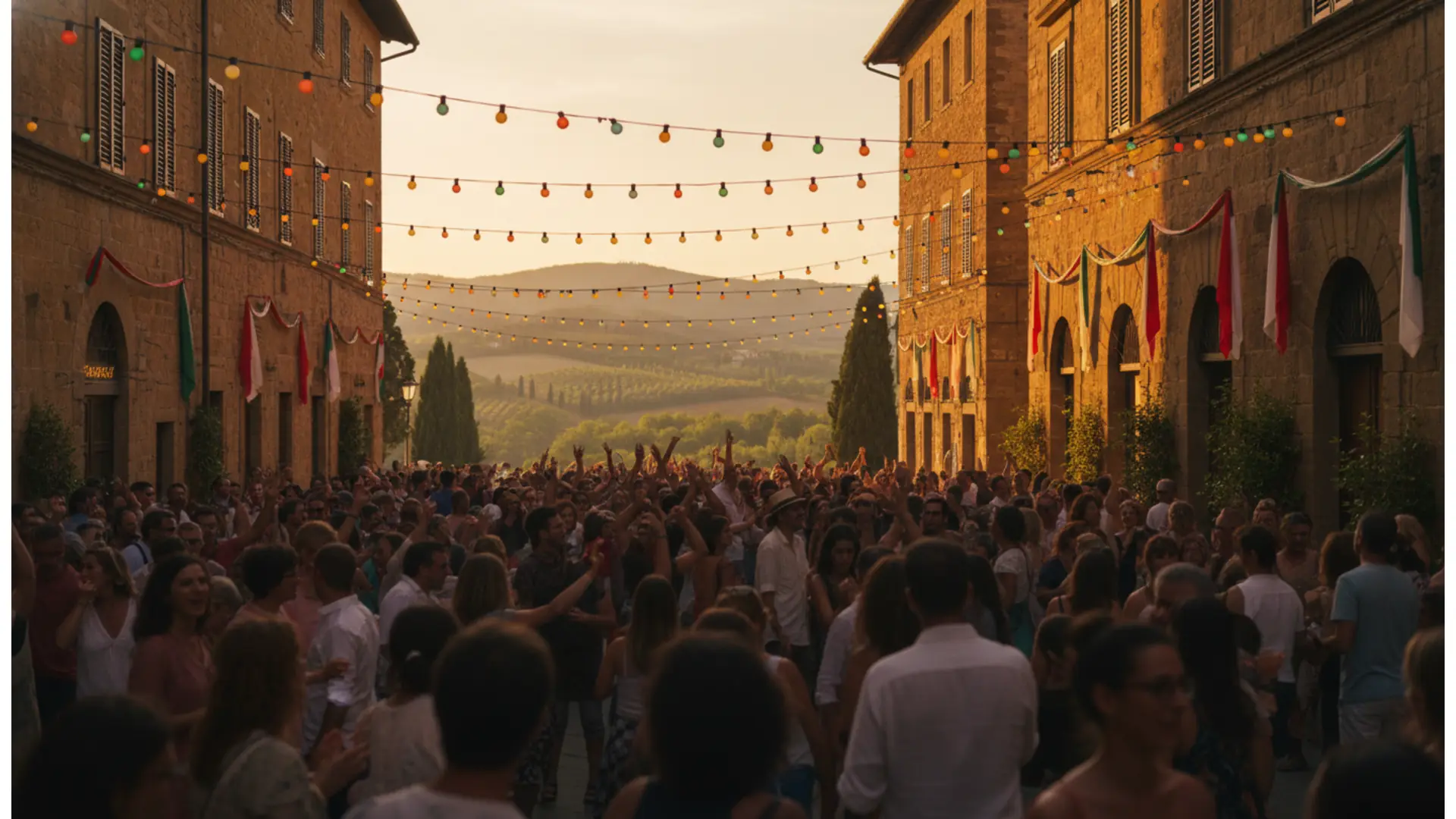
Palio de li Normanni
The medieval re-enactment of the Castrum Sancti Angeli de Ravecanina, in the heart of the Matese mountains in Caserta
Edition 2026 not confirmed to date
This edition has not been confirmed by the organiser to date. We recommend checking before going.
About Palio de li Normanni
A Matese village that turns Norman again
For a few days in August, Sant'Angelo d'Alife, a small town in the province of Caserta overlooking the middle Volturno valley and nestled in the Matese Regional Park, in Campania, ceases to be a 21st-century village. The alleys, squares, and open spaces of the historic center fill with counts and countesses, ladies, jesters, men-at-arms, artisans, and merchants: it is the Palio de li Normanni, the historical re-enactment that the Pro Loco Archangelus association dedicates to the Castrum Sancti Angeli de Ravecanina, the ancient fortified settlement that dominates the town from above.
The history behind the Palio
The event was created in the 2000s to commemorate the nine centuries since the birth of the county of Rupecanina, established in 1106 during the height of the Norman adventure in Southern Italy. The narrative thread follows the Drengot family, who arrived from Normandy and were key players in the conquest of the Terra di Lavoro: from Rainulfo Drengot, the first count of Aversa, to Rainulfo of Alife, count of Alife and Caiazzo, leading up to the separation of Rupecanina from the county of Alife. Each evening, history is brought to life through living tableaux that reconstruct the daily, military, and courtly life of the 11th to 13th centuries.
The competing districts and the contested Palio
The competitive heart of the festival is the challenge between the town's districts — Concha, Cupa, Rave, and Valle — who face off in disfide (duels), single-combat tournaments, and popular games of strength and skill, under the banners of the historic terzieri of Paparini, Chiaje, and Raviscanino. At stake is the banner painted with the image of Saint Michael the Archangel, the saint to whom the village owes its name and to whom the sacred cave that defines its religious identity is linked.
What to see during the evenings
- Historical pageant in costume along the village streets, with ladies, knights, falconers, and men-at-arms
- Flag-wavers, drummers, and musicians visiting from other Italian re-enactment cities
- Archery and crossbow competitions and knightly investiture ceremonies
- Jousts and horse duels, theatrical performances, and nighttime fire shows
- Medieval market and workshops of ancient crafts, with artisans at work
- Taverns and stalls featuring food and wine products from the Matese and Alto Casertano regions
- Handing over of the keys to the new lord of the Castrum, the highlight of the re-enactment in the main square
Rupecanina, the natural stage
The Palio owes much to its landscape. Above the town stands the fortified site of Rupe Canina, with its Norman tower, the remains of the abandoned village, and the fortifications later linked to Frederick II and the Marzano family: a place that makes the theatrical fiction believable and is worth a visit even outside of festival days. It is from this fortress that the Palio draws its imagery, filled with sieges, fires, and flags that light up the August night.
Why it's worth the trip
Compared to the large Italian re-enactments, the Palio de li Normanni retains an authentic village dimension: it is the residents, divided by district, who sew the costumes, prepare the taverns, and stage their own history. For those visiting the Alto Casertano in summer, it is the perfect opportunity to combine a medieval evening with a day in the Matese Regional Park, among hikes, lakes, and villages like Piedimonte Matese, Alife, and Gioia Sannitica.
Palio de li Normanni — edition 2026
2026 Edition: no dates announced
As of the update of this page, there are no official announcements or posters regarding a 2026 edition of the Palio de li Normanni in Sant'Angelo d'Alife, in the province of Caserta. The event has historically taken place around mid-August, but the calendar is not published far in advance and not every year has seen an edition.
For this reason, the date indicated here is purely indicative and does not correspond to an announcement by the organizers. Information will be updated as soon as the Pro Loco Archangelus releases the days and program.
How to stay updated
- Official Facebook page of the event
- Communications from the Municipality of Sant'Angelo d'Alife
- Local newspapers of the Alto Casertano and Matese regions
Practical information — Palio de li Normanni
How to get there
Sant'Angelo d'Alife can be reached by car from the Caianello motorway exit (A1 Milan-Naples) by continuing towards Alife along the Volturno valley, or from Caserta by driving up the state road towards Piedimonte Matese. The nearest train station is in Piedimonte Matese, on the Alifana line; from Naples, the drive takes about an hour and a half.
During the event
The shows take place in the historic center and the village squares, with pedestrian routes: it is advisable to leave your car in the parking lots at the entrance to the town and continue on foot. The streets are uphill and have uneven paving, so comfortable shoes are recommended.
Tips
- The evenings come alive after sunset and continue late into the night: in the mountains, the temperature drops, so it is best to bring a sweatshirt.
- In the taverns and stalls, you can taste typical Matese products; it is the easiest way to dine during the festival.
- For accommodation, the supply of farmhouses and bed and breakfasts is concentrated between Alife, Piedimonte Matese, and neighboring towns: in August, it is best to book in advance.
- Dates and the program are mainly shared through the event's Facebook page and the local Matese press: it is worth checking them before setting off.
Festival-goer photos
No photos yet. Share yours!
Share your photos
5 photos max, 5 MB per photo (JPG, PNG, WebP)
Noticed an error or missing information?
Help us keep this listing up to date. Every proposal is verified by our team before publication.
Festival-goer reviews
No rating yet — be the first!
No comments yet. Be the first!
Were you there?
Share your experience with the community.
Published by Valentin Contard, festival listings writer. Reviewed, corrected and approved by Christophe Contard, editor-in-chief. .
Where does it take place — Palio de li Normanni
Centro storico di Sant'Angelo d'Alife