Our Lady of Mount Carmel Festival
Eighteen days of Marian devotion and popular celebration in the heart of Palestrina
About Our Lady of Mount Carmel
A devotion spanning the centuries
The Our Lady of Mount Carmel Festival is, along with the Palio of Sant'Agapito, the most heartfelt event in the religious calendar of Palestrina, a city in the Metropolitan City of Rome Capital, in the heart of Lazio. The cult of the Blessed Virgin Mary of Mount Carmel is linked to the presence of the Carmelite friars, who have been established in the convent attached to the Church of Sant'Antonio Abate since 1467. Originally celebrated on August 15th, the feast was moved to July 16th in 1605 by the will of Father Sebastiano Fantoni, provincial prior of Rome; since 1612, the solemnity and the procession have consistently taken place on that date, giving the recurrence a continuity that has lasted for over four centuries.
The church and the statue
The heart of the festival is the Church of Sant'Antonio Abate, overlooking the intimate Piazza del Carmine, just a few steps from the Sanctuary of Fortuna Primigenia. The building, redesigned in the 17th century by architect Orazio Turriani, was completed in 1623 and consecrated in 1626, becoming a parish in 1802. The third chapel on the left houses the statue of Our Lady of Mount Carmel, venerated by the ancient Confraternity of Mary Most Holy of Mount Carmel; the processional statue dates back to 1667, and with it, the tradition of the stop at Sant'Agapito was born. The banner was renewed in the 1980s by artist Antonio Nelvis Fornasin, while a new standard was created in 1992. In 2015, Bishop Domenico Sigalini placed the entire city under the maternal protection of the Virgin of Mount Carmel.
How the festival is structured
The festivities span approximately twenty days: they begin with the novena in the nine days preceding the feast Sunday and conclude eight days later, with the repositioning of the statue in its chapel. It is an ancient structure that marks the community's time and allows those living far away to return to the city for the occasion.
- Preparatory Novena — evening celebrations, catechesis, and formation moments;
- July 16th — liturgical feast of the Blessed Virgin Mary of Mount Carmel, with the rite of the Scapular;
- Sunday closest to July 16th — solemn Holy Mass and procession through the city streets at the end of the evening celebration;
- Octave — eight days of concluding celebrations until the return of the statue to its chapel.
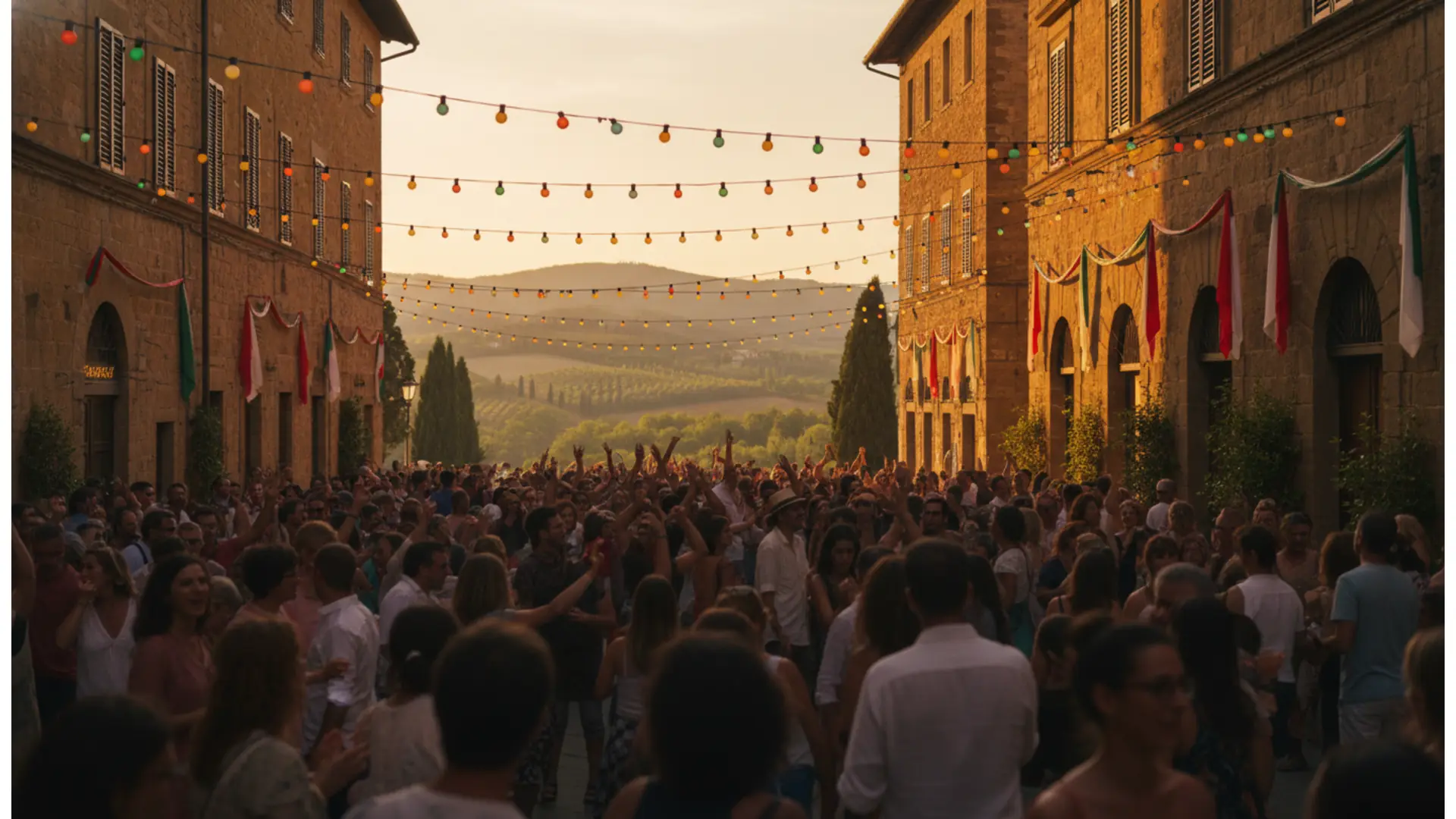
Until the 1960s, the procession took place in the morning: today it is held in the evening, at the end of Mass, when the warm sunset light on the polygonal walls and the uphill alleys gives the parade a particularly evocative atmosphere. The Confraternity of Carmel, the Third Order of Carmelites, other city confraternities, the clergy, and a crowd of faithful participate in the procession.
Faith and neighborhood life
A popular component has always developed around the liturgical dimension: the Carmel festival involves the neighborhood and the local community as a whole, far beyond just the members of the Confraternity. On summer evenings, the streets around Piazza del Carmine come alive with meetings, convivial moments, and events designed for families, children, and young people, according to a tradition of sociality that in Palestrina is also found in the Borgo Festival and the Corpus Domini Flower Festival.
Palestrina, city of art and music
Those arriving for the festival find much more than a religious celebration. Palestrina, the ancient Praeneste, houses one of the most extraordinary archaeological complexes in Lazio, the Sanctuary of Fortuna Primigenia, on whose terraces the historic center rests, and the National Archaeological Museum of Palazzo Colonna Barberini with the famous Nile mosaic. The city was the birthplace of Giovanni Pierluigi da Palestrina, one of the greatest composers of Renaissance sacred music: an ideal bond with a feast where liturgical chant plays a central role. From the terraces of Palestrina, the view stretches to the Roman countryside and, on clear days, to the sea.
Tips for visitors
The evening of the procession is when the city shows itself in its most authentic guise: it is best to arrive well in advance, both to find a spot along the route and to enjoy the historic center at a leisurely pace. The intimate character of the festival requires a respectful attitude during the celebrations, while the evenings of the novena and the octave offer a more informal contact with neighborhood life.
Our Lady of Mount Carmel — edition 2026
2026 Edition
The Parish of Sant'Antonio Abate has announced the program of festivities in honor of the Blessed Virgin Mary of Mount Carmel, which will take place in Palestrina from July 10 to 27, 2026. As tradition dictates, the journey begins with the preparatory novena and concludes with the octave, when the statue returns to the chapel that houses it inside the church.
The day of the feast
The central event is Sunday, July 19, 2026: the solemn Holy Mass is celebrated in Piazza del Carmine and is presided over by the priests of Palestrina; at the end, the procession through the city streets begins with the statue of the Madonna, accompanied by the Confraternity of Mary Most Holy of Mount Carmel, the Third Order of Carmelites, the clergy, and the faithful.
More than just liturgy
Alongside the celebrations, the program includes moments of prayer and formation, as well as events dedicated to families, children, and the youth of the Palestrina community. On July 16, the liturgical feast of Our Lady of Mount Carmel is celebrated with the rite of the Scapular.
The complete details of the celebration times are published in the flyer distributed by the parish and posted in the city.
Programme Our Lady of Mount Carmel 2026
2026 Program
- Friday, July 10 — opening of the festivities and start of the preparatory novena
- July 10-18 — novena: evening celebrations, moments of prayer and formation, events for families, children, and youth
- Thursday, July 16 — liturgical feast of the Blessed Virgin Mary of Mount Carmel, with the rite of the Scapular
- Sunday, July 19 — solemn day: Holy Mass in Piazza del Carmine presided over by the priests of Palestrina, followed by the traditional procession through the city streets
- July 20-27 — octave of the feast, with concluding celebrations and repositioning of the statue in its chapel in the Church of Sant'Antonio Abate
The exact times of the individual celebrations are indicated in the official flyer of the Parish of Sant'Antonio Abate.
Highlights Our Lady of Mount Carmel 2026
- The solemn Holy Mass in Piazza del Carmine on Sunday, July 19, presided over by the city's priests
- The evening procession with the 18th-century statue of Our Lady of Mount Carmel through the historic center
- The novena, nine evenings of prayer that prepare the community for the feast
- The liturgical feast of July 16 with the rite of the Scapular
- Events for families, children, and youth throughout the festivities
- The repositioning of the statue in the chapel at the end of the octave, the gesture that closes the feast
Prices Our Lady of Mount Carmel 2026
Practical information — Our Lady of Mount Carmel
Location
Church of Sant'Antonio Abate, Piazza del Carmine 1, 00036 Palestrina (Metropolitan City of Rome Capital, Lazio). The main celebrations and the procession involve the square and the streets of the historic center.
How to get there
- By car: from the A1 motorway, Valmontone exit, or from the Grande Raccordo Anulare via the SS155 Casilina or Via Prenestina; about 40 km from Rome. Parking is available in the lower parts of the city; the historic center is reached on foot uphill.
- By train: FL5 or FL6 line to Zagarolo, then bus connection to Palestrina.
- By bus: Cotral connections from Rome Anagnina.
- By plane: Rome Ciampino (approx. 30 km) and Rome Fiumicino (approx. 60 km) airports.
Admission
Celebrations and the procession are free of charge.
Tips
Wear comfortable shoes: the historic center is entirely uphill and cobbled. On July evenings, the climate is warm but breezy due to the altitude. Combine with a visit to the Sanctuary of Fortuna Primigenia and the National Archaeological Museum.
Information
Parish of Sant'Antonio Abate — tel. +39 06 9538131 — [email protected]
Festival-goer photos
No photos yet. Share yours!
Share your photos
5 photos max, 5 MB per photo (JPG, PNG, WebP)
Noticed an error or missing information?
Help us keep this listing up to date. Every proposal is verified by our team before publication.
Festival-goer reviews
No rating yet — be the first!
No comments yet. Be the first!
Were you there?
Share your experience with the community.
Published by Valentin Contard, festival listings writer. Reviewed, corrected and approved by Christophe Contard, editor-in-chief. .
Where does it take place — Our Lady of Mount Carmel
Chiesa di Sant'Antonio Abate (Piazza del Carmine)
Piazza del Carmine 1, 00036 Palestrina