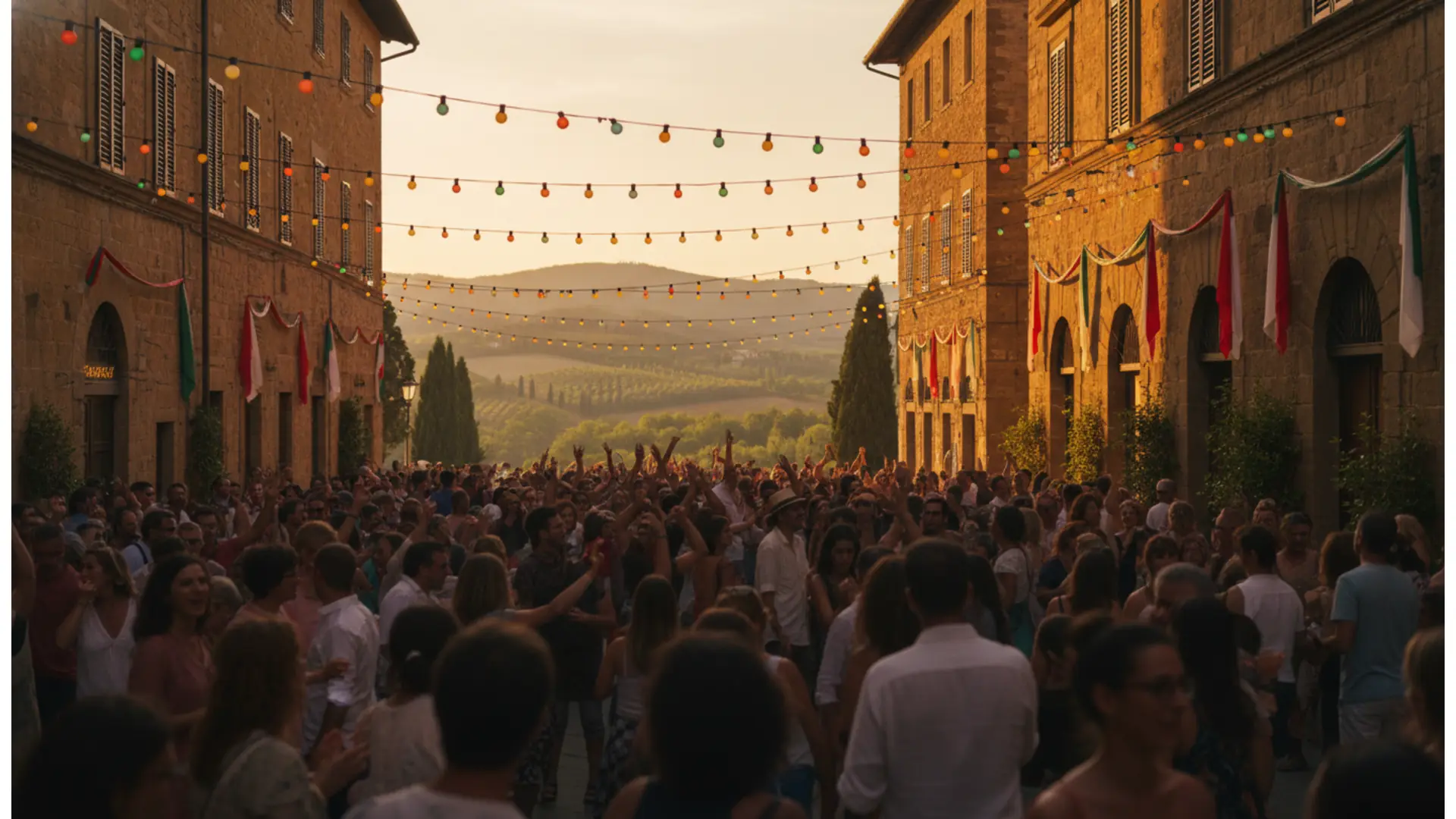
Most Holy Crucifix Festival (Tri di Maju)
The Tri di Maju festival, the heart of Bisacquino's devotion
About Crucifix Festival
Bisacquino's most beloved festival
In Bisacquino, a town in the western Madonie mountains in the province of Palermo (Sicily), May 3rd is no ordinary date: it is the "Tri di Maju" festival, the celebration of the Most Holy Crucifix, the most deeply felt religious appointment for the community. For centuries, the people of Bisacquino have returned to their hometown for this day, no matter where they are, because the Crucifix festival is the strongest bond with their roots.
The vara by Giuseppe Bellacera
The heart of the festival is the wooden vara, a work by local artisan Giuseppe Bellacera, created between 1792 and 1793. It is a monumental Baroque artifact, about six meters high and weighing around two tons, depicting the Crucified Christ. Restored and blessed in 2016, the vara is kept in the Church of San Giovanni Battista and, on the day of the festival, becomes the focal point around which the entire town revolves.
The thirty-two statues of the Saints
The most evocative tradition is that of the thirty-two statues of the Saints: on the afternoon of May 3rd, the simulacra, festively adorned and coming from the churches of Bisacquino's various districts, are gathered in the Mother Church to pay homage to Christ on the vara. This custom was already documented in the 18th century, when the Saints formed a crown around the Crucifix. At the end of the procession, in front of the Mother Church, the statues of Saint Joseph and the Madonna join the Most Holy Crucifix in the famous "bowing of the Saints."
The solemn procession
The day follows an unchanging ritual: morning celebrations and High Mass, the afternoon gathering of the simulacra in the Mother Church, and finally, in the evening, the grand procession that traverses the streets of the historic center. The vara, preceded by the statues of the Saints and the figures of the Madonna and Saint Joseph, slowly makes its way through the town until the final farewell to the Crucifix.
A ritual of identity in the Madonie
The Most Holy Crucifix Festival is not just a religious event, but the moment when Bisacquino rediscovers its collective identity. For visitors, it is an opportunity to discover an authentic village in the Palermo hinterland, far from mass tourism circuits, and to witness one of the most characteristic patronal festivals of inland Sicily, where popular faith, Baroque art, and community tradition merge into a single day.
Crucifix Festival — edition 2026
2026 Edition
In 2026, Bisacquino once again renewed the "Tri di Maju" festival. The statues of the Saints from the various districts gathered in the afternoon at the Mother Church to pay homage to the Crucifix, while in the evening, the wooden vara traversed the historic center in a solemn procession, concluding with the farewell to the Most Holy Crucifix and the bowing of the Saints in front of the Mother Church.
Programme Crucifix Festival 2026
May 3rd
- 10:00 AM — First liturgical celebration
- 12:00 PM — High Mass
- 4:00 PM — Gathering of the Saints' simulacra in the Mother Church
- 7:00 PM — Start of the solemn procession with the Most Holy Crucifix vara
- 10:30 PM — Conclusion with the farewell to the Most Holy Crucifix and the bowing of the Saints
The liturgical program follows the traditional festival schedule; times may be subject to slight variations set by the parish.
Highlights Crucifix Festival 2026
Prices Crucifix Festival 2026
Practical information — Crucifix Festival
How to get there
Bisacquino is located in the western hinterland of the province of Palermo, in the Madonie area. By car, it can be reached from Palermo (about an hour and a half) via the SS 624 Palermo-Sciacca and provincial roads leading to the village. The nearest train station is in Palermo; the journey continues by car or local bus.
When
The festival is celebrated every year on May 3rd. The main celebrations are concentrated throughout the day, with the evening procession as the highlight.
Costs
Participation in the celebrations and the procession is free and open to everyone.
Festival-goer photos
No photos yet. Share yours!
Share your photos
5 photos max, 5 MB per photo (JPG, PNG, WebP)
Noticed an error or missing information?
Help us keep this listing up to date. Every proposal is verified by our team before publication.
Festival-goer reviews
No rating yet — be the first!
No comments yet. Be the first!
Were you there?
Share your experience with the community.
Published by Valentin Contard, festival listings writer. Reviewed, corrected and approved by Christophe Contard, editor-in-chief. .
Where does it take place — Crucifix Festival
Chiesa Madre di Bisacquino