Montecastello Festival
The 1656 miracle re-enactment in Cava de' Tirreni
About Montecastello
A festival spanning over three and a half centuries
The Montecastello Festival, officially known as the Celebrations in honor of the Most Holy Sacrament, is the heart of the civic and religious identity of Cava de' Tirreni, in the province of Salerno, Campania. Born in the aftermath of the plague that devastated the Kingdom of Naples in 1656, the event has been held uninterruptedly for over three and a half centuries: in 2026, the 370th edition was celebrated, a record that places it among the longest-running historical re-enactments in the country.
The miracle of 1656
In the summer of 1656, the bubonic plague struck the city hard: chronicles report about 6,300 victims, nearly half the population. According to tradition, the contagion ceased in December of that same year after the priest Don Angelo Franco carried the Most Holy Sacrament in procession to the summit of the Castello di Sant'Adiutore, blessing the city and the surrounding territory. From that gesture, the perpetual vow was born, which led to the start of regular celebrations the following year: every year, the city renews that blessing to be preserved from further calamities.
When it takes place
The festival does not have a fixed date: the climax always falls on the Thursday of the octave of Corpus Domini, with historical pageants distributed across the following Friday, Saturday, and Sunday. For this reason, the calendar shifts from year to year between late May and late June, following the liturgical cycle of Easter.
The protagonists: trombonieri, flag-wavers, and participants
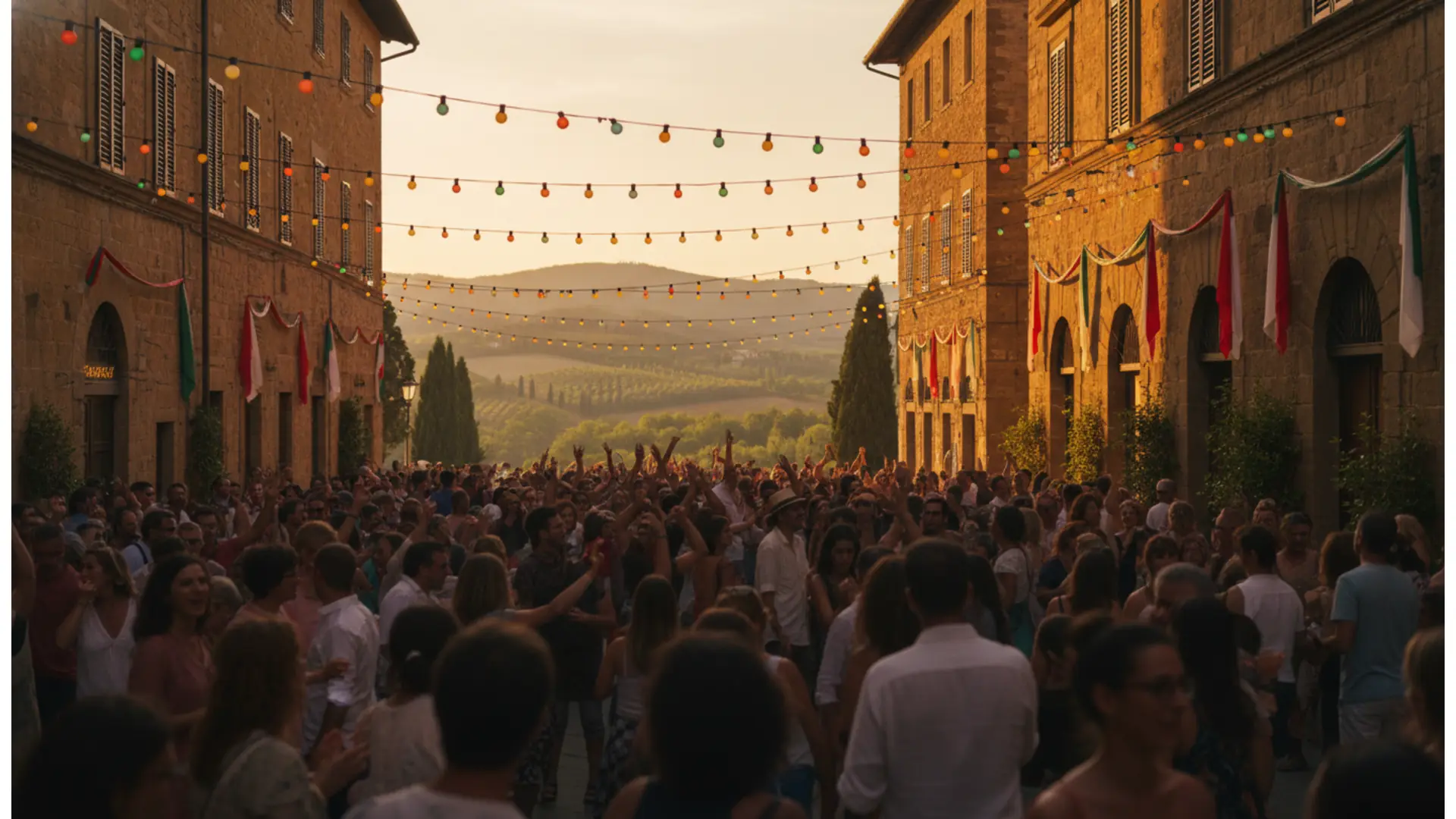
The most spectacular face of the festival is the 17th-century Historical Pageant, which crosses the famous Borgo Scacciaventi — the porticoed street that is the symbol of Cava — to converge in Piazza Duomo. About 1,500 participants in period costumes take part:
- The Trombonieri: groups armed with ancient muskets (the so-called pistoni or tromboni) that fire deafening salutes, representing the four historic districts of the city.
- The Flag-wavers of Cava, with their flag and drum choreographies.
- Dames, knights, and commoners, along with representatives of ancient Cava families.
- The Guilds of arts and crafts, protagonists of the final parade on Sunday.
The Procession of the Plague-Stricken
Alongside the festive dimension, the event preserves a moment of strong emotional impact: the Procession of the Plague-Stricken, a nocturnal penitential procession where participants re-enact the despair of the population struck by the disease, with flagellants, death carts, and the recitation of the Rosary along the streets of the Borgo Grande, leading to the final blessing in Piazza Duomo.
Tradition and innovation
In recent years, the festival has renewed its language without betraying tradition: traditional fireworks have given way to luminous drone choreographies that draw symbols of Cava's devotion in the sky starting from Monte Castello, while the facade of the Cathedral of Santa Maria della Visitazione lights up with video mapping projections that tell the story of the plague, the miracle, and the characters of the festival.
The taste of the festival
The Thursday, traditionally spent on the castle square after the morning masses, is also a great convivial occasion: people hike up the paths of Monte Castello to enjoy typical traditional Cava products — milza 'mbuttunata (stuffed spleen), local cured meats, rustic bread, sweets, and taralli — in a popular picnic atmosphere that unites entire families and neighborhoods.
Cava de' Tirreni and its territory
Nestled in a green valley between the Amalfi Coast and Salerno, Cava de' Tirreni is known for its Borgo Scacciaventi, the thousand-year-old Benedictine Abbey of the Most Holy Trinity, and its proximity to Vietri sul Mare, the home of ceramics. The Montecastello Festival is the time of year when the city shows its best: an entire community that, generation after generation, guards the memory of a vow made in 1656.
Montecastello — edition 2026
The 370th edition
2026 marked a symbolic milestone for Cava de' Tirreni: the 370th edition of the Celebrations in honor of the Most Holy Sacrament, held uninterruptedly since 1657. The program opened on Saturday, June 6, with the lighting of the great luminous Monstrance on Monte Castello, visible from the entire valley, and continued on Sunday, June 7, with the solemnity of Corpus Domini.
The key days
The religious heart fell on Thursday, June 11, with morning masses on the castle square and, in the evening, the historic Eucharistic procession concluding with the blessing of the city. On Friday, June 12, the Procession of the Plague-Stricken crossed the Borgo Grande in a penitential atmosphere, followed by video mapping on the Cathedral facade dedicated to scenes of the plague. Saturday, June 13, from the afternoon, the blessing of the trombonieri and folk groups in Piazza Duomo preceded the great 17th-century Historical Pageant and, in closing, the luminous drone show. On Sunday, June 14, the pageant of the 17th-century Guilds and the thanksgiving Te Deum at the convent of San Francesco concluded the festival.
Between re-enactment and new technologies
In 2026, the organization confirmed the choice to replace traditional fireworks with drone choreographies, which are more sustainable and animal-friendly, accompanied by video mapping storytelling of the city's history. The event was organized in collaboration with the Municipality of Cava de' Tirreni, the Archdiocese of Amalfi-Cava de' Tirreni, and the local branch of Archeoclub d'Italia.
Programme Montecastello 2026
Saturday, June 6
- 9:00 PM — Lighting of the great luminous Monstrance on Monte Castello
Sunday, June 7 — Corpus Domini
- 7:00 PM — Solemn Pontifical Mass at the church of San Vito Martire
- 8:00 PM — Eucharistic procession towards the Cathedral
Wednesday, June 10
- 8:00 PM — Torch of Faith: relay from Monte Castello to Piazza Duomo, in collaboration with CSI
Thursday, June 11 — Main day
- 8:00 AM and 11:00 AM — Holy Masses on the square of the Castello di Sant'Adiutore
- 7:30 PM — Animation and Eucharistic preparation
- 8:30 PM — Historic Eucharistic procession of 1656 and solemn blessing of the city (370th blessing)
- During the day — Hike to Monte Castello and traditional picnic with typical Cava products
Friday, June 12
- 9:00 PM — Procession of the Plague-Stricken: penitential procession with recitation of the Rosary from Piazza San Francesco along the Borgo Grande to Piazza Duomo
- 10:00 PM — Video mapping on the Cathedral facade with scenes of the 1656 plague
Saturday, June 13
- Morning — Blessing of the Trombonieri, Flag-wavers, and folk groups in Piazza Duomo
- From 5:00 PM — Opening of the day in the historic center
- 8:30 PM — 17th-century Historical Pageant with about 1,500 participants along Borgo Scacciaventi and in Piazza Duomo, with trombonieri salutes and flag-waver performances
- 11:00 PM — Luminous drone choreographies from Monte Castello
Sunday, June 14
- 6:30 PM — Historical Pageant "The 17th-century Guilds", from the municipal stadium along the Borgo Grande to the convent of San Francesco
- 8:00 PM — Singing of the thanksgiving Te Deum and closing of the festivities
Highlights Montecastello 2026
- 370th edition of one of Italy's longest-running historical re-enactments
- About 1,500 participants in 17th-century costumes: dames, knights, commoners, and ancient Cava families
- Parade of the Trombonieri with ancient musket salutes and performances by the Flag-wavers of Cava
- Procession of the Plague-Stricken, a evocative nocturnal penitential procession
- Luminous drone show from Monte Castello instead of fireworks
- Video mapping on the Cathedral facade dedicated to the 1656 plague and the history of the festival
- Historic Eucharistic procession with the blessing of the city from the Castello di Sant'Adiutore
Prices Montecastello 2026
Practical information — Montecastello
How to get there
By train: the Cava de' Tirreni station is on the Naples–Salerno line and is a few minutes' walk from the historic center and Piazza Duomo. By car: take the Cava de' Tirreni exit on the A3 Naples–Salerno motorway; during the festival days, the center is closed to traffic, and it is advisable to leave your car in peripheral parking lots. By plane: Naples-Capodichino airport (approx. 60 km) and Salerno-Costa d'Amalfi airport (approx. 25 km).
Admission and hours
All events (processions, historical pageants, trombonieri blessing, drone show, and video mapping) take place outdoors and are free. Evening parades generally start between 8:30 PM and 9:00 PM; it is advisable to arrive at least an hour early to find a spot along the Borgo Scacciaventi or in Piazza Duomo.
Useful tips
- The salutes of the trombonieri are very loud: caution is advised with small children and animals.
- For the climb to Monte Castello (Thursday), comfortable shoes, water, and sun protection are needed.
- For accommodation, in addition to Cava de' Tirreni, you can choose between Vietri sul Mare, Salerno, and the Amalfi Coast, all a short distance away.
Information
Ente Montecastello, Piazza Duomo 10, Cava de' Tirreni (SA) — phone +39 089 466249 — [email protected] — www.entemontecastello.it
Festival-goer photos
No photos yet. Share yours!
Share your photos
5 photos max, 5 MB per photo (JPG, PNG, WebP)
Noticed an error or missing information?
Help us keep this listing up to date. Every proposal is verified by our team before publication.
Festival-goer reviews
No rating yet — be the first!
No comments yet. Be the first!
Were you there?
Share your experience with the community.
Published by Valentin Contard, festival listings writer. Reviewed, corrected and approved by Christophe Contard, editor-in-chief. .
Where does it take place — Montecastello
Centro storico, Borgo Scacciaventi e Monte Castello
Piazza Duomo, 10, 84013 Cava de' Tirreni