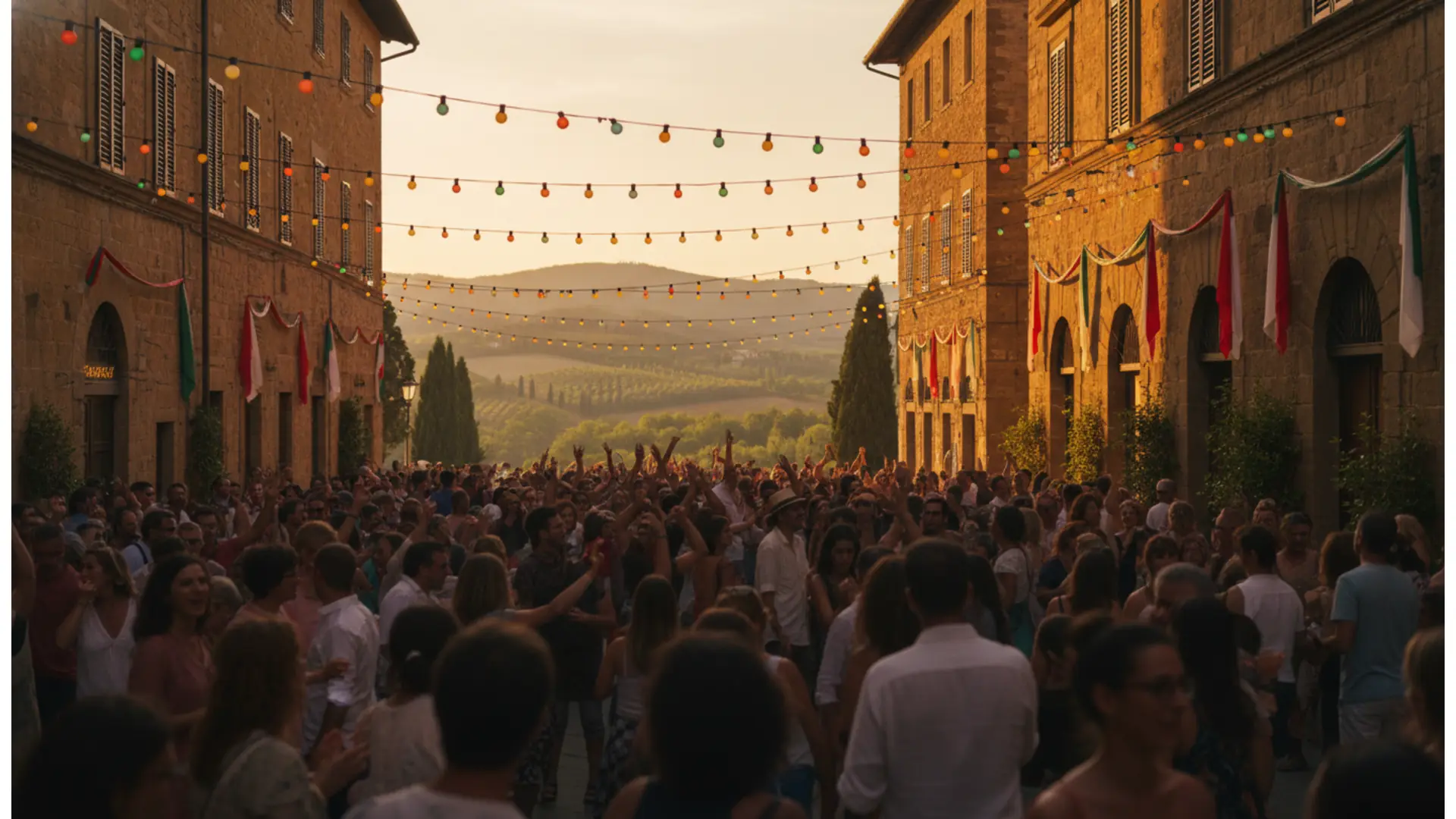
Grottaferrata National Fair
Nine days of craftsmanship, food, wine, and culture at the foot of the Abbey of San Nilo
About Grottaferrata Fair
A fair with roots in the Middle Ages
The Grottaferrata National Fair is much more than a commercial event: it is a collective ritual that the Municipality of Grottaferrata, in the Metropolitan City of Rome Capital, has celebrated for centuries at the foot of the Greek Abbey of Santa Maria, founded by Saint Nilus of Rossano. Its origins are linked to the pilgrimages that, since the 11th century, brought crowds of faithful to the abbey church for the Feast of the Annunciation (March 25) and the Nativity of the Virgin (September 8). The first written record dates back to the Commentaries of Pope Pius II, who, while visiting the Abbey in 1463, noted that the fair rarely ended without a few brawls.
The March fair, as we know it today, has been documented since the early 17th century: 1600 was chosen as the conventional starting date, the year of the famous painting by Agostino Tassi that depicts the fair as a grand country festival. In 1761, Pope Clement XIII regulated its conduct during the two periods of March and September through a motu proprio. Since then, the event has never stopped reinventing itself, reaching its 426th edition in 2026.
What to find at the fair
The heart of the exhibition is Piazzale San Nilo, where over a hundred exhibitors line up every year in thematic pavilions. The selection is deliberately broad and diverse:
- Regional and national food and wine: Castelli Romani wines, extra virgin olive oil, cured meats, cheeses, sweets, and local agricultural products;
- Craftsmanship and artisan trades: ceramics, woodwork, textiles, handicrafts, and custom-made creations;
- Home decor and living: furniture, home accessories, and interior design solutions;
- Home and personal care: natural cosmetics, herbal products, and wellness;
- Food area with tastings and musical evenings, a popular evening meeting point for families and young people.
Culture, shows, and biodiversity
For several editions now, the fair has expanded its scope well beyond the pavilions: the event has become a widespread program involving Spazio Ghelfi, the Sacro Cuore Theatre, and the AlFellini Municipal Cinema. The calendar features choral and swing concerts, Salento pizzica performances, theatre festivals, scientific conferences, and the Castelli Romani Contemporary Art Biennale. The AlFellini Cinema also hosts screenings for the Colli Albani Film Festival.
Great emphasis is placed on families and education, with workshops for children and adults on seasonal products, sustainability, and dog behaviour, as well as a pavilion dedicated to biodiversity — from silkworms to local animal species — designed to bring the public closer to the natural world. There is no shortage of guided tours to the Abbey of San Nilo, which remains the monumental and spiritual landmark of the event.
A tradition of the Castelli Romani
In the Lazio region, the Grottaferrata event represents one of the most defining moments for the Castelli Romani: here, the fair is not an imported event but the continuation of a custom of exchange born around the Italo-Greek monastery, the only one of its kind in Italy. For international visitors, it is the ideal opportunity to understand how devotion, commerce, and conviviality intertwine in Lazio: you can stroll among the stalls, taste wine from the vineyards surrounding the town, and walk a few hundred metres to the Abbey.
When to go
The fair traditionally takes place in the last ten days of March, spanning the Feast of the Annunciation, with daily opening hours from 10 am to 9 pm and an opening ceremony on the first day, led by a procession starting from the Abbey square accompanied by a marching band. Admission to the fairgrounds is free, making it a perfect destination for a day trip from Rome, which is about twenty kilometres away.
Grottaferrata Fair — edition 2026
The 426th edition
The 2026 edition of the Grottaferrata National Fair was held from Saturday, March 21 to Sunday, March 29, in the exhibition area of Piazzale San Nilo, with continuous hours from 10:00 am to 9:00 pm and free admission. The event received the patronage of the Lazio Region and the Metropolitan City of Rome Capital.
The inauguration ceremony took place on Saturday, March 21 at 10:00 am: the procession, accompanied by the marching band, departed from the square of the Abbey of San Nilo in the presence of civil, military, and religious authorities, before reaching the fairgrounds for institutional greetings, the ribbon-cutting, the traditional blessing, and the inaugural tour of the pavilions.
2026 Highlights
The main novelty was the pavilion dedicated to biodiversity, focusing on silkworms and various animal species, designed to introduce the public — especially families and school groups — to the natural world. The edition also focused heavily on culture and education, with initiatives distributed throughout various points of the city in addition to the institutional pavilion.
Programme Grottaferrata Fair 2026
Fairgrounds — Piazzale San Nilo
- Open daily from March 21 to 29, 10:00 am - 9:00 pm, free admission
- Pavilions for regional and national food and wine, crafts, home decor, and personal care
- Food area with tastings and musical evenings
- Biodiversity pavilion dedicated to silkworms and animal species
- Institutional pavilion with educational workshops, conferences, and tastings
Inauguration
- Saturday, March 21, 10:00 am: Procession from the Abbey of San Nilo square with a marching band, institutional greetings, ribbon-cutting, blessing, and tour of the pavilions
Culture and shows in the city
- Concerts by the Grottaferrata Polyphonic Choir, swing and blues shows, Salento pizzica
- Theatre festivals and musical events between Spazio Ghelfi and Sacro Cuore Theatre
- Colli Albani Film Festival at the AlFellini Municipal Cinema (March 24-26)
- Castelli Romani Contemporary Art Biennale
- Scientific conferences, including a meeting dedicated to astrobiology
- Guided tours of the Greek Abbey of San Nilo
Workshops and services
- Educational workshops for children and adults on seasonal products, sustainability, and dog behaviour
- Entertainment for children
- Saturday, March 28: Free microchipping of pets for residents in the ASL Roma 6 territory
Highlights Grottaferrata Fair 2026
- 426th edition of one of Italy's oldest fairs
- Nine days of events at Piazzale San Nilo, free admission
- New biodiversity pavilion with silkworms
- Inaugural procession from the Greek Abbey of San Nilo with a band
- Colli Albani Film Festival at the AlFellini Cinema
- Swing, blues, and pizzica concerts, Grottaferrata Polyphonic Choir
- Patronage of the Lazio Region and the Metropolitan City of Rome Capital
Prices Grottaferrata Fair 2026
Practical information — Grottaferrata Fair
How to get there
By car: from Rome, take the GRA exit 21-22 and follow Via Anagnina or Via Tuscolana towards Grottaferrata (approx. 20 km). During the fair, it is recommended to use the peripheral parking lots indicated by signage, as the Piazzale San Nilo area is very busy.
By train and bus: take the FL4 line to Frascati or Roma Casilina, then a Cotral bus towards Grottaferrata. Alternatively, take Metro A to Anagnina and use the direct Cotral connection.
Opening hours and admission
Fairgrounds open daily from 10:00 am to 9:00 pm. Free admission. Cultural events hosted in the theatre, cinema, or city spaces may have specific access requirements: it is best to check the program published by the Municipality.
Tips
Saturdays and Sundays are the most crowded days: to visit the pavilions in peace, it is better to choose a weekday. We recommend combining your visit with a trip to the Abbey of San Nilo and a stop at the wineries of the Castelli Romani.
Contacts
Municipality of Grottaferrata, Piazzetta Eugenio Conti 1, 00046 Grottaferrata (RM) — tel. +39 06 945401699 — official website: www.fieradigrottaferrata.it
Festival-goer photos
No photos yet. Share yours!
Share your photos
5 photos max, 5 MB per photo (JPG, PNG, WebP)
Noticed an error or missing information?
Help us keep this listing up to date. Every proposal is verified by our team before publication.
Festival-goer reviews
No rating yet — be the first!
No comments yet. Be the first!
Were you there?
Share your experience with the community.
Published by Valentin Contard, festival listings writer. Reviewed, corrected and approved by Christophe Contard, editor-in-chief. .
Where does it take place — Grottaferrata Fair
Piazzale San Nilo
Piazzale San Nilo, 00046 Grottaferrata