Feast of the Patron Saint Arsenius the Abbot
The Vallo di Diano village celebrates the saint who gave it its name
Edition 2026 not confirmed to date
This edition has not been confirmed by the organiser to date. We recommend checking before going.
About Patron Saint Feast
A village that bears the name of its patron saint
In Sant'Arsenio, a village of just over two thousand inhabitants nestled at an altitude of 448 meters in the Vallo di Diano, in the province of Salerno, the patronal feast is no ordinary recurrence: it is the day the community celebrates its very essence. The town owes its name to Arsenius the Great, the anchorite of the Egyptian desert whom the Church remembers on July 19th and who is venerated here as Arsenius the Abbot, a master of contemplative life and protector of the village. The locals also show devotion to Saint Anne, the co-patron, celebrated a few days later.
The Collegiate Church of Santa Maria Maggiore
The heart of the festivities is the Collegiate Church of Santa Maria Maggiore, on Via Antonio Cafaro, which houses the village's most precious devotional heritage. Here lies the famous wooden bust of Arsenius the Abbot, a work by the sculptor Giacomo Colombo (Este 1663 – Naples 1731), one of the greatest woodcarvers active in Southern Italy between the 17th and 18th centuries; in 2018, the community celebrated its third centenary with a study conference. The same church houses other works attributed to Colombo, including a group featuring Saint Anne and the Virgin Mary as a child, a crucifix, and a Saint Vitus.
A legend still alive in local memory is tied to the statue: it is said that in 1709, the sculptor returned to his workshop to complete the work, which lacked only the face, and found it already finished, as if by divine intervention. Another tradition recalls that on May 14, 1857, the statue exuded moisture and the fabric flower held in the saint's hand revived its colors, which had faded over time. These episodes explain the intense participation in the procession.
Experiencing the festival
As with other patronal feasts in the Vallo di Diano, the day alternates between liturgical and community dimensions: Eucharistic celebrations in the collegiate church, the procession with the patron saint through the streets of the historic center, and subsequently, convivial moments in the square, when the village fills with families, emigrants returning for the occasion, and visitors from neighboring towns in the evening. Access to all celebrations is free and open to all.
- Holy masses and prayer moments in the Collegiate Church of Santa Maria Maggiore
- Procession with the patron saint's wooden bust through the village streets
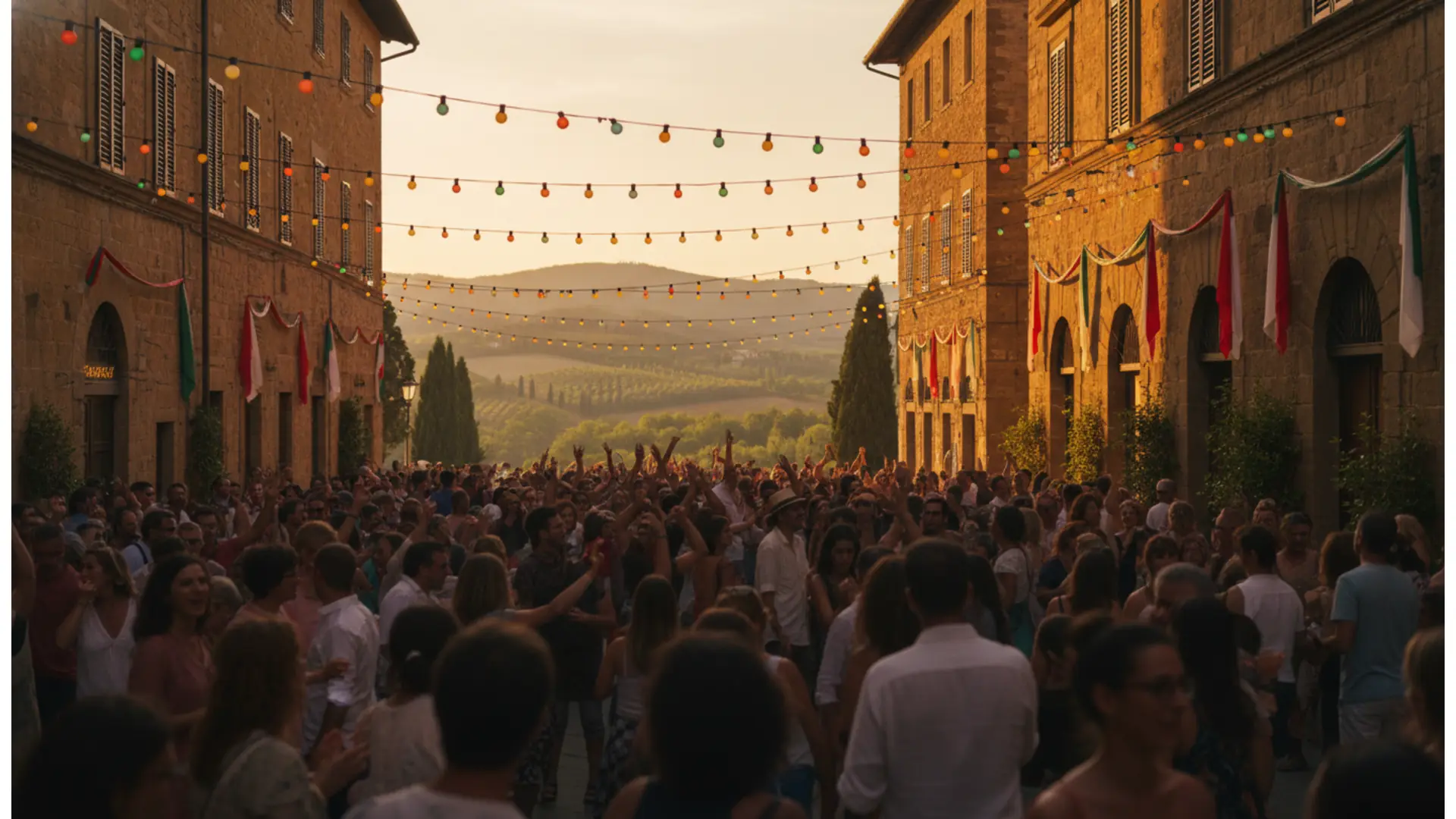
- Streets and squares of the historic center decorated for the feast
- An evening of social gathering in the square, open to everyone
The detailed program, including mass and procession times and any civil events, is released each year close to the date by the Santa Maria Maggiore Parish and the Municipality of Sant'Arsenio: it is therefore advisable to check official channels in the days leading up to the event.
A historic center with an unusual layout
Those arriving for the festival discover a settlement different from other Vallo di Diano villages: between the 16th and 19th centuries, Sant'Arsenio developed according to a regular plan, with parallel and orthogonal streets and noble palaces featuring carved stone portals. The origins of the center likely date back to the 9th century, within the Byzantine sphere, while a 1136 document links it to the State of Diano; the fiefdom later passed through the hands of noble families such as the Guarna and the Sanseverino until the abolition of feudalism. In addition to the collegiate church, the village preserves the Church of the Annunziata, with a 16th-century Flemish panel of the Madonna of the Rosary, the Sanctuary of Monte Carmelo, and the churches of Saint Sebastian and Saint Roch.
Other local traditions
The patronal feast effectively opens the season of summer traditions in the municipality, nestled in the territory of the Cilento, Vallo di Diano and Alburni National Park, a UNESCO World Heritage site:
- Saint Anne, co-patron of the village, celebrated at the end of July
- Pizziddo Santarsenese Festival, dedicated to a typical local dish, in early July
- Re-enactment of the deeds of the brigand Tittariello, in August
- Feast of the Madonna of Mount Carmel, with a pilgrimage to the Monte Carmelo sanctuary, in September
Why it's worth the trip
For those visiting inland Campania, the Patronal Feast is the best opportunity to see the Vallo di Diano off the beaten tourist path: a mountain village that tells its story through its devotion, the art of a great Neapolitan sculptor, and the simple hospitality of the province of Salerno. The day can easily be combined with a visit to the nearby Certosa di Padula or the villages of Teggiano and Polla, all just a few kilometers away.
Patron Saint Feast — edition 2026
2026 Edition: information not yet official
At the time of writing this entry, neither the Municipality of Sant'Arsenio nor the Santa Maria Maggiore Parish have released the dates and program for the 2026 Patron Saint Feast. The events section of the municipal website does not list any appointments on the calendar.
The reference remains the liturgical recurrence of Arsenius the Great, set for July 19th, around which the Vallo di Diano village usually organizes its celebrations: holy masses in the collegiate church and a procession with the 18th-century wooden bust by Giacomo Colombo through the streets of the historic center.
As soon as the program is published, we will update this page with times, locations, and appointments. For direct information, you can contact the Municipality at +39 0975 398033.
Prices Patron Saint Feast 2026
Practical information — Patron Saint Feast
Getting there
By car: A2 del Mediterraneo motorway, take the Atena Lucana or Polla exits, then follow local roads towards Sant'Arsenio. The village is approximately 76 km from Salerno and 180 km from Naples.
By public transport: The reference railway stations are Salerno and Battipaglia, connected to the Vallo di Diano by regional bus lines; from there, continue by bus to Polla and neighboring towns.
Parking
During festival days, the historic center may be closed to traffic for the procession: it is advisable to leave your car in parking spaces along the access roads to the village and continue on foot.
Costs
Free entry to all celebrations and social events in the square.
Contacts and information
Municipality of Sant'Arsenio, tel. +39 0975 398033 — official website www.comune.santarsenio.sa.it. For mass and procession times, please refer to the Santa Maria Maggiore Parish.
Tips
The celebrations take place in mid-summer: bring light but respectful clothing for entering the church, and comfortable shoes for following the procession on the village's sloping streets.
Festival-goer photos
No photos yet. Share yours!
Share your photos
5 photos max, 5 MB per photo (JPG, PNG, WebP)
Noticed an error or missing information?
Help us keep this listing up to date. Every proposal is verified by our team before publication.
Festival-goer reviews
No rating yet — be the first!
No comments yet. Be the first!
Were you there?
Share your experience with the community.
Published by Valentin Contard, festival listings writer. Reviewed, corrected and approved by Christophe Contard, editor-in-chief. .
Where does it take place — Patron Saint Feast
Chiesa collegiata di Santa Maria Maggiore e centro storico
Via Antonio Cafaro, 84037 Sant'Arsenio