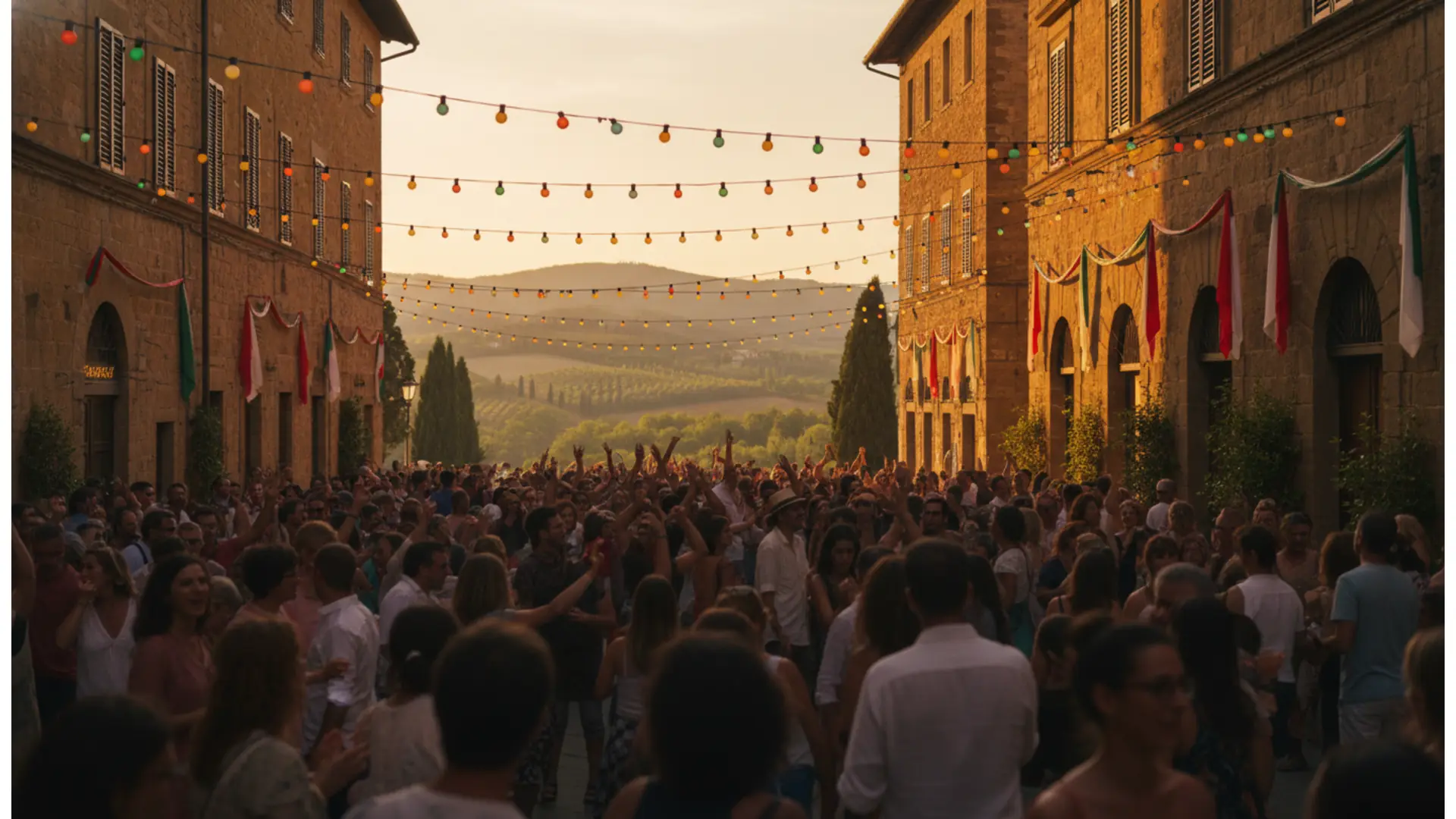
Calendimaggio (Kalènnemàju) and Vertuti Festival
The May Day propitiatory rite and the legume and cereal soup in the Turano Valley
About Calendimaggio and Vertuti Festival
An archaic rite in the heart of Sabina
The Calendimaggio, known in the local dialect of Paganico Sabino as Kalènnemàju, is one of the most unique folk traditions in the province of Rieti and the entire Lazio region. Every May 1st, this small village overlooking the Turano Valley, surrounded by woods and chestnut groves, renews a propitiatory gesture rooted in peasant culture and the cult of the May Calends, when the return of spring was welcomed as a true rebirth after the harshness of winter.
The gesture and the formula
The central moment is disarmingly simple, which is exactly why it strikes those witnessing it for the first time. The inhabitants, strictly on an empty stomach, dip three walnut kernels into a glass of wine while reciting the dialect formula "San Félìppu e Jàku, faccio a Kalènnemàju, se mòro affonno, se nò ritorno", an invocation to Saints Philip and James, whose feast day traditionally fell around this time. If the kernels float, the year will be favorable for the harvest; if they sink, the omen is less benevolent. It is a small domestic oracle that every family has repeated for generations, which the local Pro Loco has successfully brought into the collective dimension of the festival.
The Vertuti Festival
Once the rite is over, the day naturally shifts to the table. The vertuti are a humble yet sophisticated soup, created to use up the last supplies of the winter pantry before the new agricultural cycle: beans, chickpeas, fava beans, wheat, and corn cooked slowly, seasoned with wild thyme gathered on the surrounding slopes, and finished with Sabina extra virgin olive oil, one of the oldest denominations in Italy. Alongside the soup, the menu offers macaroni with tomato sauce, grilled sausages, bruschetta, and local wine, served under the covered area set up for the occasion.
Exhibitions, village, and views
The festival goes beyond gastronomy. From the morning, the Sala San Nicola hosts permanent exhibitions dedicated to Peasant Civilization Tools and Sacred Furnishings, concrete testimonies of a rural world that has not yet entirely disappeared here. A walk through the historic center leads to the Torre Portaia and the Belvedere della Rocca, from which the view embraces Lake Turano and the surrounding mountains, while the churches of Santa Maria dell'Annunciazione, San Nicola, and San Giovanni Battista complete the visit to the village. Local producers' stalls offer cheeses, cured meats, honey, and oil from the valley.
A community-built festival
The organization is entirely handled by the Pro Loco of Paganico Sabino, officially founded in 1981 and active continuously since 1991: by 2012, the event had already seen twenty-two editions, making it one of the longest-running and most defining events for the Municipality of Paganico Sabino. The same association manages other popular initiatives throughout the year, from the Sagne Strasciate Festival to the autumn Chestnut Festival, as well as nature excursions, concerts, and local publications. In recent years, the festival has adopted a plastic-free policy to minimize waste production.
Why it's worth the trip
In just over an hour from Rome, you arrive in a village of a few dozen inhabitants where a peasant tradition is still practiced, not reconstructed for visitors. This is what makes the Paganico Calendimaggio different from more spectacular re-enactments: the welcome is familiar, the pace is the slow one of the Turano Valley, and the festival maintains the scale of a community celebrating itself and its land.
Calendimaggio and Vertuti Festival — edition 2026
2026 Edition
On May 1st, 2026, Paganico Sabino renewed its appointment with the Kalènnemàju and the Vertuti Festival, in a day marked by precise schedules and a participation that brings visitors from Rome and all over Sabina to the small village near Rieti every year. The Pro Loco confirmed the consolidated formula, with the propitiatory rite at noon and the long afternoon banquet.
The permanent exhibitions set up in the Sala San Nicola reopened in the morning, while the free shuttle bus service from the parking lot in the valley ensured access to the historic center. In the afternoon, live musical performances accompanied the tastings and the visit to the Belvedere della Rocca.
Programme Calendimaggio and Vertuti Festival 2026
Program for Friday, May 1st, 2026
- 11:00 AM — Opening of the permanent exhibitions "Peasant Civilization Tools" and "Sacred Furnishings" at the Sala San Nicola
- 11:30 AM — Calendimaggio (Kalènnemàju) rite: dipping of the three walnut kernels in wine with the recitation of the dialect formula "San Félìppu e Jàku, faccio a Kalènnemàju, se mòro affonno, se nò ritorno"
- 12:30 PM — Opening of the Vertuti Festival and start of tastings: legume and cereal soup with wild thyme, macaroni with tomato sauce, sausages, bruschetta, and local wine
- Afternoon — Live music, local product stalls, panoramic route from Torre Portaia to the Belvedere della Rocca
The free shuttle bus service from the parking lot is active all day.
Highlights Calendimaggio and Vertuti Festival 2026
- The Kalènnemàju propitiatory rite at 11:30 AM, with walnut kernels dipped in wine on an empty stomach
- The Vertuti soup: beans, chickpeas, fava beans, wheat, and corn with wild thyme and Sabina oil
- The peasant civilization and sacred furnishings exhibitions in the Sala San Nicola
- The view over the Turano Valley from the Belvedere della Rocca
- Free shuttle bus and plastic-free event
Prices Calendimaggio and Vertuti Festival 2026
Practical information — Calendimaggio and Vertuti Festival
How to get there
Paganico Sabino is located in the Turano Valley, in the province of Rieti, about 70 km from Rome. By car: A24 Rome-L'Aquila, exit at Carsoli-Oricola or Vicovaro-Mandela, then follow provincial roads towards Lake Turano. From Rieti, take the SS578 Salaria per l'Adriatico towards Turano. There is no train station in the village: the nearest useful station is Mandela-Sambuci on the Rome-Pescara line, from which you must continue by car.
Parking and shuttle
The historic center is a limited traffic zone during the festival. A parking lot is set up in the valley with a free shuttle bus service to the village.
Hours and costs
The event takes place on May 1st. Admission to the village, the exhibitions, and the Calendimaggio rite is free; tastings at the Vertuti Festival are paid for by consumption with tickets at the food stands, at popular prices.
Tips
Bring comfortable shoes: the village is on a slope and the path to the Belvedere della Rocca includes uphill sections. For updated information, contact the Pro Loco at [email protected] or check the Pro Loco Paganico Sabino Facebook page.
Festival-goer photos
No photos yet. Share yours!
Share your photos
5 photos max, 5 MB per photo (JPG, PNG, WebP)
Noticed an error or missing information?
Help us keep this listing up to date. Every proposal is verified by our team before publication.
Festival-goer reviews
No rating yet — be the first!
No comments yet. Be the first!
Were you there?
Share your experience with the community.
Published by Valentin Contard, festival listings writer. Reviewed, corrected and approved by Christophe Contard, editor-in-chief. .
Where does it take place — Calendimaggio and Vertuti Festival
Centro storico di Paganico Sabino