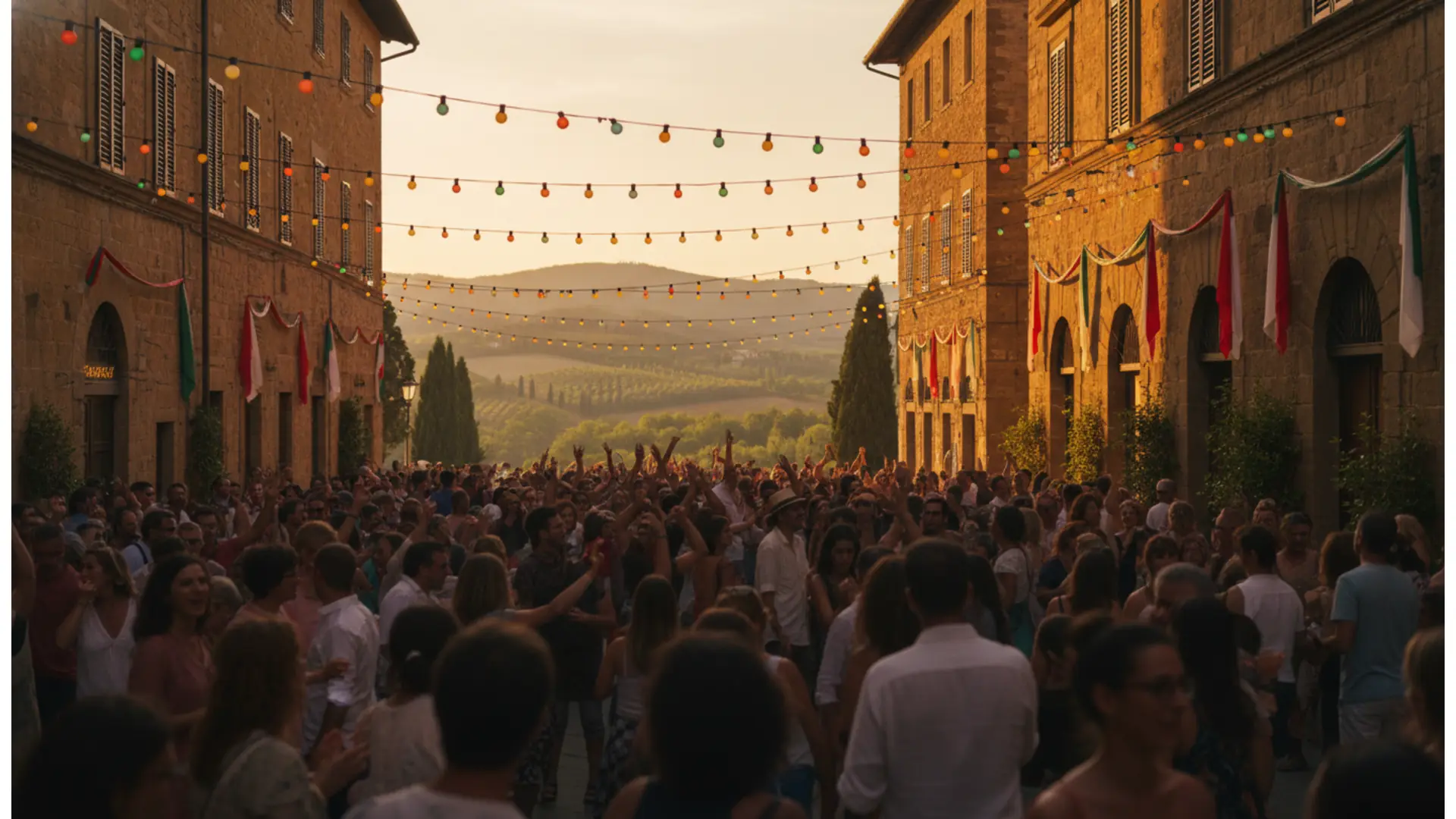
Astronomy and Cinema under the Stars - Parco Salvador Allende
Astronomy outreach and free film screenings at Parco Allende in Tor Vergata
About Astronomy and Cinema under the Stars
A neighborhood park that becomes an observatory
Parco Salvador Allende, in the Tor Vergata neighborhood of Rome, is not a place you would expect to find in the capital's tourist guides. It is a local green space, frequented by residents, at the southeastern edge of the city, in the territory of the Metropolitan City of Rome Capital, in Lazio. For two Saturdays in July, however, this ordinary space is transformed: telescopes pointed at the Sun, tables with experiments, and a screen that lights up when evening falls. This is the idea behind Astronomy and Cinema under the Stars, a free scientific outreach program designed for the whole family.
Who is behind it
The initiative was born from the researchers of Jam of Science, a group dedicated to bringing research out of academic settings, in collaboration with the Orizzonte Nuova Tor Vergata association, the Alphio association, and INAF – National Institute for Astrophysics. The presence of INAF is no coincidence: the Tor Vergata quadrant has hosted a major scientific and university hub for decades, and the festival also serves to build a bridge between that world and the surrounding neighborhood.
How a day works
The rhythm is always the same and begins early, while there is still light. From 6:30 PM, the park fills with activities: the Sun is observed with telescopes equipped with special filters, instruments that allow you to see details of our star's surface normally invisible to the naked eye — spots, prominences, and photospheric granulation. Alongside the telescopes, there are thematic games for children, interactive workshops, and, on one of the two evenings, a real mini science fair with stands and exhibits distributed among the park's trees.
At 9:00 PM, the lights go down and the screening begins. The films chosen are never random: they are space-themed movies that offer a pretext to talk about science, and in some cases, the viewing is preceded or accompanied by an in-depth discussion where researchers comment on what is real and what is narrative license in what is seen on screen.
Cinema that becomes a lesson
This formula — entertainment plus scientific commentary — is the hallmark of the event. An animated film can open a discussion on waste and planetary sustainability; a science fiction film set on Mars becomes an opportunity to explain how space exploration really works, what missions are underway, and what we know today about the Red Planet. The audience is not expected to listen passively: questions are welcome, and researchers remain available before and after the screening.
An event for families
The festival is explicitly designed for families with children. The afternoon activities have a playful and participatory tone, while the evening time of the screening allows even the little ones to stay until the end. The screenings are in Italian with English subtitles, a choice that makes the events accessible even to the foreign residents of the quadrant, who are numerous in a university area like this.
Free and local
All activities are completely free. For some specific initiatives, particularly games dedicated to children, prior registration via an online form may be required, given the limited number of spots. There are no tickets, there is no box office: you arrive, find a spot on the lawn, and participate. It is a zero-cost outreach model for the public that has a long tradition in Rome, linked to the 'Estate Romana' season and the numerous open-air arenas that animate the city's parks and squares from June to September.
Why it's worth going
Those looking for a big, spectacular event will find flashier options elsewhere in the capital. Here, the value lies in something else: the concrete possibility of looking at the Sun through a professional telescope, asking an astrophysicist a question and getting an answer, and seeing a child get curious in front of an experiment. All this in a neighborhood park, in the evening, without paying anything. It is science communication done well, in a simple format that works.
Astronomy and Cinema under the Stars — edition 2026
Two Saturdays between science and the screen
The 2026 edition was divided into two events, both at Parco Salvador Allende in Tor Vergata, Rome, with the same format: outreach activities from late afternoon and a screening at 9:00 PM.
Saturday, July 11
Opening at 6:30 PM with a Wall-E themed game for children, for which registration via an online form was required. During the afternoon, young researchers guided the public in observing the Sun through a telescope equipped with a special filter, capable of showing extraordinary details of our star's surface. At 9:00 PM, the screening of the animated film Wall-E.
Saturday, July 18
The second event expanded with a mini science fair: from 6:30 PM, stands and exhibits were distributed in the park, interactive workshops for children, new solar observations with telescopes, and the opportunity to meet the researchers directly. At 9:00 PM, the screening of The Martian by Ridley Scott, preceded by an in-depth moment where researchers commented on the scientific aspects of the film, distinguishing between what is realistic and what belongs to narrative license.
Access
Entrance to the park from via Marcello Gallian 75. All activities were free; screenings were in Italian with English subtitles.
Programme Astronomy and Cinema under the Stars 2026
Saturday, July 11, 2026
- From 6:30 PM — Wall-E themed game for children (registration via online form, limited spots)
- Afternoon — Solar observations with special filter telescope, guided by young researchers
- 9:00 PM — Screening of the animated film Wall-E
Saturday, July 18, 2026
- From 6:30 PM — Mini science fair: stands and exhibits distributed in the park, meeting with researchers
- From 6:30 PM — Interactive workshops for children
- Afternoon — Solar observations with telescopes
- 9:00 PM — Scientific in-depth session by researchers, followed by the screening of The Martian by Ridley Scott
Screenings in Italian with English subtitles. Entrance to the park from via Marcello Gallian 75, Tor Vergata, Rome.
Highlights Astronomy and Cinema under the Stars 2026
- Observation of the Sun with professional telescopes equipped with special filters
- Mini science fair with stands, exhibits, and interactive workshops in the park
- Screening of Wall-E (July 11) and The Martian by Ridley Scott (July 18)
- Scientific commentary by researchers alongside the screening
- Presence of INAF – National Institute for Astrophysics and Jam of Science researchers
- All activities completely free, designed for families
Prices Astronomy and Cinema under the Stars 2026
Practical information — Astronomy and Cinema under the Stars
Where
Parco Salvador Allende, entrance at via Marcello Gallian 75, Tor Vergata neighborhood, Rome (ZIP 00133). The green area is located in the southeast quadrant of the city, near the Tor Vergata university campus.
How to get there
By car: exit the Grande Raccordo Anulare towards Tor Vergata / via di Tor Vergata; street parking in the surrounding streets.
By public transport: Metro A to Anagnina, then city buses towards Tor Vergata / Torre Angela. Alternatively, Torre Angela train station on Metro line C with a bus connection.
Costs
Admission and activities are free. For games dedicated to children, registration via an online form may be required, subject to availability.
Tips
Bring a blanket or a folding chair for the evening screening, water, and mosquito repellent. Arriving around 6:30 PM allows you to also follow the solar observations and workshops, which are the most interesting part for children.
Information
Updates on dates and the program are shared through the social media pages of the neighborhood and the Nuova Tor Vergata committee.
Festival-goer photos
No photos yet. Share yours!
Share your photos
5 photos max, 5 MB per photo (JPG, PNG, WebP)
Noticed an error or missing information?
Help us keep this listing up to date. Every proposal is verified by our team before publication.
Festival-goer reviews
No rating yet — be the first!
No comments yet. Be the first!
Were you there?
Share your experience with the community.
Published by Valentin Contard, festival listings writer. Reviewed, corrected and approved by Christophe Contard, editor-in-chief. .
Where does it take place — Astronomy and Cinema under the Stars
Parco Salvador Allende (Tor Vergata)
Via Marcello Gallian 75, 00133 Roma