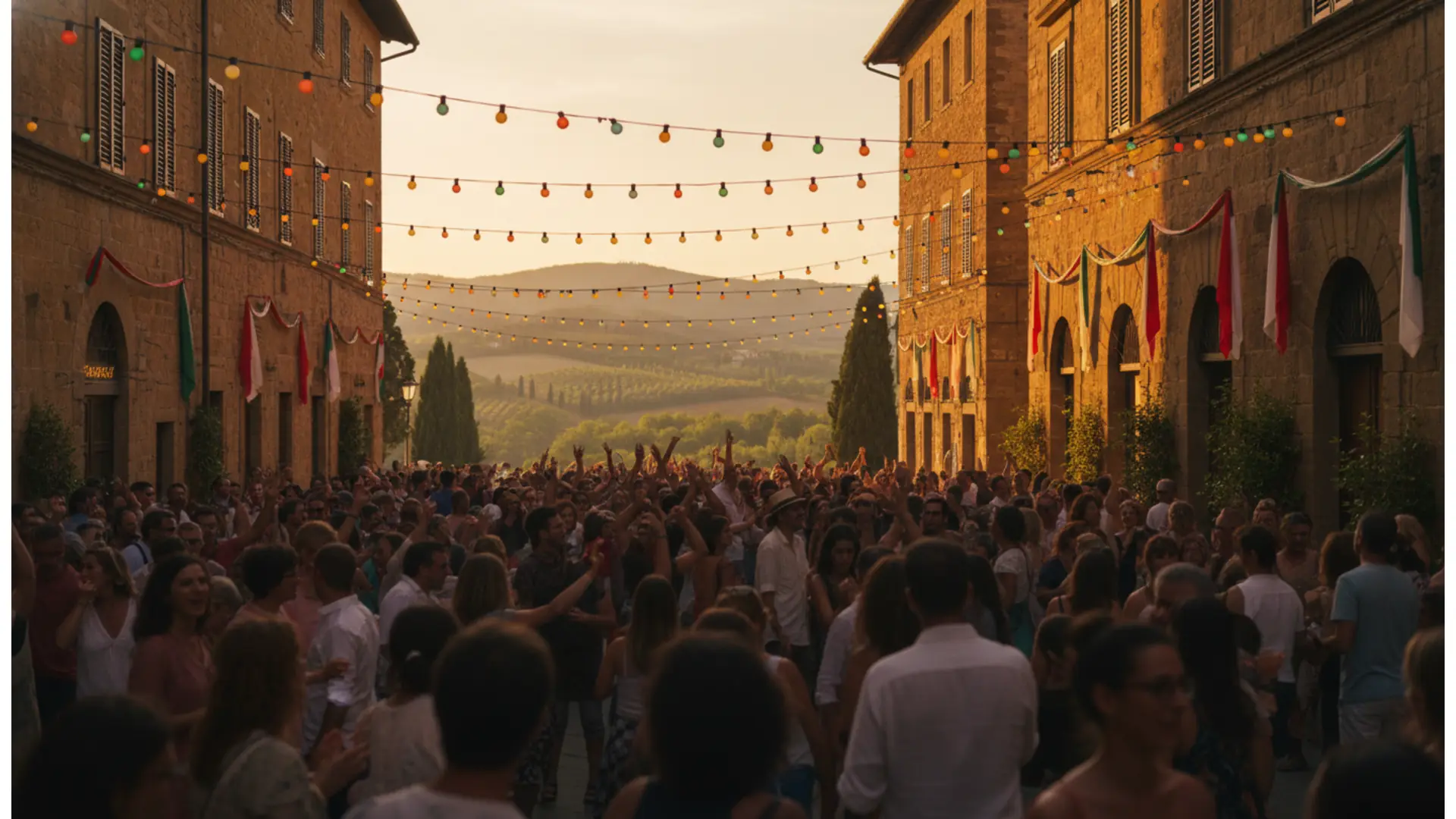
SS. Crocifisso Festival of Cesano di Roma (Palio dei Rioni)
The medieval village of Cesano returns to the 16th century with a historical pageant, the Palio dei Rioni, and popular devotion
Edition 2026 not confirmed to date
This edition has not been confirmed by the organiser to date. We recommend checking before going.
About SS. Crocifisso Festival of Cesano
A festival spanning over five centuries
The SS. Crocifisso Festival of Cesano di Roma is one of the oldest and most deeply rooted popular celebrations in Lazio. Its origins date back to 1508, the year when, according to tradition, a wooden Crucifix believed to be miraculous was discovered in the village. Since then, the community of Cesano has renewed its vow of devotion every year around the feast of the Exaltation of the Holy Cross on September 14th. In its modern form—featuring a historical pageant, the Palio, and various shows—the event was revived in the 1980s by local residents and is organized by the Pro Loco Massa Cesana in collaboration with the San Giovanni Battista parish.
Where it takes place: Cesano, Rome's hidden village
Cesano is a district of the Municipality of Rome (15th Municipality), in the Metropolitan City of Rome Capital, in Lazio. It is a medieval village with a castle layout overlooking the countryside north of the capital, nestled between Lake Martignano, the archaeological area of Veii, and the Via Francigena. Visitors arriving from the center of Rome discover an unexpected landscape of stone alleys, Renaissance palaces once owned by the Orsini, Chigi, and Sili families, and a church housing paintings from the 15th and 16th centuries. It is in this authentic setting, rather than a stage set for the occasion, that the festival comes to life.
The historical pageant in costume
The most iconic moment of the event is the historical pageant in medieval costume, a four-kilometer procession that accompanies the Crucifix to the village. Guards in armor, drummers, flag-wavers, noblewomen, and commoners parade through the streets; the participants are not professionals but local residents who sew and preserve their own costumes every year. Upon arrival, the Crucifix is displayed in front of the church, and a solemn mass is held outdoors in the square, gathering the entire community.
The Palio dei Rioni
The secular and most festive heart of the event is the Palio dei Rioni, which pits the village's historic districts—such as Borgo, Fontebacco, Gufi, and San Sebastiano—against each other in a series of medieval-inspired games and popular challenges. Teams compete before a loud and enthusiastic crowd, with district flags and colors displayed from windows throughout the festival. In richer editions, the Palio is accompanied by equestrian performances by the 'butteri', the traditional herdsmen of the Roman countryside, recalling the region's agro-pastoral heritage.
Fraschette, crafts, and street performances
Throughout the festival, the village fills with fraschette—traditional temporary taverns of the Lazio region—where visitors can sample Roman cuisine and products from the surrounding countryside: homemade pasta, porchetta, cheeses, and local wines. Along the alleys, you will find craft stalls, displays of ancient work tools, and demonstrations of traditional trades, while the evenings are dedicated to live music, marching bands, jesters, acrobats, jugglers, comedy shows, and concerts in the square.
The philatelic cancellation and the village's memory
In recent years, the festival has gained a documentary and civic dimension: Poste Italiane has created a special postal cancellation dedicated to Cesano, presented during the event alongside commemorative postcards and a conference on the history of the village, its Crucifix, and the local postal service. These initiatives perfectly capture the spirit of the festival: it is not just a local fair, but an opportunity for a community of a few thousand people to tell and defend their identity within an enormous metropolis.
Why it's worth the trip
- One of the few authentic historical re-enactments within the municipal territory of Rome.
- A genuinely rustic atmosphere, far removed from the capital's tourist circuits.
- Popular gastronomy at affordable prices, served by the village's traditional taverns.
- A medieval village and the Via Francigena to explore in a day, less than thirty kilometers from the center of Rome.
SS. Crocifisso Festival of Cesano — edition 2026
2026 SS. Crocifisso Festival in Cesano di Roma
In 2026, the village of Cesano, in the 15th Municipality of the Municipality of Rome (Lazio), prepares to renew its devotion to the wooden Crucifix discovered in 1508. The event traditionally takes place on the weekend around September 14th, the day of the Exaltation of the Holy Cross.
The festival's structure remains unchanged: the historical pageant in medieval costume traveling about four kilometers to the village, with guards in armor, drummers, and flag-wavers; the display of the Crucifix in front of the Church of San Giovanni Battista and the solemn mass celebrated in the square; the Palio dei Rioni challenges between the historic districts of Cesano; and the 'fraschette' and food stands along the alleys, craft exhibitors, and evenings of live music and street performances.
Information to be verified
At the time of writing, the organization has not released an official program for 2026, and the village's historical website is no longer updated. The dates indicated are therefore indicative and must be confirmed with the Pro Loco Massa Cesana, which manages the event together with the local parish.
Programme SS. Crocifisso Festival of Cesano 2026
Highlights SS. Crocifisso Festival of Cesano 2026
- Historical pageant in medieval costume (approx. 4 km)
- Display of the 1508 wooden Crucifix and solemn mass in the square
- Palio dei Rioni between the historic districts of Cesano
- 'Fraschette' taverns and Roman countryside cuisine
- Live music, jesters, acrobats, and street performances
Prices SS. Crocifisso Festival of Cesano 2026
Practical information — SS. Crocifisso Festival of Cesano
How to get there
By train: the Cesano di Roma station is served by the FL3 Roma Ostiense–Viterbo line, with frequent connections from Roma San Pietro, Valle Aurelia, and Roma Ostiense; from the station, the village can be reached in a few minutes. By car: take the Cassia bis (SS2 bis Veientana) and exit at Cesano, or take the Via Braccianese; parking is available in areas outside the village, which is largely closed to traffic during the festival.
Admission and costs
Access to the festival, the historical pageant, and the Palio dei Rioni challenges is free. Only food and drinks at the 'fraschette' and food stands are paid, with popular prices.
Tips
The village is made of stone and is slightly uphill: comfortable shoes are recommended. September evenings can be cool. For updated dates and programs, it is best to follow the channels of the Pro Loco Massa Cesana, which publishes the final program in the weeks leading up to the event.
Festival-goer photos
No photos yet. Share yours!
Share your photos
5 photos max, 5 MB per photo (JPG, PNG, WebP)
Noticed an error or missing information?
Help us keep this listing up to date. Every proposal is verified by our team before publication.
Festival-goer reviews
No rating yet — be the first!
No comments yet. Be the first!
Were you there?
Share your experience with the community.
Published by Valentin Contard, festival listings writer. Reviewed, corrected and approved by Christophe Contard, editor-in-chief. .
Where does it take place — SS. Crocifisso Festival of Cesano
Borgo medievale di Cesano di Roma
Borgo di Cesano, Piazza della Chiesa, 00060 Roma