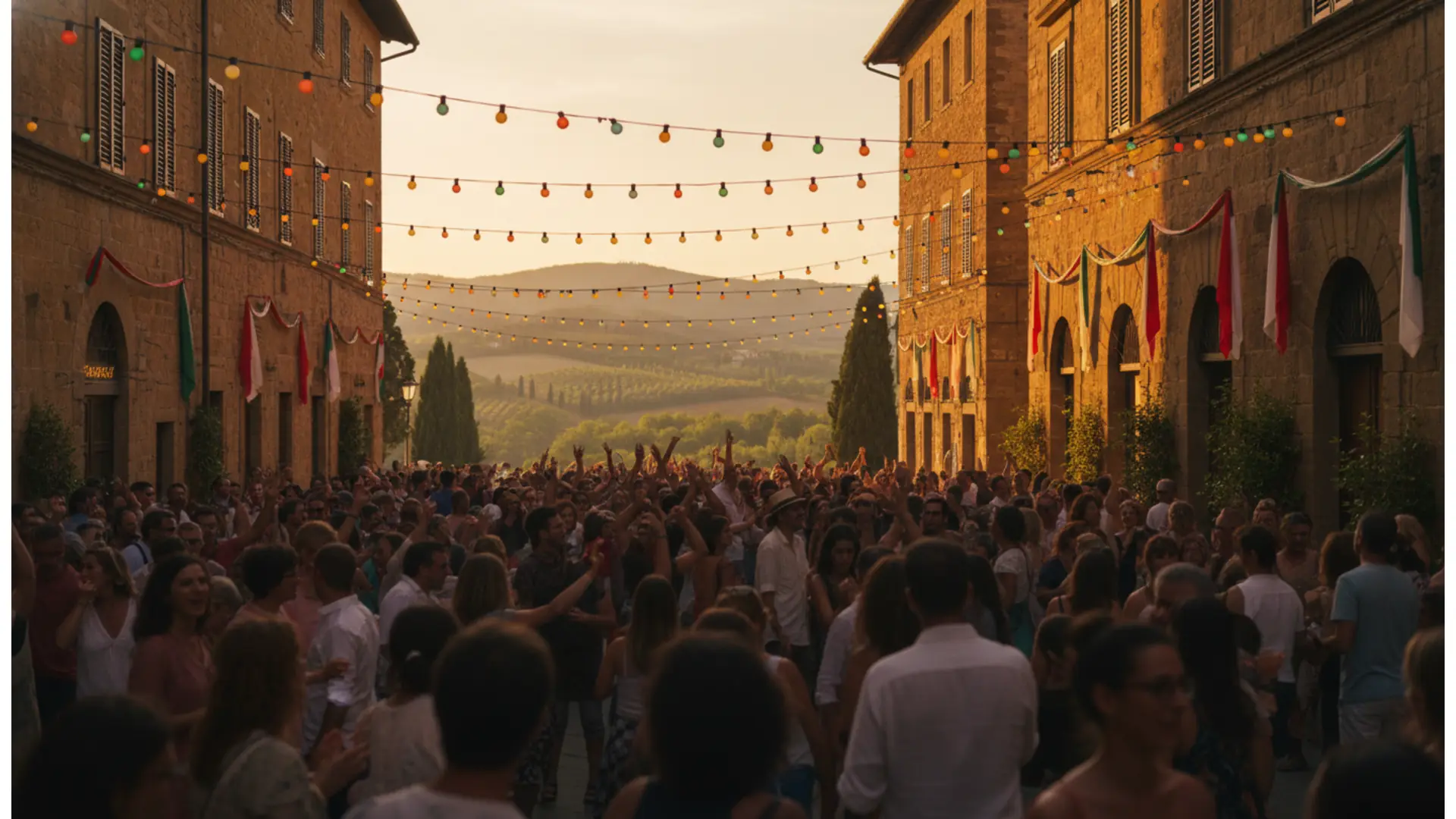
Sant'Ermete Patronal Festival (with the Giostra del Gallinaccio and Historical Pageant)
Devotion, historical pageantry, and the Giostra del Gallinaccio in the Farnese village of Alta Tuscia
Edition 2026 not confirmed to date
This edition has not been confirmed by the organiser to date. We recommend checking before going.
About Sant'Ermete Festival
A patronal festival that also honors the memory of the Duchy of Castro
In the municipality of Ischia di Castro, a village in the Alta Tuscia area of the Viterbo province in northern Lazio, the final days of August belong to Saint Hermes the Martyr, the town's patron saint. The festival is more than just a religious appointment: it is the moment the community re-enacts its historical identity, that of a territory which was once the heart of the Farnese Duchy of Castro, the fiefdom erased in 1649 by the destruction of the city of Castro. Hence the blend, typical of this corner of Tuscia, between popular devotion and historical re-enactment.
The festival calendar
The festivities traditionally take place from August 27th to 31st, with the saint's day set for August 28th. The evening of the 27th opens with the solemn procession: the statue of Saint Hermes is carried through the streets of the historic center by the Sacred Images Bearers Group, accompanied by the Ischia di Castro Marching Band. It is the most intimate moment, when the village lights up and fills with families who have returned home for the occasion.
On August 28th, in the Parish Church of Saint Hermes the Martyr—a medieval building consecrated in 1286 and rebuilt between 1759 and 1766—the solemn mass is celebrated in honor of the patron saint, concluding with the blessing of the Palio and the knights who will compete in the joust in the afternoon.
The Giostra del Gallinaccio
This is the secular heart of the festival. On the afternoon of August 28th, the historical pageant begins: twenty knights in the historical uniforms of the Duchy of Castro and as many participants wearing the colors of the five districts parade through the town to the main square, where the Giostra del Gallinaccio is held. Each district competes to win the Palio, a banner painted each year by a local artist.
The tradition is rooted in ancient imagery: according to local lore, the rooster was a symbol of evil, and the annual jousting ritual served to prevent its return. Saint Hermes, according to legend, was a Roman centurion who converted to Christianity and was martyred for his faith. Today, the joust is organized in collaboration with the Duchy of Castro Knights Association, which oversees the philological reconstruction of costumes and tack.
The medieval encampment and evening events
From 9:00 PM on August 28th, the historic center transforms into a medieval village: encampments, taverns serving period cuisine, traditional crafts, and trades, all set against the backdrop of the Farnese fortress attributed to Antonio da Sangallo the Younger. The following evenings feature a mix of traditional games, a mechanical bull for the younger crowd, local horse races organized by the municipality, and free open-air concerts, which over the years have hosted folk groups, religious-inspired singer-songwriters like Don Giosy Cento and the Parsifal, Roman street singers, and local pop bands.
Organizers
- Municipality of Ischia di Castro — general coordination and horse races
- Pro Loco — hospitality and entertainment
- Festivities Committee '74 — civil program, Palio, and musical evenings
- Duchy of Castro Knights Association — historical pageant, joust, and medieval encampment
Why it's worth the trip
Ischia di Castro is one of the lesser-traveled destinations in Alta Tuscia: we are just a few kilometers from Lake Bolsena, the Selva del Lamone Nature Reserve, and the ruins of the lost city of Castro. Arriving here at the end of August means experiencing a genuine festival, not one built for tourism, where the audience is not just a spectator but part of the village. Admission to all events is free.
Sant'Ermete Festival — edition 2026
2026 Edition
The patronal festival of Saint Hermes returns to Ischia di Castro, in the Viterbo Tuscia, around the liturgical date of August 28th. As per established tradition, the festivities are expected to span five days, from the opening procession to the highlight of the patron saint's day, through to the musical evenings and horse races.
The Municipality of Ischia di Castro, together with the Pro Loco, the Festivities Committee '74, and the Duchy of Castro Knights Association, typically publishes the full program in the weeks immediately preceding the festival. As of the update date of this page, the official 2026 calendar and poster are not yet online: it is recommended to check with the Municipality or the Pro Loco channels before planning your trip.
Programme Sant'Ermete Festival 2026
Highlights Sant'Ermete Festival 2026
- Giostra del Gallinaccio: the challenge between the five districts for the Palio
- Historical pageant with forty participants in Duchy of Castro costumes
- Evening procession of the patron saint with the marching band
- Medieval encampment and period taverns in the historic center
- Local horse races and free open-air concerts
Prices Sant'Ermete Festival 2026
Practical information — Sant'Ermete Festival
How to get there
By car: from the SS Aurelia, take the Montalto di Castro exit, then the SP road towards Canino and Ischia di Castro (about 30 km); from Viterbo, take the SS Cassia and then the SP Castrense, about 50 km. From Rome, the journey takes about two hours.
By train: Montalto di Castro station on the Rome-Grosseto Tyrrhenian line, then Cotral bus lines towards the inland areas.
Prices
The procession, mass, historical pageant, Giostra del Gallinaccio, traditional games, and evening concerts are free to attend. Food and drinks at the medieval encampment taverns are for purchase; reservations are recommended.
Tips
The historical pageant starts in the late afternoon: arrive at least an hour early to find a spot along the route and parking in the areas outside the historic center. On late August evenings, the temperature drops significantly, so a sweatshirt is recommended. Local accommodation is limited: consider agriturismos in the area, or stays in Canino, Farnese, or on the shores of Lake Bolsena.
Information
Municipality of Ischia di Castro, Via S. Rocco 2 — tel. +39 0761 425455.
Festival-goer photos
No photos yet. Share yours!
Share your photos
5 photos max, 5 MB per photo (JPG, PNG, WebP)
Noticed an error or missing information?
Help us keep this listing up to date. Every proposal is verified by our team before publication.
Festival-goer reviews
No rating yet — be the first!
No comments yet. Be the first!
Were you there?
Share your experience with the community.
Published by Valentin Contard, festival listings writer. Reviewed, corrected and approved by Christophe Contard, editor-in-chief. .
Where does it take place — Sant'Ermete Festival
Centro storico e Chiesa di Sant'Ermete Martire