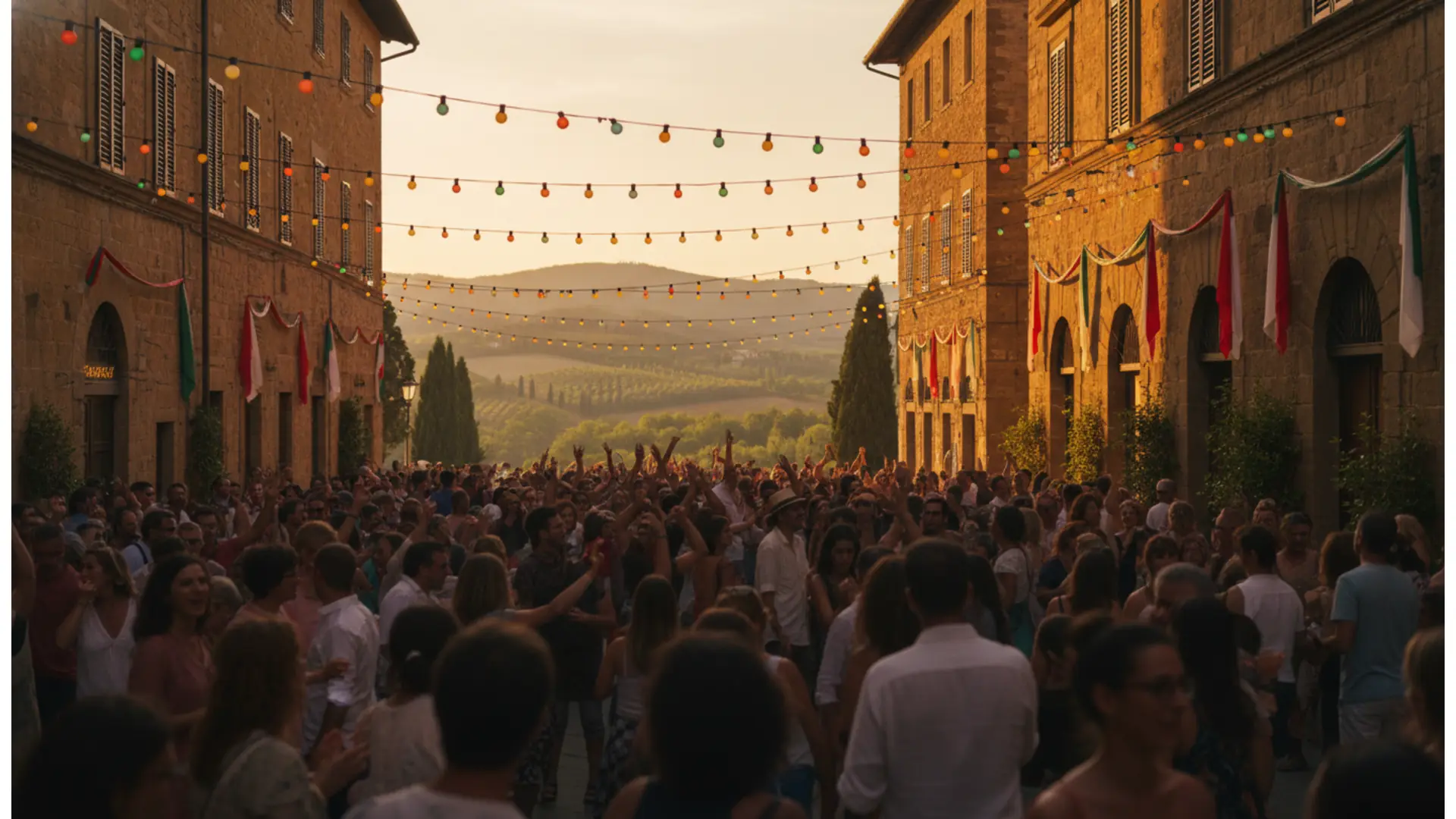
Sant'Agnello Patronal Feast
Guarcino's thousand-year devotion to its patron saint, featuring processions, silver busts, and a pilgrimage to the hermitage in the Ernici Mountains.
About Sant'Agnello Feast
A patron saint from Naples, guarded by the Ernici Mountains
The history of the Sant'Agnello Patronal Feast dates back to the late 6th century, when Agnello the Abbot, a Neapolitan nobleman, fled his city to escape the Lombard invasions and found refuge in a cave on the slopes of Monte Costa dell'Oriola, above present-day Guarcino. According to tradition, he lived there in solitary prayer until the fame of his sanctity and miracles spread even from his isolation. Local inhabitants built a small church and monastery against the rock: this is the Hermitage of Sant'Agnello, which still overlooks the Cosa river valley at an altitude of about 860 meters. Since the 10th century, Agnello has been the town's primary patron saint by popular acclaim.
Three feasts a year, one single saint
Guarcino is one of the few Italian towns to celebrate its patron saint three times a year, each with a distinct significance:
- First Sunday of May — the pilgrimage to the hermitage to invoke a blessing on the fields and the harvest;
- Last Sunday of August — the main feast, the most solemn and well-attended, which the townspeople simply call "the feast";
- December 14 — the winter pilgrimage commemorating the dies natalis of the saint, which was the primary celebration for centuries and declared a holy day of obligation by papal decree in 1911.
The August feast, moved to this date in 1892 (it previously fell in September), is now the most deeply felt: it coincides with the return of emigrants and the period when the village is most vibrant.
The procession and the silver busts
The ritual heart of the feast is the procession. In the days leading up to Sunday, the statue of Sant'Agnello—carved in 1752 and restored in 1812—is carried in a parade from the Church of San Nicola to the hermitage and then brought back to the village. The statue advances surrounded by the silver busts of Guarcino's other patron saints: San Nicola, San Benedetto, San Biagio, Sant'Emilio, San Romolo, and San Francesco di Paola. It is a striking image, unique in the landscape of southern Lazio's patronal feasts, and one of the reasons the event attracts visitors from well beyond the municipal borders.
The Confraternity, a pillar of tradition
For centuries, the organization of the feast has been entrusted to the ancient Confraternity of Sant'Agnello, based in the Church of San Nicola. Reorganized in 1760, the confraternity adopted the habit still worn by its members today: a white sackcloth with a turquoise collar and belt. Its historical duty—collecting funds, overseeing the cult, and organizing the festivities—has never wavered. In recent years, the confraternity has also re-established ties with Pisciotta, in the Cilento region, another center linked to the cult of Sant'Agnello: in May 2026, the two communities reunited for a joint pilgrimage to the hermitage, featuring sacred music concerts and an exchange of gifts.
The village in celebration
Alongside the religious dimension, the August feast is also the great social highlight of the Guarcino summer. The streets of the historic center fill with illuminations, the brass band accompanies the parade and performs in the squares, and stalls offer the products of the Ciociaria: Guarcino prosciutto, amaretti cookies, fresh pasta, and cheeses from the Ernici Mountains. On the preceding Sunday, the town celebrates the co-patron San Rocco, making the final stretch of August a long sequence of celebrations.
Guarcino and the Ciociaria
Located in the province of Frosinone, in Lazio, the Municipality of Guarcino is a medieval village nestled at an altitude of 625 meters, at the foot of the Ernici Mountains and a few kilometers from the Campocatino ski resort. Its historic center, with its stone alleys and Romanesque churches, retains an intimate atmosphere that transforms completely during the festival days. For those visiting the area, the climb to the hermitage along the Via San Luca—about an hour's walk from the village, with two fountains along the way—is an experience worth the trip even outside of festival days.
Sant'Agnello Feast — edition 2026
Sant'Agnello 2026 in Guarcino
The Sant'Agnello Patronal Feast of 2026 centers on Sunday, August 30, the last Sunday of the month. In the preceding days—according to custom, starting from Friday—the statue of the saint is carried in procession from the Church of San Nicola to the Hermitage of Sant'Agnello and brought back to the village, surrounded by the silver busts of San Nicola, San Benedetto, San Biagio, Sant'Emilio, San Romolo, and San Francesco di Paola.
Sunday is dedicated to the solemn Mass and the main procession through the streets of the historic center, with the participation of the Confraternity of Sant'Agnello and the brass band. Alongside the religious aspect are moments of civil celebration: illuminations, concerts in the square, and stalls featuring typical Ciociaria products. On the preceding Sunday, August 23, the town celebrates the co-patron San Rocco.
The 2026 devotional cycle is completed on December 14, with the winter pilgrimage to the hermitage commemorating the saint's death.
Programme Sant'Agnello Feast 2026
2026 Program (traditional structure)
The detailed program for the 2026 edition has not yet been published by the parish and the Confraternity of Sant'Agnello. Based on the established schedule of the feast, the following are expected:
- Friday, August 28 — procession of the statue of Sant'Agnello from the Church of San Nicola to the hermitage and return to the village;
- Saturday, August 29 — evening celebrations and musical moments in the historic center;
- Sunday, August 30 — solemn Mass and main procession with the silver busts of the patron saints, accompanied by the brass band; followed by civil festivities in the square.
Times and details will be released in the weeks prior through the channels of the Confraternity of Sant'Agnello and the Municipality of Guarcino.
Highlights Sant'Agnello Feast 2026
- Procession of the statue of Sant'Agnello surrounded by the silver busts of Guarcino's six patron saints
- The walk to the Hermitage of Sant'Agnello, at 860 meters in the Ernici Mountains
- The Confraternity of Sant'Agnello in historical attire: white sackcloth with turquoise collar and belt
- The brass band and illuminations in the historic center
- Typical Ciociaria products: Guarcino prosciutto, amaretti, Ernici cheeses
Prices Sant'Agnello Feast 2026
Practical information — Sant'Agnello Feast
How to get there
By car: A1 motorway, Anagni-Fiuggi exit, then SR155 and SP towards Guarcino (approx. 25 km). From Rome, it is about 90 km. By train: Frosinone station on the Rome-Naples line via Cassino, then COTRAL bus lines to Guarcino.
Admission and hours
Religious celebrations and the procession are free to attend. The detailed program is released in the weeks prior by the parish and the Confraternity of Sant'Agnello.
Practical tips
For those wishing to hike to the hermitage, wear trekking shoes and bring water: the Via San Luca trail climbs from 625 to 860 meters in about an hour. Parking in the historic center is limited during festival days: it is best to leave your car at the entrance to the village. There is no shortage of agritourisms and accommodations in the surrounding area between Guarcino, Fiuggi, and Vico nel Lazio.
Festival-goer photos
No photos yet. Share yours!
Share your photos
5 photos max, 5 MB per photo (JPG, PNG, WebP)
Noticed an error or missing information?
Help us keep this listing up to date. Every proposal is verified by our team before publication.
Festival-goer reviews
No rating yet — be the first!
No comments yet. Be the first!
Were you there?
Share your experience with the community.
Published by Valentin Contard, festival listings writer. Reviewed, corrected and approved by Christophe Contard, editor-in-chief. .
Where does it take place — Sant'Agnello Feast
Centro storico, Chiesa di San Nicola ed Eremo di Sant'Agnello