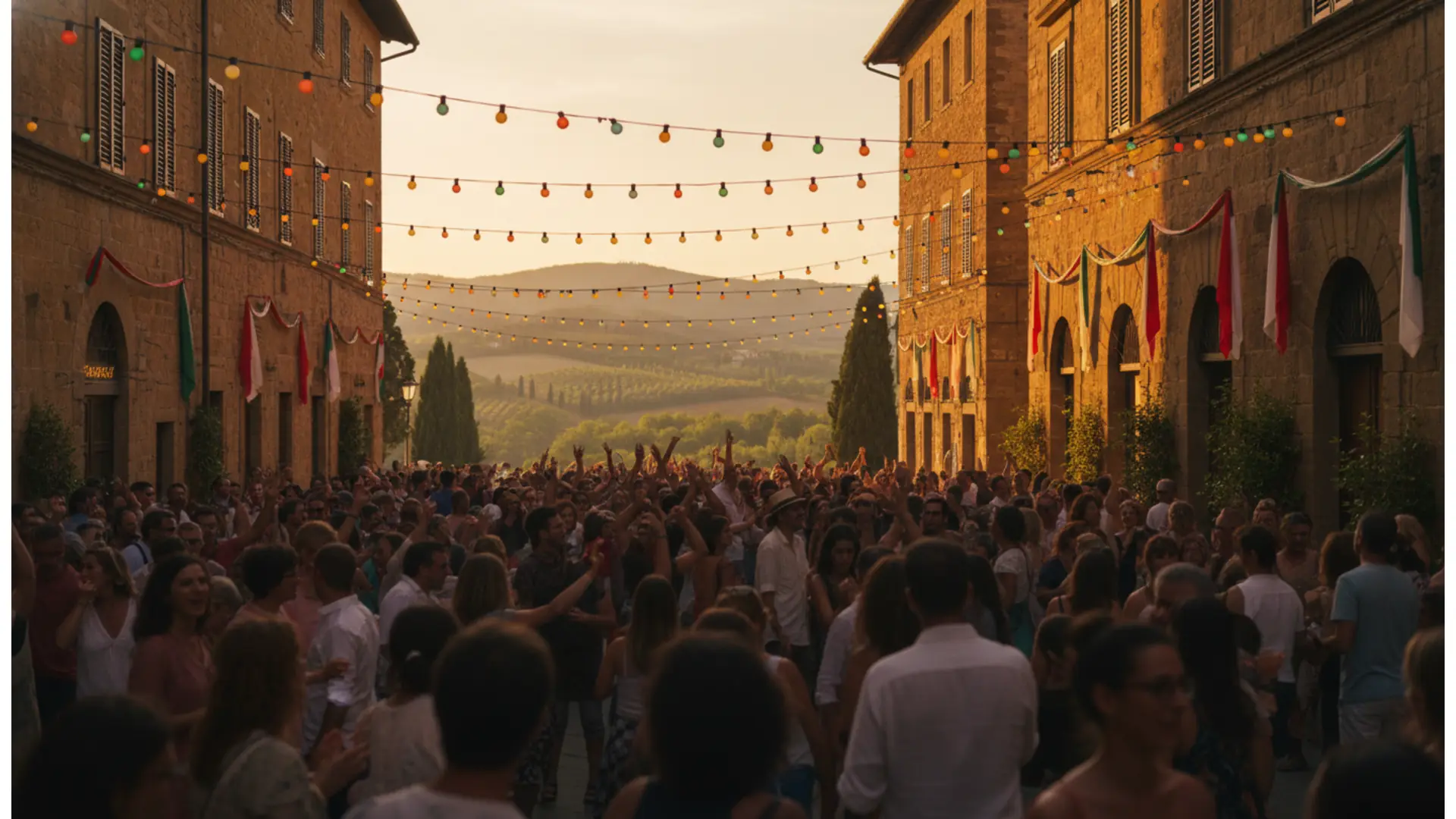
Salento Carnival – The Zeza Comedy
Square quadrilles and the Zeza farce in the heart of Cilento
About Salento Carnival
A rustic Carnival in the heart of Cilento
In Salento, a village of just over 1,700 inhabitants perched at 414 meters above sea level in the province of Salerno, Carnival is not measured in floats or papier-mâché. Here, the festival remains as it has always been: the square filling up, drums marking the rhythm, masks emerging from the alleys of the historic center, and a community finding itself through shared gestures. It is a village Carnival, one of many dotting the Cilento hinterland between Gioi, Sacco, Orria, and Perito, together forming one of the areas richest in Campania's carnival traditions.
The Quadriglia, a 19th-century dance
The beating heart of the event is the Quadriglia, a traditional dance dating back to the 19th century. Couples arrange themselves in the square and move according to figures called out by the dance master, in a sequence of crossings, turns, and partner swaps that require memory, rhythm, and complicity. Dancers wear traditional costumes, and the entire village gathers around the circle.
The Salento Quadriglia is not just a dance; it is a gastronomic celebration. During the Carnival days, traditional Cilento rustic dishes are prepared and shared, and the dance becomes an opportunity to rediscover local culture, where music and food intertwine in an atmosphere of joy and conviviality.
The Zeza comedy
The second major highlight is the commedia della Zeza, which takes place in Salento on Shrove Tuesday. This is a sung and acted farce, widespread throughout Campania and derived from popular masked theater: the plot revolves around Pulcinella's family, his wife Zeza, and their daughter Vicenzella, who is courted by a suitor the father refuses to accept. This leads to a comic, boisterous argument in verse, which the local group performs from square to square, dressed in costume and accompanied by folk instruments.
In Cilento, the Zeza is one of the most ancient and recognizable carnival expressions, shared by Salento with neighboring towns like Sacco. Many Cilento carnivals are now listed in the Inventory of Intangible Cultural Heritage of Campania for their historical and anthropological value.
Agrarian rites and the cycles of the earth
Behind the masks lies a substrate much older than the Christian festival. Like other ritual carnivals in the South, the Salento one has roots in agrarian cults and the cycle of the seasons: the transition from winter to spring, the temporary overturning of social order, and satire against the powerful and family conventions. This is why the Cilento Carnival still retains a power that more spectacular carnivals have lost.
Salento, a village in the Cilento hinterland
The municipality of Salento—not to be confused with the Apulian peninsula of the same name—is located in the Cilento hinterland, a short distance from Vallo della Lucania, and includes the hamlets of Fasana, Maroccia, and Palazza. The village is known for its white fig production and olive oil, and its historic center preserves the church of Santa Barbara with its characteristic bell tower. Surrounding it is the hilly landscape of the Cilento, Vallo di Diano and Alburni National Park.
Why it's worth the trip
- A Quadriglia authentically danced by locals, not performers.
- The commedia della Zeza on Shrove Tuesday, one of the few remaining Cilento versions.
- A free, open-air Carnival, perfect for families.
- Traditional Cilento rustic cuisine shared during the festivities.
- The chance to follow other carnivals in neighboring villages during the same weekend.
Salento Carnival — edition 2026
Salento Carnival 2026
The regional calendar of Campania carnivals included Salento among the events in the province of Salerno with two dates: Sunday, February 15 and Tuesday, February 17, 2026. As per tradition, the first day was dedicated to the Quadriglia danced in the square, with couples taking turns following the dance master's commands before the whole village.
Shrove Tuesday brought the commedia della Zeza to the stage. The local press, in the summary published the day after the festival, noted that «moments dedicated to tradition were experienced in Salento and Sacco, where the Zeza comedy was the protagonist»: the farce in verse of Pulcinella, his wife Zeza, and their daughter Vicenzella thus closed the village Carnival.
Around the two main events, there was no shortage of convivial moments with traditional Cilento rustic dishes, which have always accompanied the Carnival days in Salento.
Programme Salento Carnival 2026
Sunday, February 15, 2026
- Quadriglia in the square: traditional couple's dance in period costumes, led by the dance master's commands.
- Parade of masks through the streets of the town.
- Convivial moments with traditional rustic dishes.
Tuesday, February 17, 2026 – Shrove Tuesday
- Performance of the commedia della Zeza, a popular Campania farce in verse.
- Closing of the Carnival with folk music and dances.
Exact times for individual events were not released by official sources: the events traditionally take place in the afternoon in the village squares.
Highlights Salento Carnival 2026
- Quadriglia danced in the square on Sunday, February 15.
- Commedia della Zeza on Shrove Tuesday, February 17.
- Masks and groups in traditional costumes through the historic center.
- Traditional Cilento rustic cuisine shared during the festivities.
- Free access to all events.
Prices Salento Carnival 2026
Practical information — Salento Carnival
How to get there
Salento can be reached by car from the A2 del Mediterraneo motorway (Battipaglia exit), continuing on the SS18 to Vallo della Lucania and then along the provincial roads of the Cilento hinterland. The most convenient train station is Vallo della Lucania-Castelnuovo on the Tyrrhenian line, from where you can continue by car or local bus. The reference airports are Salerno-Costa d'Amalfi and Naples-Capodichino.
Where it takes place
The events are held in the squares and streets of the town: it is advisable to leave your car at the edge of the village and continue on foot.
Admission
A free public outdoor event: no tickets required.
Tips
We are at 414 meters above sea level in the middle of winter: warm clothing and comfortable shoes are essential. For updated schedules and any changes due to bad weather, it is best to contact the Municipality of Salento (tel. +39 0974 62018) or check the local Cilento press in the days leading up to the event.
Festival-goer photos
No photos yet. Share yours!
Share your photos
5 photos max, 5 MB per photo (JPG, PNG, WebP)
Noticed an error or missing information?
Help us keep this listing up to date. Every proposal is verified by our team before publication.
Festival-goer reviews
No rating yet — be the first!
No comments yet. Be the first!
Were you there?
Share your experience with the community.
Published by Valentin Contard, festival listings writer. Reviewed, corrected and approved by Christophe Contard, editor-in-chief. .
Where does it take place — Salento Carnival
Centro storico e piazze del paese