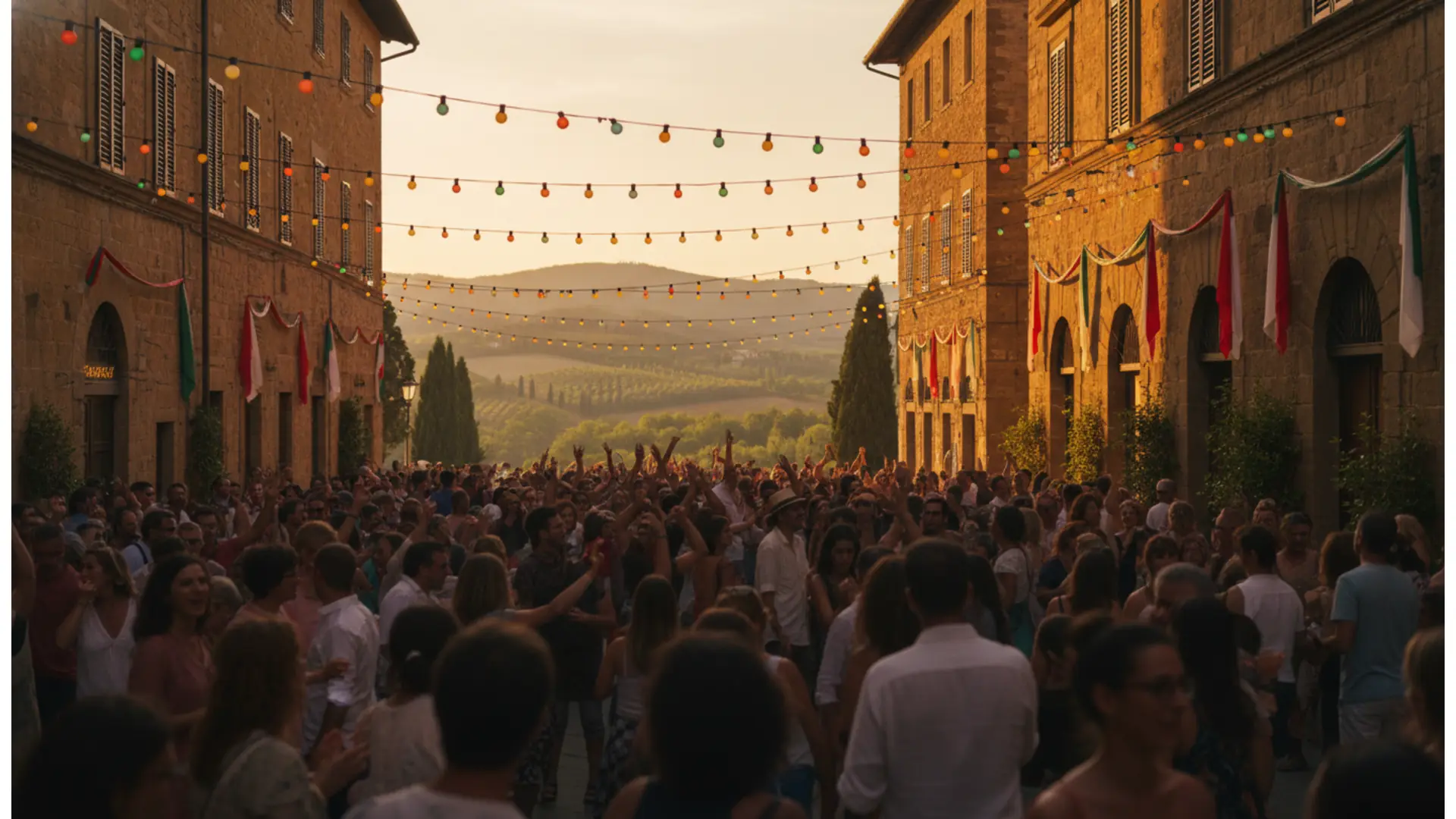
Saint Nicholas of Bari Festival (Patronal Feast)
A year-long cycle of rituals in the Sannio region: the milling, the Great Table, and the Table of the Poor
Edition 2026 not confirmed to date
This edition has not been confirmed by the organiser to date. We recommend checking before going.
About Saint Nicholas Festival
A devotion that lasts twelve months
In Fragneto Monforte, a municipality of about 1,650 inhabitants perched on the hills of the Sannio region at an altitude of 415 meters, in the province of Benevento (Campania), the Saint Nicholas of Bari Festival does not end on the patron saint's day. It is a system of rituals that occupies the entire calendar, defined as devotional mutual aid: the community collects for twelve months and then redistributes to everyone, following a principle of charity that recalls the Nicolaian legend of the dowry given to the three poor maidens.
The cult of Saint Nicholas is believed to have arrived in the Benevento area as early as the 8th or 9th century. The mother church, dedicated to Saints Nicholas and Roch and rebuilt in a Baroque style in the second half of the 17th century, is its most visible testimony; a dedication to Saint Nicholas has been documented since at least the 12th century. The Confraternity of the Holy Cross, refounded in the 17th century on an older foundation, still oversees the organization of the festival today, and the lists of 'economi' (festival masters) have been documented since at least 1849.
The 'economo', the festival master
Every January 1st, the Confraternity entrusts the festival to a new economo, the festival master: he must be a confrere, a practicing Catholic, married, at least thirty years old, and have been a member for five years. A procession brings the ancient painted icon of Saint Nicholas—a canvas surrounded by votive gold and protected by an unbreakable iron and glass case—to his home, which becomes the House of Saint Nicholas for a year. Every first Sunday of the month, the 'economo' goes from house to house with la pignata, the ritual vessel, to collect oil for the votive lamp in front of the image.
Throughout the year, the collection never stops: money, oil, firewood, wine, grain, and local produce are donated by families; in March, the conta dell'oro (gold count) takes place, an inventory of the gold donated to the saint. With these offerings, the 'economo' can meet every commitment of the festival, where no gesture is accidental.
The ritual calendar
- January 1st — Handover of the festival to the new 'economo' and transfer of the icon.
- February-March — Collection of firewood for the November ovens.
- June-October — Field harvest: grain, wine, oil, and various offerings.
- November 25th — Saint Nicholas Milling: on Saint Catherine's Day, about 60 quintals of grain are taken to the mill; the following day, the flour returns and a dinner is offered to the farmers.
- November 27th — Saint Nicholas Table, the Great Table: the communal meal that gathers an average of 600-700 diners, with songs, dances, and games.
- November 28th - December 4th — Production of panelle, the ritual fritters, with about twenty women working non-stop.
- December 5th — San Nicola và p' la tèrra: distribution of meat, 'panelle', wine, and oil to all families, in proportion to the offering made, from the quintale to the simple devotion.
- December 6th — Liturgical feast of the patron saint: solemn mass, procession through the village streets, and Table of the Poor.
- December 8th — Distribution of the panelluzze of Saint Francis.
- December 31st — The icon returns in procession, Te Deum of thanksgiving, and fireworks display.
December 6th: Procession and Table of the Poor
On the patron saint's day, the procession stops in front of the House of Saint Nicholas, where a simple table is set in the middle of the street: this is the Table of the Poor, with twelve diners recalling the Last Supper. Beside it, tradition recalls the table of the emigrants: the Nicolaian festival of Fragneto Monforte has also been celebrated in Adelaide, South Australia, since 1968.
'Panelle' are not street food: they are consumed with prayer and blessing. More than a spectacle, this is an economy of gift-giving that the village sets in motion every year.
Mautunate, songs, and sacred drama
On the night between December 5th and 6th, the mautunate resonate—satirical rhyming doggerels improvised in front of houses and also addressed to local administrators: an ancient ritual license that dissolves village tensions in comedy. The intangible heritage of the village also includes the Sacred Drama of Saint Nicholas, written in 1887 by the parish priest Father Giovanni Battista Mastrogiacomo, and the Ballad of Santunikòlài, a choreography created in the eighties by the folk group La Takkarata.
Fragneto Monforte, a village in the Sannio
The village is also known for the international hot air balloon festival that has enlivened it since 1986 at the beginning of October, and for the Feast of Our Lady of Purity, on the last Sunday of May, entrusted to the same 'economo'. But it is in December that the identity of the village is fully revealed: in the homes, in the ovens, and at the table set for those who have nothing.
Saint Nicholas Festival — edition 2026
2026 Edition: awaiting the calendar
As of now, no program has been published for the 2026 Saint Nicholas of Bari Festival in Fragneto Monforte (province of Benevento, Campania). The Nicolaian devotional cycle is traditionally marked by recurring dates—the grain milling around November 25th, the communal Great Table on November 27th, the door-to-door distribution on December 5th, and the procession with the Table of the Poor on the patron saint's liturgical day, December 6th—but until confirmation arrives from the acting 'economo' and the Confraternity of the Holy Cross, times and details remain to be verified.
Those wishing to participate can follow the channels of the Municipality of Fragneto Monforte and the parish of Saints Nicholas and Roch throughout the autumn. We will update this page as soon as the 2026 calendar is made public.
Highlights Saint Nicholas Festival 2026
- Saint Nicholas Milling: grain taken to the mill, traditionally on November 25th.
- Saint Nicholas Great Table: the communal meal that gathers an average of 600-700 diners, traditionally on November 27th.
- San Nicola và p' la tèrra: distribution of meat, 'panelle', wine, and oil to families, traditionally on December 5th.
- December 6th: solemn mass, procession through the village, and Table of the Poor with twelve diners in front of the House of Saint Nicholas.
- The 'mautunate', satirical rhyming doggerels improvised on the night between December 5th and 6th.
Prices Saint Nicholas Festival 2026
Practical information — Saint Nicholas Festival
How to get there
By car: from Benevento, go up the Tammaro valley towards the Fragneti, about 20 km north-west of the city; the most convenient connection from the A1 motorway is the Caianello exit or, from the A16, the Benevento junction via the SS 372 Telesina. By train: the useful station is Benevento, served by lines to Naples, Caserta, and Foggia, from where you can continue by bus or rental car. Reference airport: Naples-Capodichino, about 90 km away.
Where it takes place
The rituals are concentrated in the historic center of Fragneto Monforte: the mother Church of Saints Nicholas and Roch for liturgical celebrations, the House of Saint Nicholas (the home of the year's 'economo') for the custody of the icon and for the Table of the Poor, and the village streets for the procession.
Costs
Participation in religious celebrations and the procession is free. The distribution of meat, wine, oil, and 'panelle' is not a sale: it follows the logic of the offerings made during the year to the Confraternity.
Tips
In December, at an altitude of 415 meters, the evenings are cold and damp: wear warm clothing and shoes suitable for sloping streets. The village is small and has limited accommodation: it is advisable to look for lodging in Benevento or in the farmhouses in the area of Pesco Sannita and Fragneto l'Abate. For precise times and information on the Great Table, it is advisable to contact the Municipality (tel. +39 0824 986006) or the parish in the days preceding the event.
Festival-goer photos
No photos yet. Share yours!
Share your photos
5 photos max, 5 MB per photo (JPG, PNG, WebP)
Noticed an error or missing information?
Help us keep this listing up to date. Every proposal is verified by our team before publication.
Festival-goer reviews
No rating yet — be the first!
No comments yet. Be the first!
Were you there?
Share your experience with the community.
Published by Valentin Contard, festival listings writer. Reviewed, corrected and approved by Christophe Contard, editor-in-chief. .
Where does it take place — Saint Nicholas Festival
Centro storico e Chiesa madre dei Santi Nicola e Rocco