Sagra dullo Callarosto i dull'Acquata Festival
Roasted chestnuts and 'acquata' in the village of Giuliano di Roma
Edition 2026 not confirmed to date
This edition has not been confirmed by the organiser to date. We recommend checking before going.
About Sagra dullo Callarosto Festival
A festival that speaks the Giulianese dialect
The name of the festival itself is a piece of heritage: Sagra dullo Callarosto i dull'Acquata, meaning "Roasted Chestnut and Acquata Festival," written in the local dialect of Giuliano di Roma, a municipality in the province of Frosinone, in southern Lazio. This is no mere folkloric detail: in this part of the Ciociaria region, the dialect remains the language of celebrations, recipes, and nicknames, and the Pro Loco has chosen to preserve it even on event posters.
The two stars: chestnuts and acquata
The callarosto is a chestnut roasted in a perforated pan, turned repeatedly over the embers until it blackens and splits. Acquata, on the other hand, is an ancient peasant drink made by adding water to already-pressed grape pomace: a light, slightly vinous beverage that once accompanied autumn farm work in the Frosinone countryside and today survives almost exclusively thanks to festivals like this one. Pairing the two is the perfect synthesis of a 'cucina povera' tradition that wasted nothing.
The role of the Pro Loco
The Pro Loco of Giuliano di Roma, established on July 16, 1975, celebrated its fiftieth anniversary in 2025. Over half a century, the association has built a calendar that marks the rhythm of the village: alongside the better-known Sagra dugli Maccaruni cugli Feri, dedicated to handmade pasta shaped on knitting needles, and the re-enactment of Pope Innocent III's passage, the Sagra dullo Callarosto i dull'Acquata is cited as one of the organization's historic events. These are complemented by dialect poetry competitions, exhibitions, and theatrical evenings that round out the Pro Loco's cultural activities.
What to expect
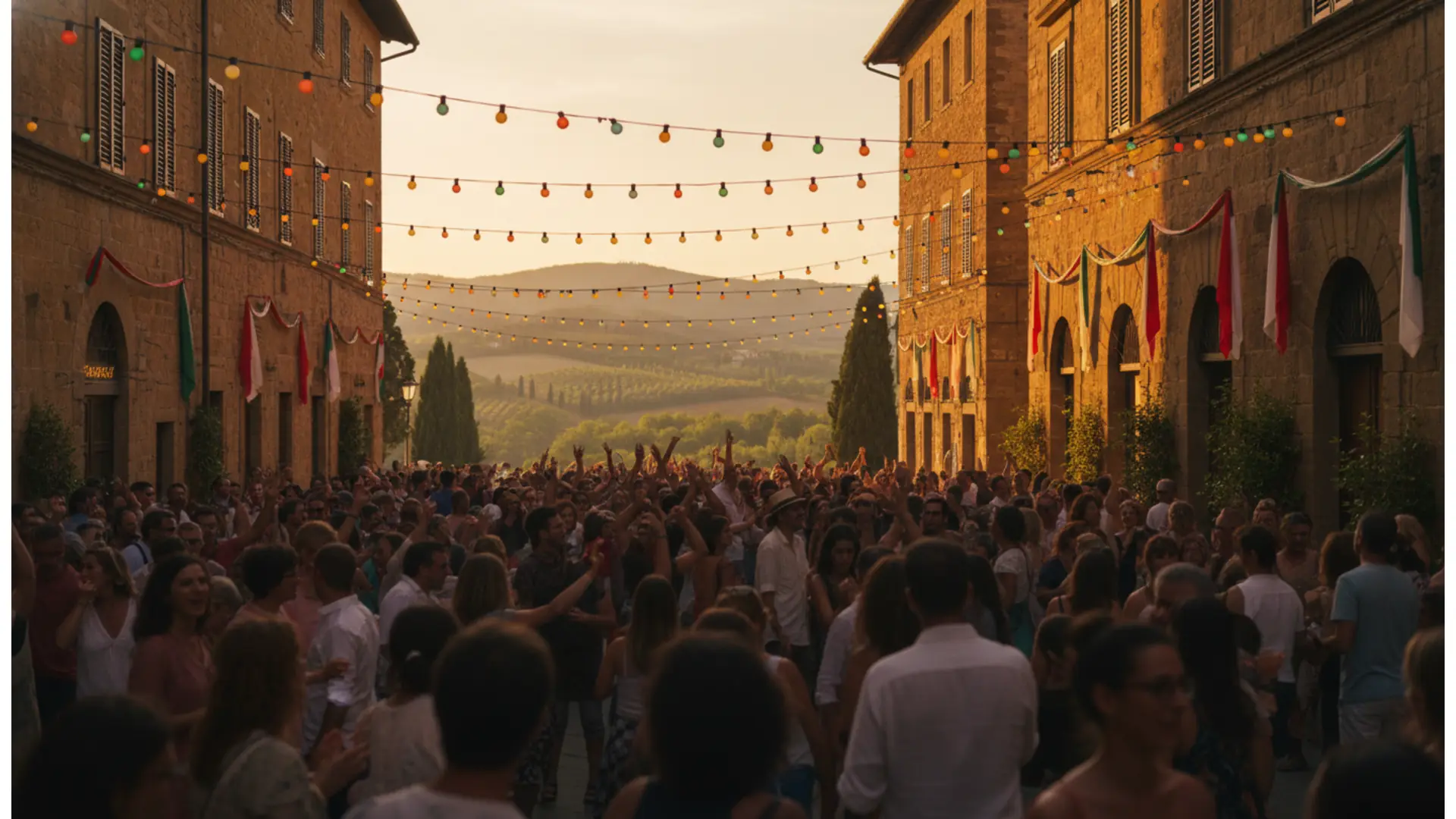
This is a small-scale festival, very different from the large food and wine events in Lazio: no massive stages, just the squares and alleys of the historic center filled with stalls, braziers, and long communal tables. It is the kind of event where the association's volunteers do the actual cooking, where the village elders recount how 'acquata' was prepared at home, and where children run between the stalls. Visitors from outside will find a genuine atmosphere and affordable prices.
- Roasted chestnuts cooked on the spot and served hot in paper cones
- Acquata and local wines from the Amaseno Valley
- Traditional Ciociaria dishes prepared by volunteers
- Folk music, accordion players, and square dancing
- Stalls featuring local products and crafts
Giuliano di Roma and the Amaseno Valley
Giuliano di Roma is a village perched on the slopes of the Lepini Mountains, overlooking the Amaseno River valley. The historic center retains its medieval layout, with narrow alleys, arches, and stairways that open up to views of the plains. The area is known for its extra virgin olive oil production, the chestnut groves on the mountain slopes, and a dense network of village festivals that animate towns like Patrica, Villa Santo Stefano, and Amaseno between late summer and autumn. It should be noted that nearby Patrica organizes a better-known festival with a similar name, now in its fiftieth year: the two events are distinct and testify to how deeply rooted the chestnut-and-acquata pairing is throughout the area.
Why it's worth the trip
Those looking for the Italy of village festivals—the kind not yet shaped by mass tourism—will find exactly what they are looking for here. It is also a unique opportunity to taste 'acquata', a product not found commercially and which survives only in the memory and hands of those who still prepare it. An afternoon in Giuliano di Roma can easily be combined with a visit to the village and a walk along the trails of the Lepini Mountains.
Sagra dullo Callarosto Festival — edition 2026
2026 Edition: dates not yet announced
At the moment, the Pro Loco of Giuliano di Roma has not released the date or the program for the 2026 Sagra dullo Callarosto i dull'Acquata. As this is a village event, the calendar is defined by volunteers in the weeks leading up to the festival and communicated mainly through the association's social media channels and local Frosinone press.
Those wishing to attend can monitor the Pro Loco page: the structure of the festival remains consistent, with chestnuts roasted in the square, the serving of 'acquata', and food stalls managed by volunteers in the historic center of the municipality in the province of Frosinone.
Programme Sagra dullo Callarosto Festival 2026
Highlights Sagra dullo Callarosto Festival 2026
Prices Sagra dullo Callarosto Festival 2026
Practical information — Sagra dullo Callarosto Festival
Getting there
By car: from the A1 motorway, take the Frosinone exit, then the SS156 'dei Monti Lepini' towards Latina and follow signs for Giuliano di Roma (about 20 km from the toll booth). From Rome, the journey takes approximately one hour and forty minutes.
By train: Frosinone station on the Rome-Cassino line, then take a Cotral bus towards the Amaseno Valley.
Parking
The historic center is pedestrianized with narrow alleys: it is best to leave your car in the parking areas at the entrance to the village and continue on foot.
Costs
Free admission. Tastings are paid for with tickets at individual stalls, at the affordable prices typical of village festivals.
Tips
Autumn evenings in the Lepini Mountains are cool: it is advisable to bring a jacket. For updated dates and programs, check the official social media page of the Pro Loco Giuliano di Roma, which publishes posters a few days in advance.
Festival-goer photos
No photos yet. Share yours!
Share your photos
5 photos max, 5 MB per photo (JPG, PNG, WebP)
Noticed an error or missing information?
Help us keep this listing up to date. Every proposal is verified by our team before publication.
Festival-goer reviews
No rating yet — be the first!
No comments yet. Be the first!
Were you there?
Share your experience with the community.
Published by Valentin Contard, festival listings writer. Reviewed, corrected and approved by Christophe Contard, editor-in-chief. .
Where does it take place — Sagra dullo Callarosto Festival
Centro storico di Giuliano di Roma