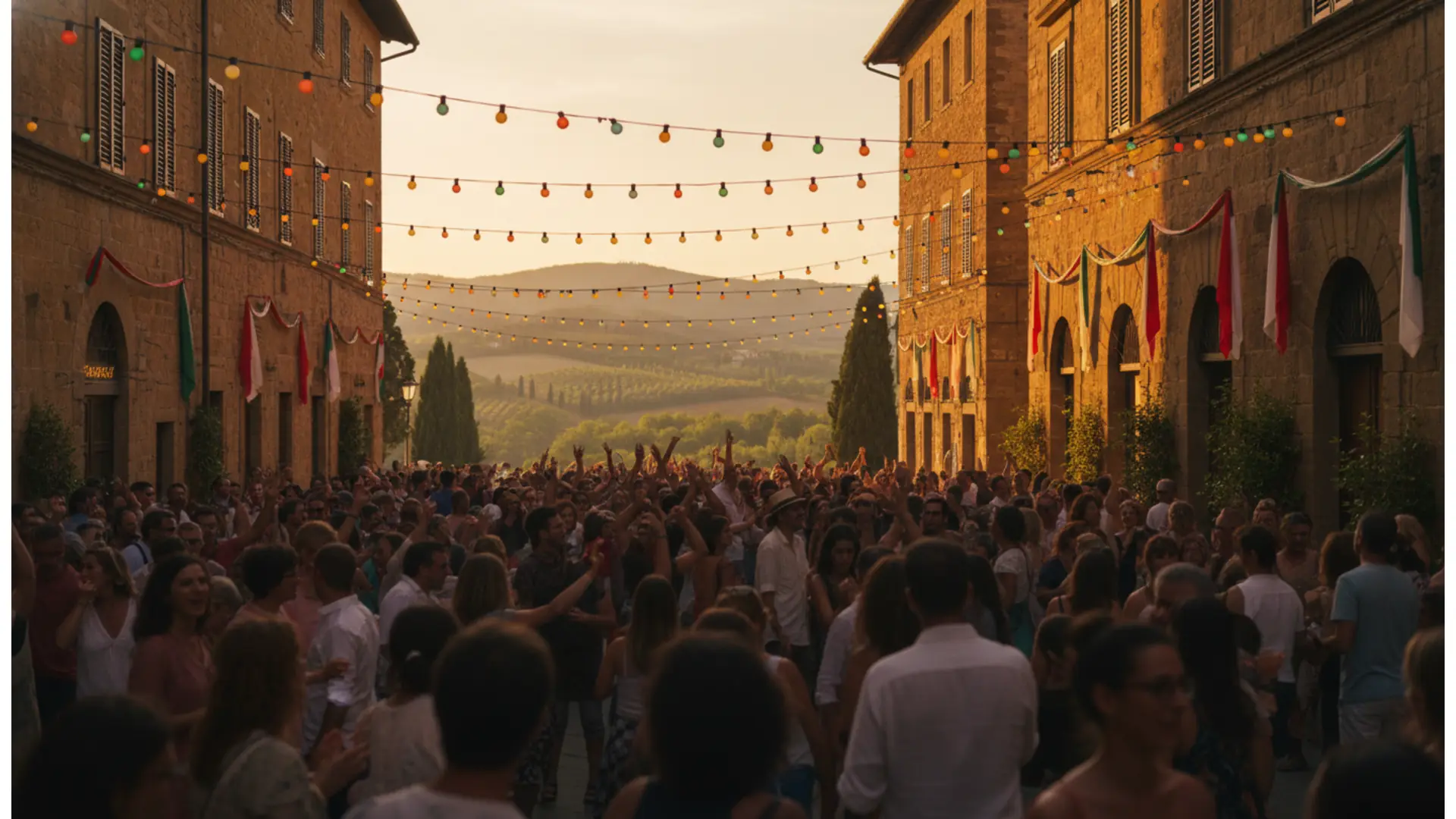
Maggiaiole Procession (Madonna della Gaggia)
The pilgrimage of flower-crowned maidens to the ancient cathedral of Conza
Edition 2026 not confirmed to date
This edition has not been confirmed by the organiser to date. We recommend checking before going.
About Le Maggiaiole
An ancient rite in the heart of Alta Irpinia
The Maggiaiole Procession is one of the most evocative folk traditions in inland Campania. Every year, on the last Saturday of May, the unmarried women of the municipality of Sant'Andrea di Conza, in the province of Avellino, set out on foot toward the ancient site of Conza della Campania to honor the Madonna della Gaggia. These young pilgrims—the 'maggiaiole'—traverse the countryside of the Ofanto Valley in a journey that weaves together Marian faith, folk song, and community identity.
The legend of the pact with the Madonna
According to a legend passed down through generations, the ritual stems from a 'pact' made long ago between the inhabitants of Sant'Andrea and the Madonna della Gaggia. Tradition tells of the 'flight' of the sacred image and the mutual promises that followed: promises that are solemnly renewed every year during the May procession. This is the origin of the special, unbroken bond between these two villages in Alta Irpinia.
The pilgrims of love
The maggiaiole climb to Conza to ask the Virgin for the grace of finding a good suitor, destined to become a husband, as a reward for their domestic virtues. This is a unique trait of this pilgrimage within the landscape of Italian Marian rites: spring, the season of falling in love, becomes the perfect time to entrust one's future to the Madonna. The older girls carry a white handkerchief adorned with a crown of fruit, while the younger ones wear a crown of roses.
How the procession unfolds
- The procession departs from the mother church of Sant'Andrea di Conza, led by the Crucifix.
- The maggiaiole are escorted by their mothers and the village youth, alongside the Mayor and the parish priest.
- The statue of the Madonna of the Rosary accompanies the cortege to the edge of the town, where it waits in a chapel for the girls' return from Conza.
- Along the way, the maggiaiole sing traditional songs recalling the 'story' of the flight and the promises made.
- Before arriving in Conza, the fields are blessed with the Crucifix.
- The central moment is the Mass in the Cathedral of Santa Maria Assunta, where the priest and the mayor of Conza symbolically hand over the keys of the city to the people of Sant'Andrea.
- At the end, the ritual concludes with an outdoor picnic, where the girls consume the fruits from their crowns.
Ancient Conza, a cathedral among the ruins
The destination of the pilgrimage is particularly evocative. The ancient cathedral dedicated to the Virgin of the Assumption was destroyed by the earthquake of November 23, 1980, which razed the old town of Conza della Campania. Today, the archaeological site of ancient Compsa and the Co-cathedral of Santa Maria Assunta provide a setting suspended between memory, stone, and landscape, overlooking the oasis of Lake Conza.
Sant'Andrea di Conza, the village of the maggiaiole
Sant'Andrea di Conza is a small town of about 1,700 inhabitants, nestled at an altitude of 665 meters in the Ofanto Valley, about sixty kilometers from Avellino. The village preserves the 13th-century Bishop's Palace with its cylindrical tower, the 1826 Metropolitan Seminary with the church of San Michele, the church of San Domenico, and the Clemente-Malanga brick kiln, a testament to the local ancient brick-making art. The maggiaiole, along with the kiln, are the symbolic identity of the village, so much so that they have become part of the narrative used in the territory's recent cultural bids.
When to go
The date is set by tradition for the last Saturday of May. The exact dates and times of the celebrations are announced each year by the parish and the Municipality of Sant'Andrea di Conza in the preceding weeks, in coordination with the Municipality of Conza della Campania, which hosts the procession.
Le Maggiaiole — edition 2026
2026 Edition: appointment in May
The Maggiaiole Procession returns in May 2026 to Sant'Andrea di Conza, in the province of Avellino. Custom dictates that the pilgrimage to the Madonna della Gaggia, in ancient Conza della Campania, takes place on the last Saturday of the month, but the exact date and times have not yet been published on official channels.
As every year, the rite should follow its historical moments: the departure of the procession led by the Crucifix, the girls' songs along the road, the blessing of the fields, the Mass in the Cathedral of Santa Maria Assunta, and the return to the chapel where the statue of the Madonna of the Rosary awaits.
Those wishing to attend are invited to check the date and times with the parish and the Municipality of Sant'Andrea di Conza in the weeks preceding the event.
Highlights Le Maggiaiole 2026
Prices Le Maggiaiole 2026
Practical information — Le Maggiaiole
How to get there
Sant'Andrea di Conza can be reached by car via the A16 Naples-Canosa motorway and the SS 7 Ofantina road; it is about 65 km from Avellino and just over two hours from Naples. Ancient Conza della Campania is a few kilometers from the village and is connected by the road that the maggiaiole travel on foot.
Costs
Participation in the pilgrimage and celebrations is free.
Tips
The route is covered on foot through the countryside: comfortable shoes, water, and sun protection are essential. Those who prefer not to walk can reach Conza by car and wait for the procession to arrive in front of the cathedral.
Nearby
Recommended visits: the archaeological park of ancient Compsa, the natural oasis of Lake Conza, and the Clemente-Malanga kiln in Sant'Andrea di Conza.
Festival-goer photos
No photos yet. Share yours!
Share your photos
5 photos max, 5 MB per photo (JPG, PNG, WebP)
Noticed an error or missing information?
Help us keep this listing up to date. Every proposal is verified by our team before publication.
Festival-goer reviews
No rating yet — be the first!
No comments yet. Be the first!
Were you there?
Share your experience with the community.
Published by Valentin Contard, festival listings writer. Reviewed, corrected and approved by Christophe Contard, editor-in-chief. .
Where does it take place — Le Maggiaiole
Chiesa madre di Sant'Andrea di Conza e Cattedrale di Santa Maria Assunta a Conza della Campania