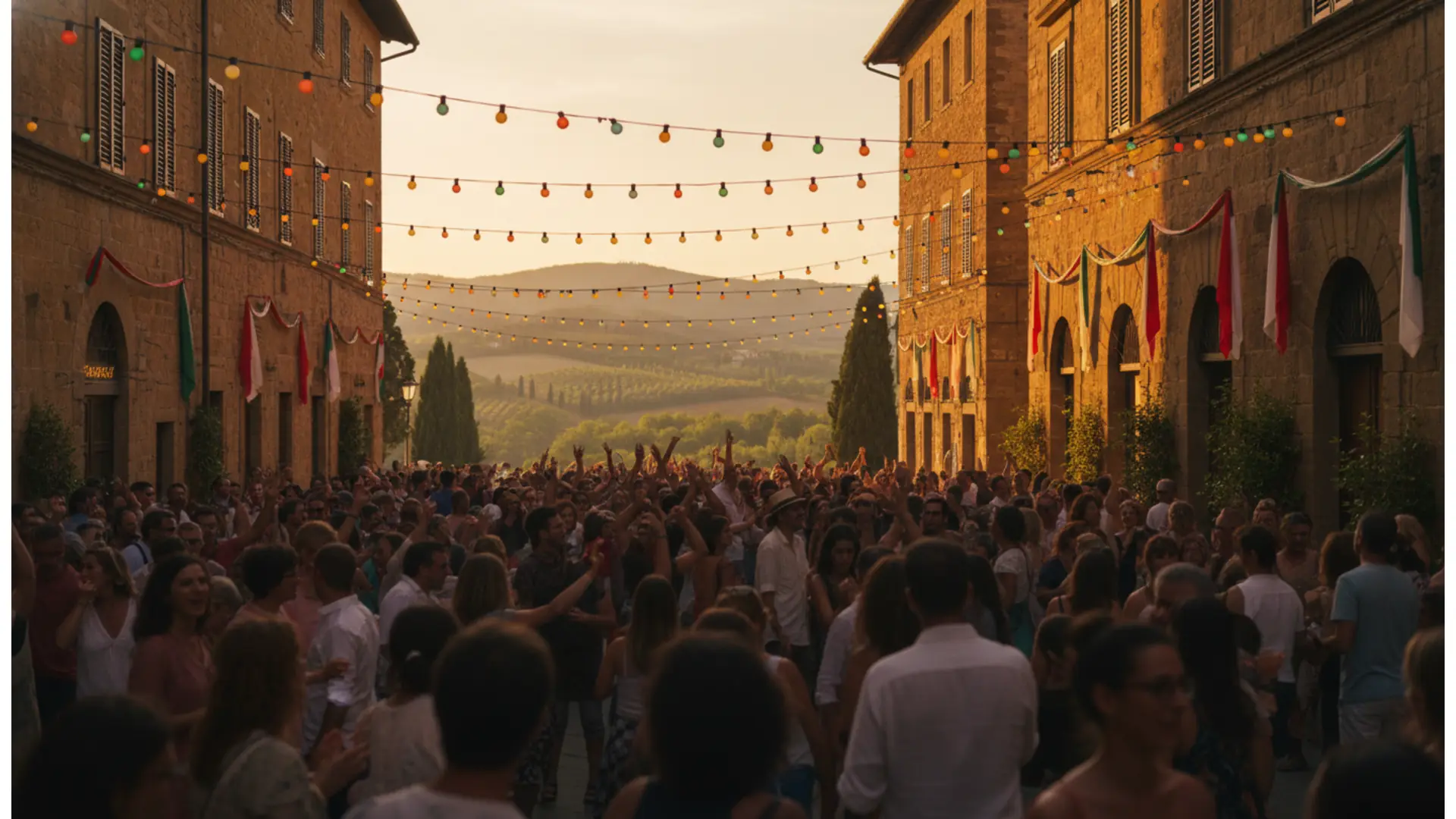
Madonna del Carmine Festival
The patronal feast of Romagnano al Monte featuring liturgy, processions, and musical evenings
Edition 2026 not confirmed to date
This edition has not been confirmed by the organiser to date. We recommend checking before going.
About Carmine Festival
The patronal feast of Romagnano al Monte
In the hinterland of the Province of Salerno, on the border between Campania and Basilicata, the small Municipality of Romagnano al Monte celebrates its patron saint, the Madonna del Carmine, every year. It is the most heartfelt event on the local calendar: for a few days, the village, which has just over three hundred inhabitants, fills with families, emigrants returning for the occasion, and visitors from the surrounding valley.
The festival traditionally takes place on the last weekend of July, with a structure that has remained largely unchanged over the years: Saturday is dedicated to liturgy and music, Sunday to the solemn procession through the town streets, and Monday evening to the grand finale with a musical performance.
An ancient cult born around a Carmelite convent
The devotion of the people of Romagnano to the Virgin of Mount Carmel has roots in the Middle Ages. Around 1400, Carmelite monks built the chapel of Santa Maria del Carmine alongside their convent, which became the center of local Marian worship. Beside the image of the Madonna, numerous silver ex-votos are preserved, donated by the community between the late 18th and early 20th centuries as a sign of gratitude for graces received.
The venerated icon is now kept in the town's mother church. Every year, on Easter Monday, it is carried in procession to its ancient chapel, located about five kilometers from the town, and returns—again in procession—on the second Sunday of May. The July festival is the culmination of this devotional cycle that marks the community's year.
How the festival unfolds
- Saturday: Liturgical celebrations in preparation for the solemnity and the first musical evening in town.
- Sunday: Solemn mass and procession of the Madonna del Carmine icon through the streets, accompanied by the faithful.
- Monday evening: Concluding musical show, a moment of gathering for the entire community.
As in many patronal feasts in Southern Italy, religious and secular dimensions coexist naturally: functions are accompanied by illuminations, market stalls, and the conviviality of summer evenings outdoors.
One town, two settlements
Those arriving in Romagnano al Monte discover a unique history. The old village, perched over 600 meters high on a spur overlooking the Bianco River gorge, was severely damaged by the earthquake of November 23, 1980 and gradually abandoned: today it is one of the most well-known "ghost towns" in Southern Italy, a destination for the curious and photographers. The population moved to the new settlement built in the Ariola area, where the parish church dedicated to the Madonna del Rosario was also rebuilt, frequently cited among the FAI's "Places of the Heart".
It is here, in the new town, that the procession and festivities take place today: the Madonna del Carmine festival has thus become the way a community scattered by the earthquake continues to recognize itself and reunite.
History and territory
The name Romagnano is thought to derive from fundus Romanianus, land belonging to the patrician Romanius family in Roman times; the addition "al Monte" dates back to the Unification of Italy to distinguish the town from Romagnano Sesia. The community endured difficult centuries—the plague of 1656, the earthquake of 1694 that led to the abandonment of the medieval castle, and the terrible famine of 1763-64—eventually reaching nearly a thousand inhabitants by the end of the 19th century.
Today, the municipal territory is part of the Sele-Tanagro district, not far from the Alburni Mountains: an ideal setting to combine the festival with a day exploring villages, nature, and typical products of the Campanian hinterland. In autumn, the town also hosts the "del Palazzo" craft and local produce fair.
Good to know
The exact dates for the 2026 edition have not yet been officially released: it is advisable to check with the Municipality of Romagnano al Monte or the parish in the days leading up to the last weekend of July.
Carmine Festival — edition 2026
The 2026 edition of the Madonna del Carmine Festival in Romagnano al Monte (Province of Salerno, Campania) has not yet been officially announced. Local tradition places the patronal solemnity on the last weekend of July, with the usual three-day format: liturgical celebrations and music on Saturday, solemn mass and procession of the venerated icon through the streets on Sunday, and a musical show on Monday evening.
While waiting for the official program, those wishing to participate can contact the Municipality of Romagnano al Monte (Piazza della Libertà, tel. +39 0828 432164) or the parish, which usually release the program only a few weeks before the festival. Participation in the services and the procession is free and open to all.
Prices Carmine Festival 2026
Practical information — Carmine Festival
Getting there
Romagnano al Monte can be reached by car along the Provincial Road 415, which connects the valley floor to the Ariola settlement. The town is located in the upper Bianco River valley, on the border between the province of Salerno and Basilicata, and is accessible from the exits of the A2 del Mediterraneo motorway in the Sele-Tanagro section.
Parking and mobility
During the festival, town center streets may be temporarily closed to traffic for the procession: it is best to leave your car in free spaces on the outskirts of the village and continue on foot.
Costs
Religious celebrations, the procession, and the festivities in the square are free and open to the public.
Where to stay and eat
Accommodation in the village is very limited: for overnight stays, it is best to look at neighboring towns in the Tanagro valley and the Alburni area, where there is no shortage of farmhouses and small family-run establishments.
Tips
Summer evenings at this altitude can be cool: it is useful to bring a light jacket. Those with time can combine the festival with a visit to the abandoned old village, which should be explored with suitable footwear and the utmost caution.
Festival-goer photos
No photos yet. Share yours!
Share your photos
5 photos max, 5 MB per photo (JPG, PNG, WebP)
Noticed an error or missing information?
Help us keep this listing up to date. Every proposal is verified by our team before publication.
Festival-goer reviews
No rating yet — be the first!
No comments yet. Be the first!
Were you there?
Share your experience with the community.
Published by Valentin Contard, festival listings writer. Reviewed, corrected and approved by Christophe Contard, editor-in-chief. .
Where does it take place — Carmine Festival
Centro abitato di Romagnano al Monte (località Ariola)