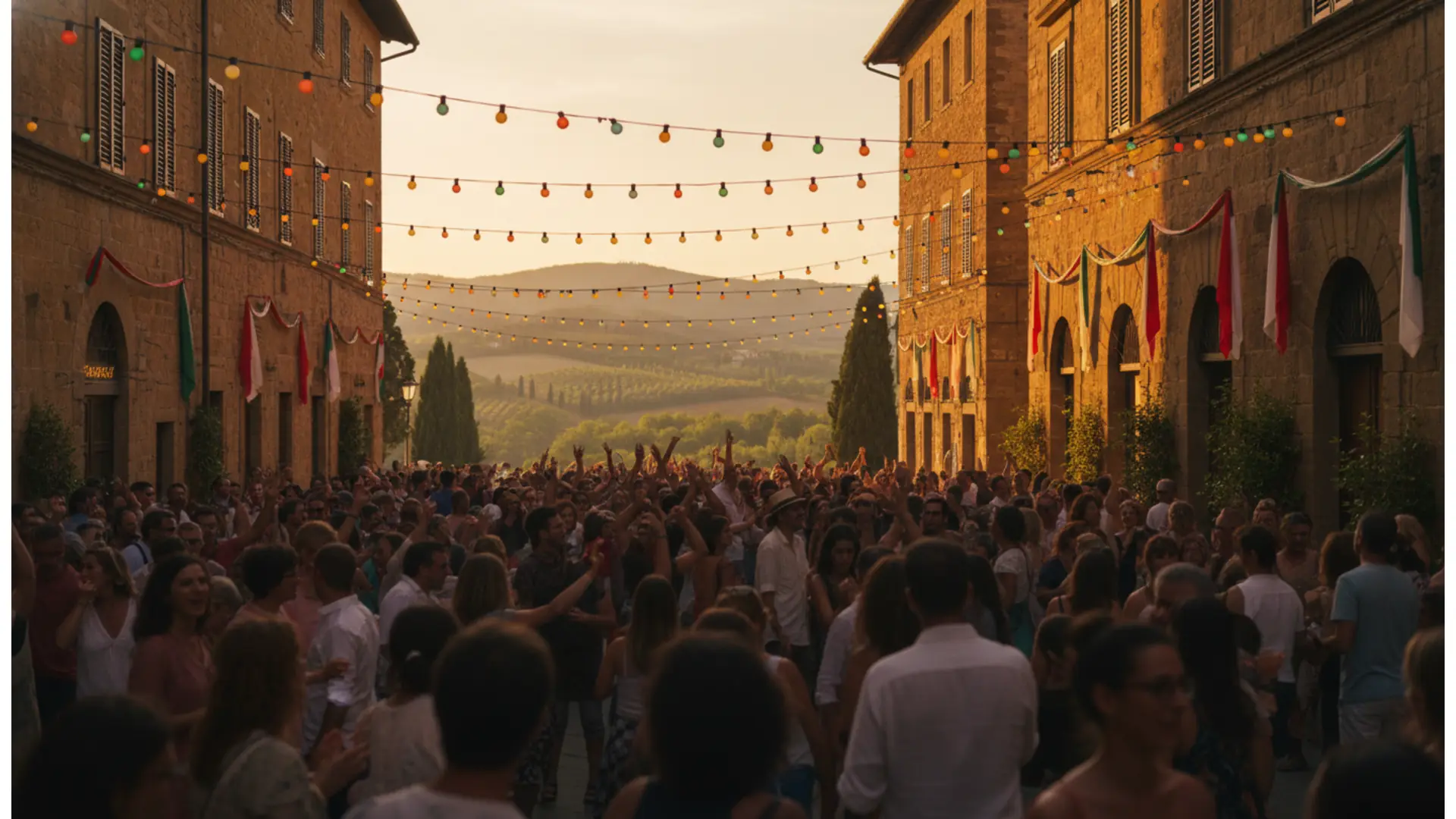
Errichetta Festival
The great traditional music festival in Rome
About Errichetta
A grassroots festival in the heart of Rome
The Errichetta Festival is one of the most original experiences in the musical landscape of Rome and the entire Lazio region. It began in 2012 as an idea from eight young Roman musicians—the Errichetta Underground collective—who, upon returning to the city after studying at major European conservatories, decided to meet once a year to share their work on oral tradition music. What started as a gathering of friends has grown in just over a decade into an internationally recognized event, produced by the Officina delle Culture APS association and supported by the Ministry of Culture as a premier contemporary and auteur music festival.
Traditional music as a living language
The core of the project is a simple conviction: oral tradition music is not a museum piece, but a living language that continues to generate new forms. For this reason, the program always pairs great performers of traditional repertoires—polyphonies, songs, dances, and ancient instruments—with new original creations inspired by those same roots. Over the years, the stage has hosted musicians from Georgia, Macedonia, Moldova, Poland, Greece, Turkey, Catalonia, Portugal, Lebanon, and France, always in dialogue with Roman and Italian traditions.
More than just concerts
The Errichetta Festival stands out for its multidisciplinary structure, which goes far beyond the standard evening concert format:
- Evening concerts at the Teatro Garbatella, the event's historic home, featuring multiple groups each night;
- Concerts in evocative settings, particularly in the city's historic churches, where sacred and polyphonic repertoires find ideal acoustics;
- Free workshops on traditional music, open to professional musicians, amateurs, and enthusiasts (registration required);
- Film screenings dedicated to world music;
- Folk dances and after-parties, which extend the evening and turn the audience into active participants.
Teatro Garbatella and the festival venues
The home of Errichetta is the Teatro Garbatella, located at Piazza Giovanni da Triora 15, in Rome's most beloved working-class neighborhood: a place with a strong identity, far from tourist circuits, which perfectly suits the communal spirit of the event. Over the years, the festival has expanded to other spaces in the capital and the Roman province—the Church of San Giorgio in Velabro, the La Città dell'Utopia social center on Via Ostiense, the Cinema Greenwich in Testaccio, and in some editions, the Church of San Nicola in Riofreddo, in the upper Aniene Valley.
An international network
While remaining an independent and self-managed project, the Errichetta Festival has built a dense network of cultural partners over the years: the Fondation Meyer, ISMEO, the French Academy in Rome (Villa Medici), the Institut Ramon Llull, and the cultural institutes of Poland, Bulgaria, Switzerland, Turkey, and Georgia. The festival is also a member of the European festival network and is supported through the Art Bonus, the state tax credit for cultural patronage, which allows individuals and businesses to contribute directly to the project.
Why attend
For those seeking an alternative to the typical Christmas lights and markets in Rome this December, this festival offers something rare: five days where you can listen to Georgian polyphony, learn a Greek dance step, attend a concert in a medieval church, and end the night dancing. It is a human-scale festival with a loyal audience and accessible prices, restoring the most authentic meaning of the word "tradition": something that is passed on because it continues to be practiced.
Errichetta — edition 2026
Errichetta Festival XV — Rome, December 10-14, 2026
The Roman traditional music festival reaches its fifteenth edition. The dates are confirmed: from December 10 to 14, 2026, with the usual format alternating evening concerts at the Teatro Garbatella with events in historic locations across the capital and free traditional music workshops.
As per tradition, the program will bring together international performers of European and Mediterranean oral repertoires with original productions created within the Errichetta Underground collective. The festival is produced by Officina delle Culture APS with the support of the Ministry of Culture.
The full program, including the line-up, times, venues, and prices, has not yet been published; it will be released on the official website and the festival's social media channels, typically between late October and November.
Programme Errichetta 2026
Highlights Errichetta 2026
- 15th edition of the Roman traditional music festival, established in 2012
- Five days of programming from December 10 to 14, 2026
- Evening concerts at the Teatro Garbatella, in the Garbatella district
- Oral tradition music from Europe and the Mediterranean
- Free workshops open to professional musicians and amateurs
- Festival supported by the Ministry of Culture and the Art Bonus
Prices Errichetta 2026
Practical information — Errichetta
How to get there
The Teatro Garbatella is located at Piazza Giovanni da Triora 15, in Rome. By metro: Line B, Garbatella stop, just a few minutes' walk away. By train: Roma Ostiense station is the closest hub, connected to Termini and Fiumicino Airport via the Leonardo Express (change at Termini) or the FL1 line to Ostiense. By car: Exit from Via Cristoforo Colombo or Via Ostiense; the festival usually arranges a discounted rate at a nearby garage, as street parking in the area is difficult.
Tickets
Evening tickets have historically been affordably priced (roughly between 10 and 25 euros per day, with multi-day passes available). Traditional music workshops are free but require advance registration. Tickets are sold online via the platforms indicated on the official website for each edition.
Tips
Evenings at the Teatro Garbatella generally start around 8:45 PM, with doors opening at 8:00 PM: it is advisable to arrive early as the venue is intimate and seats sell out. December in Rome is mild but humid: a jacket is sufficient. For those arriving from out of town, the Garbatella neighborhood and the Ostiense-Testaccio area offer numerous bed & breakfasts and a lively selection of trattorias and bars for dinner before the concert.
Festival-goer photos
No photos yet. Share yours!
Share your photos
5 photos max, 5 MB per photo (JPG, PNG, WebP)
Noticed an error or missing information?
Help us keep this listing up to date. Every proposal is verified by our team before publication.
Festival-goer reviews
No rating yet — be the first!
No comments yet. Be the first!
Were you there?
Share your experience with the community.
Published by Valentin Contard, festival listings writer. Reviewed, corrected and approved by Christophe Contard, editor-in-chief. .
Where does it take place — Errichetta
Teatro Garbatella
Piazza Giovanni da Triora 15, 00154 Roma