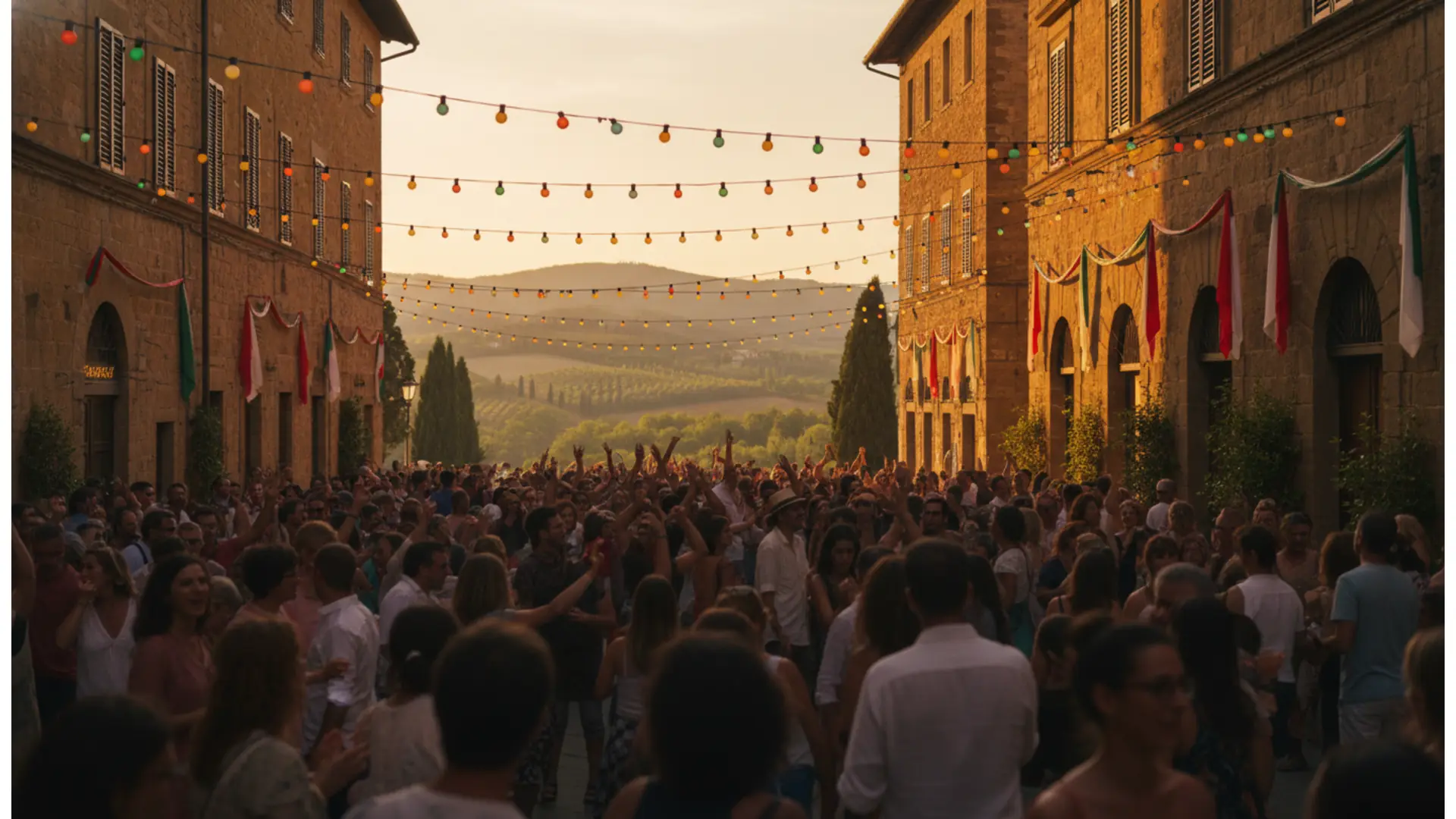
Saint Anthony of Padua Festival and Living Tableaux
The Miracles of Saint Anthony in living tableaux, through the streets of San Potito Sannitico
About Saint Anthony Festival
A village festival at the foot of the Matese
San Potito Sannitico is a village of just under two thousand inhabitants in the province of Caserta, Campania, spread across the southern slopes of the Matese massif. Here, the Saint Anthony of Padua Festival represents the most anticipated moment of the community calendar: for about ten days, between early and mid-June, village life revolves around the church dedicated to the Saint, an early 20th-century building housing valuable frescoes and an 18th-century nativity scene.
The festival is organized by the parish community of Santa Caterina together with the Saint Anthony Festival Committee, with the collaboration of the Municipality. It is not an event staged for tourism: it is a devotion passed down from generation to generation, which is why it retains an authenticity that strikes those visiting from outside.
The liturgical heart: novena, blessing of the bread, procession
The spiritual journey begins with the novena, recited in the late afternoon and followed by Holy Mass in the church of Saint Anthony. This leads to June 13th, the Saint's liturgical feast day, a day marked by specific moments:
- the morning Eucharistic celebration with the blessing of the bread, an ancient gesture linked to Antonian charity;
- the recitation of the Rosary and the evening Holy Mass;
- the procession with the Saint's effigy through the streets of the historic center.
The distribution of blessed bread recalls one of the most popular episodes of the Antonian tradition and remains, for many local families, the most tangible sign of the festival.
The living tableaux: the Miracles of Saint Anthony
Since 2025, the procession has been enriched with a novelty that has changed the face of the festival: the living tableaux dedicated to the Miracles of Saint Anthony. Along the route, groups of costumed performers position themselves at fixed points in the town and remain motionless and silent, reconstructing with their bodies the scenes of the miracles attributed to the Saint. There is no acting or movement: it is a painting made of people, accompanied by narrating voices that convey its spiritual meaning and relevance.
The stops were designed to utilize the village's architecture rather than artificial sets: via Porta Agricola, the Scalelle, the church of San Michele, and piazza della Vittoria. The tableaux of the first edition — The Reattached Foot, The Distribution of Bread, The Miser's Heart, and The Speaking Newborn — were constructed by looking at precise pictorial models, from Titian's 1511 fresco in the Scuola del Santo in Padua to the canvas by Willem van Herp the Elder held at the National Gallery in London.
A popular theater involving the whole village
Adults, young people, and children participate in the creation of the tableaux: the result is a popular drama where the community is both author and spectator. This is perhaps the most interesting aspect for the visitor, the feeling of witnessing not a packaged show but a collective rite, in which every family recognizes a familiar face under the costume. Silence, more than words, becomes the true protagonist of the evening.
When to go and what to expect
The festivities are concentrated between the first days and the middle of June, with the focus on the 13th and the evening performance of the living tableaux. June evenings at the foot of the Matese are mild, and the natural backdrop of the massif behind the village adds much to the atmosphere. Those visiting San Potito Sannitico on this occasion can combine the festival with a visit to the Museum of Brigandage and Emigration and excursions in the nearby Matese Regional Park, one of the most beautiful natural areas in inland Campania.
Saint Anthony Festival — edition 2026
The Miracles of Saint Anthony return to the stage
On Sunday, June 14, 2026, at 8:30 PM, San Potito Sannitico hosted a new edition of the Miracles of Saint Anthony performance, with five living tableaux inspired by the iconographic and devotional tradition linked to the Saint of Padua.
The festival was enriched by a moment born from the encounter between artistic study, religious reflection, and popular culture: through gestures, images, costumes, and scenes, the performers conveyed the simple and profound power of stories that have spoken to people's hearts for centuries. The tableaux were composed by adults, young people, and children of the community, involved by the Saint Anthony Festival Committee.
Re-enactment, faith, and participation
As in the first edition, the format is that of wordless popular theater: motionless bodies, silence, and narrating voices that guide the viewer's gaze. The result is a blend of re-enactment, faith, memory, and collective participation that has confirmed the living tableaux as the most recognizable feature of the Antonian festival in San Potito Sannitico, in the Alto Casertano area.
Civil and religious festivities traditionally take place in the first half of June, around the liturgical feast of June 13th, with celebrations in the church of Saint Anthony and the procession with the Saint's effigy through the streets of the center.
Programme Saint Anthony Festival 2026
Highlights Saint Anthony Festival 2026
- Five living tableaux dedicated to the Miracles of Saint Anthony, one more than in 2025
- Motionless and silent scenes, with narrating voices as commentary
- Performers of all ages: adults, young people, and children from the village
- Evening appointment at 8:30 PM on Sunday, June 14
- Organized by the Saint Anthony Festival Committee
Prices Saint Anthony Festival 2026
Practical information — Saint Anthony Festival
How to get there
San Potito Sannitico is located in the Alto Casertano area, at the foot of the Matese, near Piedimonte Matese. By car from the A1 motorway, exit at Caianello or Capua and continue on the state roads towards Piedimonte Matese; from Naples, the journey takes about an hour and a half. By public transport, the reference point is Piedimonte Matese, connected by regional bus lines, from which you can reach the village in a few minutes.
Where it takes place
Liturgical celebrations are held in the church of Saint Anthony; the procession and living tableaux pass through the historic center, with stops in via Porta Agricola, at the Scalelle, near the church of San Michele, and in piazza della Vittoria.
Costs
Participation in the festival, the procession, and the performance of the living tableaux is free and open-air.
Tips
It is advisable to arrive a little early to find a spot along the route and to bring a light jacket for the evening. As this is a religious event, a respectful attitude is requested during the silent stops. For updated schedules, you can refer to the parish of Santa Caterina or the Municipality of San Potito Sannitico, via Pozzo Campagna 1, tel. +39 0823 912690.
Festival-goer photos
No photos yet. Share yours!
Share your photos
5 photos max, 5 MB per photo (JPG, PNG, WebP)
Noticed an error or missing information?
Help us keep this listing up to date. Every proposal is verified by our team before publication.
Festival-goer reviews
No rating yet — be the first!
No comments yet. Be the first!
Were you there?
Share your experience with the community.
Published by Valentin Contard, festival listings writer. Reviewed, corrected and approved by Christophe Contard, editor-in-chief. .
Where does it take place — Saint Anthony Festival
Chiesa di Sant'Antonio e centro storico di San Potito Sannitico