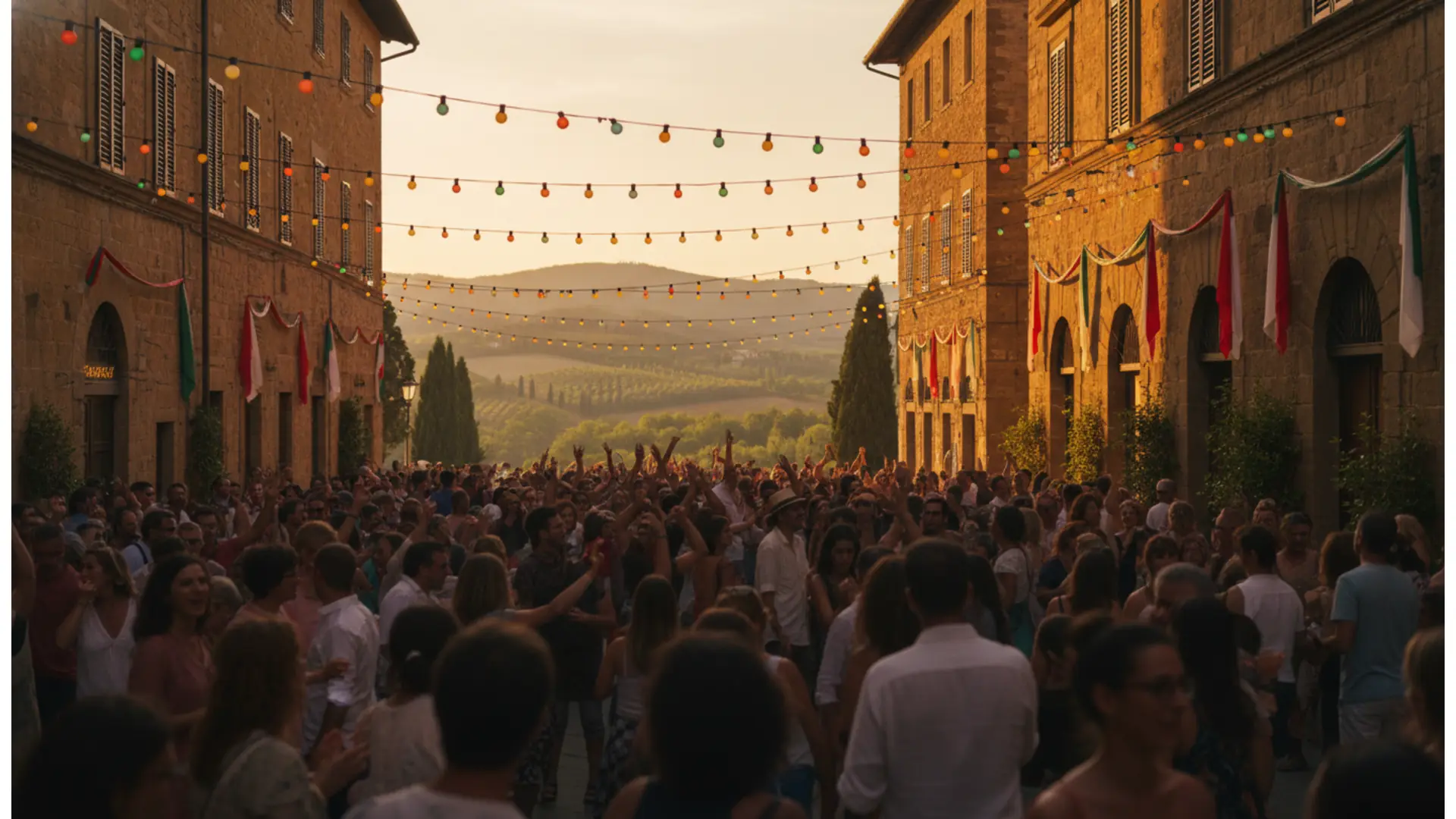
Holy Week - Procession of the Battenti
Centuries-old chants from hooded confraternities and the Procession of the Dead Christ on the Amalfi Coast
About Battenti of Minori
The Holy Week of the Battenti in Minori
In the Municipality of Minori, a small seaside village nestled between the sea and the lemon terraces of the Amalfi Coast, in the Province of Salerno (Campania), Holy Week is more than just a liturgical season: it is the most deeply felt identity-defining event of the year. From Holy Thursday to Good Friday, the streets of the historic center, the hillside alleys, and the hamlets of Villamena and Torre fill with the voices of the Battenti—confreres wrapped in long white robes, heads covered, and waists tied with rough ropes.
Who are the Battenti
The name stems from the ancient penitential practice of flagellation: in the past, confreres would "beat" themselves with ropes along their path and walk barefoot on the coastal mule tracks. Today, physical mortification is no longer part of the rite, but the structure of the procession remains unchanged: the cross carried on the shoulder, the slow, rhythmic pace, the face hidden by a hood, and above all, the singing, passed down orally from father to son without sheet music.
The procession is not limited to the town center: the Battenti reach even the most remote districts, ensuring that every house, even the most isolated, can hear the announcement of the Passion. This is what makes the Minori rite a communal event before it is a spectacle.
The "ton' e vascie" and "ton' e ncoppe" chants
The true uniqueness of Minori lies in the dual tonality of the singing, linked to the village's topography and the historical presence of two confraternities:
- "Ton' e vascie" (lower tone): the deeper tonality, intoned on Holy Thursday evening. The name recalls that the confraternity that preserved it was based "abbascio" (down below), in the lower part of the town near the sea.
- "Ton' e ncoppe" (upper tone): the higher tonality, which resonates at dawn on Good Friday and belonged to the confreres of the upper part, towards the Villa Amena hill.
The repertoire is documented by a source from the Mansi collection kept in the archive of the Badia di Cava de' Tirreni, dating back to around 1375—testimony that places these melodies firmly in the 14th century. The Canto dei Battenti was declared an intangible demo-ethno-anthropological heritage on March 30, 2010, and is now protected by the Ministry of Culture. Its modal structure has also been studied by ethnomusicologist Roberto De Simone.
The Schiodatura and the Procession of the Dead Christ
The climax arrives on Good Friday evening. In the Basilica of Santa Trofimena, the main example of 18th-century sacred architecture in the village and guardian of the patron saint's relics, the "in Passione Domini" liturgical action is celebrated, followed by the evocative Schiodatura liturgy: the body of Christ is detached from the cross and placed on the "tavuto," the large processional board.
From there, the Procession of the Dead Christ begins. Public streetlights are turned off, and the cortege traverses the town illuminated only by candles and torches, accompanied by the singing of the Battenti: a hushed, almost spectral atmosphere that involves residents and visitors in silence.
The two Archconfraternities
The rite is preserved and organized by local confraternities, in particular the Archconfraternity of the Most Holy Sacrament, the historical custodian of the singing in the lower part of the town, and the Archconfraternity of the Most Holy Rosary of Villa Amena, linked to the hillside hamlet. They are responsible for preparing the confreres, passing the melodies to the younger generation, and ensuring the continuity of a practice that has never seen significant interruptions.
Minori and Holy Week on the Coast
Holy Week is experienced with great intensity throughout the Amalfi Coast, but each village has its own character: in Minori, the distinctive trait is the singing of the Battenti, recognizable from the very first notes. The liturgical calendar begins in the preceding days with the local Via Crucis and the liturgy of the welcoming of the grain, closing on Easter Monday with the solemn mass in honor of Santa Trofimena and the procession of the patron saint's statue.
Tips for attendees
- The Good Friday dawn procession starts very early, before sunrise: it is advisable to stay overnight in the town or nearby villages.
- This is a religious rite, not a show: discreet, silent, and respectful behavior is required, especially during the singing.
- The evening procession takes place almost in the dark: avoid flashes and bright lights.
- The historic center is explored on foot, through stairways and narrow alleys: comfortable shoes are necessary.
Battenti of Minori — edition 2026
2026 Edition
Holy Week 2026 in Minori centered around the two key days of Holy Thursday, April 2, and Good Friday, April 3, concluding with the Easter Vigil on April 4, Easter on April 5, and the feast of Santa Trofimena on Easter Monday, April 6.
As per tradition, the Battenti traveled not only through the historic center but also the hamlets of Villamena and Torre, carrying the cross on their shoulders and intoning the chants protected by the Ministry of Culture. The nocturnal Procession of the Dead Christ, preceded by the Schiodatura liturgy in the Basilica of Santa Trofimena, once again confirmed the strength of a rite that has been passed down in Minori since the 14th century.
Programme Battenti of Minori 2026
Holy Thursday - April 2, 2026
- 5:00 PM - Holy Mass at Villamena and Torre
- 5:30 PM - Penitential procession of the Battenti towards Torre
- 6:30 PM - 'in Coena Domini' Mass in the Basilica of Santa Trofimena and repositioning of the Blessed Sacrament; followed by the penitential procession of the Battenti through the streets with the centuries-old 'ton' e vascie' chants
- 9:30 PM - Community Adoration in the Basilica
- 11:00 PM - Penitential Office of the Battenti
Good Friday - April 3, 2026
- 5:30 AM - Penitential procession of the Battenti through the city streets with the centuries-old 'ton' e ncoppe' chants
- 11:00 AM - Celebration of the Midday Hour in the Basilica
- 12:00 PM - Penitential Office of the Battenti in the Basilica
- 7:00 PM - 'in Passione Domini' liturgical action; followed by the Schiodatura and the Procession of the Dead Christ through streets illuminated by candles and torches
Holy Saturday - April 4, 2026
- 5:00 PM - Holy Mass at Villamena
- 6:00 PM - Holy Mass at Torre
- 8:00 PM - Solemn Easter Vigil 'in Resurrectione Domini'
Easter Sunday - April 5, 2026
- Holy Masses at 8:00 AM, 9:00 AM, 10:30 AM, and 7:00 PM
Easter Monday - April 6, 2026
- 7:00 PM - Solemn Mass in honor of Santa Trofimena, with the procession of the patron saint's statue
Highlights Battenti of Minori 2026
- The 'ton' e vascie' chant of the Battenti on Holy Thursday evening, immediately after the 'in Coena Domini' mass
- The dawn procession on Good Friday at 5:30 AM, with the 'ton' e ncoppe' chants reaching even the most distant hamlets
- The Schiodatura liturgy in the Basilica of Santa Trofimena
- The Procession of the Dead Christ on the 'tavuto', with the town illuminated only by candles and torches
- The solemn mass and procession of the statue of Santa Trofimena on Easter Monday
Prices Battenti of Minori 2026
Practical information — Battenti of Minori
How to get there
Minori is located on the SS163 Amalfitana road, between Maiori and Ravello. By car, you can reach it from Salerno (about 20 km) or from Vietri sul Mare following the coast; in high season and on holidays, traffic is heavy and the road is narrow. By train, the reference station is Salerno, connected to Minori by local buses that travel along the coast. The nearest airports are Salerno-Costa d'Amalfi and Naples-Capodichino.
Parking
Parking spaces in town are very limited and the historic center is pedestrianized. It is best to leave your car in paid parking lots at the entrance to the town or reach Minori by public transport, especially on Holy Thursday and Good Friday evenings, when the influx is high.
Costs
All celebrations and processions take place in churches and on public land: participation is free and open to all, with no tickets or reservations required.
Where to find information
The detailed program is released every year in the weeks preceding the event by the Basilica of Santa Trofimena, the Archconfraternity of the Most Holy Sacrament, and the Municipality of Minori.
Things to see in the area
While staying in the area, you can visit the Roman Villa of Minori, the Lemon Path (Sentiero dei Limoni) towards Maiori, and the nearby villages of Ravello, Atrani, and Amalfi.
Festival-goer photos
No photos yet. Share yours!
Share your photos
5 photos max, 5 MB per photo (JPG, PNG, WebP)
Noticed an error or missing information?
Help us keep this listing up to date. Every proposal is verified by our team before publication.
Festival-goer reviews
No rating yet — be the first!
No comments yet. Be the first!
Were you there?
Share your experience with the community.
Published by Valentin Contard, festival listings writer. Reviewed, corrected and approved by Christophe Contard, editor-in-chief. .
Where does it take place — Battenti of Minori
Basilica di Santa Trofimena e vie del centro storico