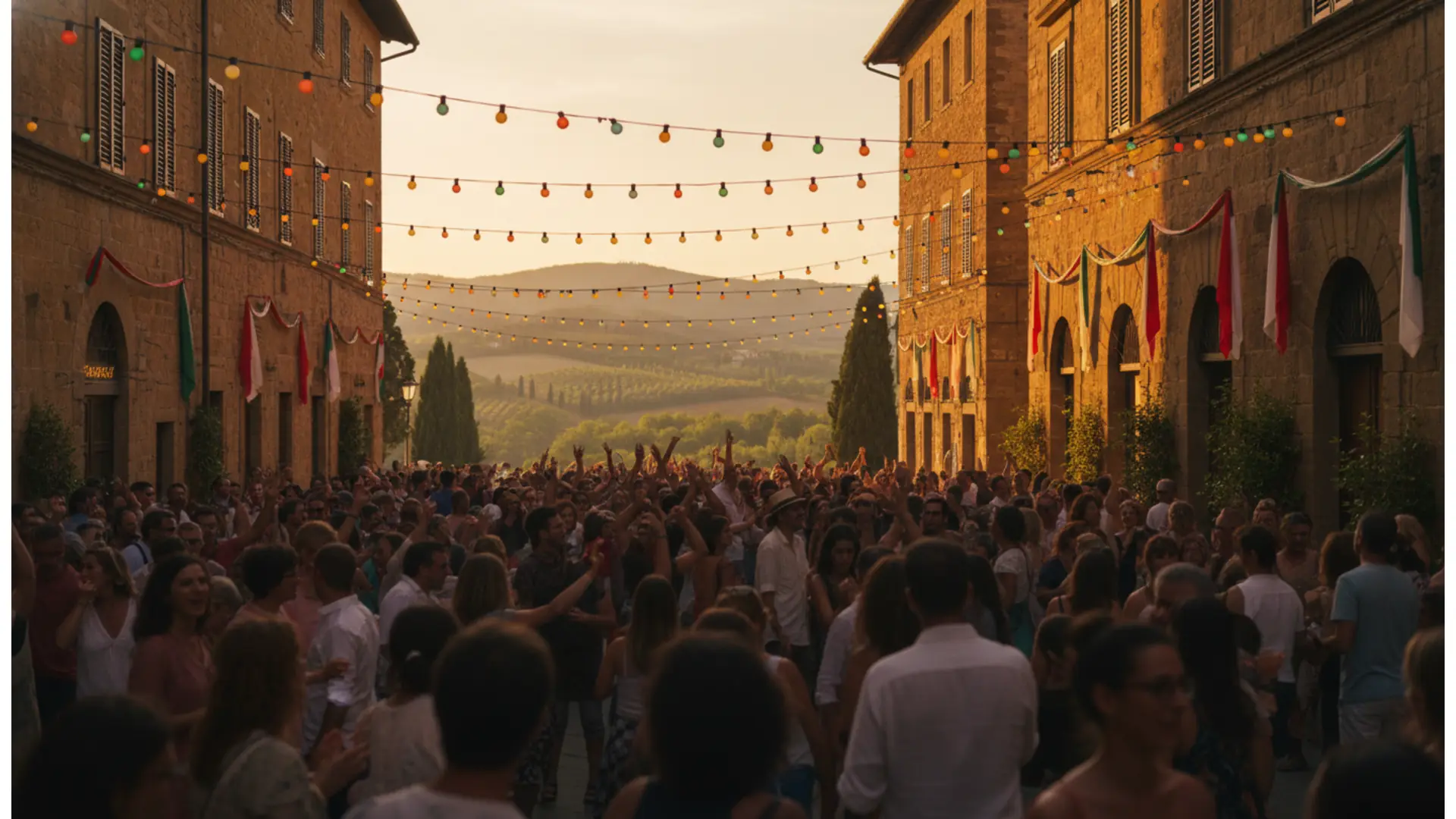
Hellenic National Day in Rome
Greece celebrates March 25th at the Auditorium Parco della Musica
About Hellenic National Day
A national holiday turned into a Roman evening
March 25th is the most significant date in the Greek civil calendar: it commemorates the start of the 1821 revolution against Ottoman rule, the birth of modern Greece. In Rome, the capital of the Lazio region and home to the Embassy of the Hellenic Republic in Italy, the occasion is not confined to diplomatic halls. For years, it has been celebrated with a major public event at the Auditorium Parco della Musica Ennio Morricone in the Flaminio district, one of the most popular cultural complexes in Europe.
The venue: the Auditorium and the Sala Sinopoli
The concert is typically held in the Sala Sinopoli, one of the three "sound boxes" designed by Renzo Piano along Viale Pietro de Coubertin. The Auditorium's peristyle, the open space surrounding the halls, hosts exhibitions and the final reception on these occasions. This choice reflects the spirit of the initiative: not a closed-door reception, but a cultural celebration hosted in a venue that Romans consider their own.
Twenty-eight centuries of ties
The common thread of the Roman celebrations is always the same: the relationship between Greece and Italy. Ambassador Eleni Sourani has repeatedly recalled from the Auditorium stage how the two countries share a common heritage dating back to Magna Graecia, with colonies and archaeological sites scattered across Puglia, Calabria, and the entire Mezzogiorno. These ties were further strengthened in the modern era thanks to the Italian Philhellenes, who participated in the Greek war of independence, drawing inspiration for the Italian Risorgimento.
Music, art, and cuisine
The evening's format is well-established and revolves around three pillars:
- The concert, the heart of the event, featuring world-class Greek performers: over the years, soloists, pianists, and orchestras have alternated, with programs built on the dialogue between Hellenic and Italian repertoires.
- The exhibition, set up in the Auditorium spaces and designed as a visual introduction to the musical evening.
- The closing reception, featuring a tasting of traditional Greek dishes offered to guests.
Who attends
The audience usually exceeds one thousand people and reflects the event's hybrid nature, being both diplomatic and civic: representatives of Italian institutions, the accredited diplomatic corps, military leaders, entrepreneurs, academics, and above all the Hellenic community of Rome and Lazio, which is historically numerous and well-rooted in the capital and has collaborated in the organization in past editions.
An invitation-only event
It must be clearly stated: the Hellenic National Day is not a ticketed festival. Access to the evening at the Auditorium is by invitation of the Embassy, in accordance with the protocol for national celebrations of countries represented in Rome. However, those wishing to follow the occasion can count on a series of fringe events: in the weeks around March 25th, cultural associations, bookstores, and Hellenic centers in the capital propose meetings, screenings, and presentations dedicated to Greek history and language, while the event is widely covered by the Italian press.
Rome and Greece
For the city, this late March evening serves as a discreet yet effective reminder. Rome preserves a decisive part of the Greek legacy in its museums and collections; Greece, for its part, looks to Italy as its closest Mediterranean partner. The Hellenic National Day at the Parco della Musica transforms this kinship into an evening of music and conviviality, giving the 1821 anniversary an unmistakably Roman accent.
Hellenic National Day — edition 2026
«Under the Mediterranean Sky»
The title chosen for the 2026 edition says it all: a musical bridge between Greece and Italy, built around the March 25th anniversary and the Greek revolution of 1821. The event took place on the evening of Tuesday, March 24, 2026, at the Auditorium Parco della Musica Ennio Morricone, in the Sala Sinopoli, before an audience of over one thousand guests.
The concert
The star of the evening was Greek tenor Stavros Salabasopoulos, trained at the Greek National Opera and later in Paris, accompanied by pianist, arranger, and composer Georgios Papachristoudis, who conducted an orchestra of fifteen musicians. The program spanned Greek tradition and contemporary Italian repertoire, weaving the two languages together within the same compositions. The evening was hosted by journalist Teodoro Andreadis Synghellakis.
The exhibition and the reception
Before the music, the Auditorium's peristyle hosted an exhibition of works by Greek painter Kostas Spiropoulos, with brightly colored canvases that welcomed the public. At the end of the concert, the traditional reception featured a tasting of Greek cuisine.
The Ambassador's speech
Ambassador Eleni Sourani recalled the twenty-eight centuries of relations between the two peoples, from the Magna Graecia colonies in Puglia and Calabria to the contribution of the Italian Philhellenes to the Greek war of independence, a struggle that in turn inspired the Italian Risorgimento. Present in the hall were representatives of Italian institutions, military leaders, entrepreneurs, academics, and numerous members of the Hellenic community of Rome.
Programme Hellenic National Day 2026
Tuesday, March 24, 2026 — Auditorium Parco della Musica, Sala Sinopoli
- Exhibition of works by painter Kostas Spiropoulos in the Auditorium peristyle, welcoming the public
- Institutional greeting by the Ambassador of Greece to Italy, Eleni Sourani
- Concert «Under the Mediterranean Sky — A musical bridge between Greece and Italy» with tenor Stavros Salabasopoulos, pianist and conductor Georgios Papachristoudis, and an orchestra of 15 musicians; program featuring Greek tradition and contemporary Italian repertoire, including bilingual pieces
- Hosted by journalist Teodoro Andreadis Synghellakis
- Closing reception with a tasting of traditional Greek dishes
Wednesday, March 25: official anniversary of the Hellenic Republic's National Day.
Highlights Hellenic National Day 2026
- The «Under the Mediterranean Sky» concert in the Sala Sinopoli, with a fifteen-piece orchestra
- The voice of tenor Stavros Salabasopoulos and the piano of Georgios Papachristoudis
- Pieces blending Greek and Italian in the same composition
- The painting exhibition by Kostas Spiropoulos in the Auditorium peristyle
- The final reception with traditional Hellenic dishes
Prices Hellenic National Day 2026
Practical information — Hellenic National Day
Location
Auditorium Parco della Musica Ennio Morricone, Viale Pietro de Coubertin 30, 00196 Rome (Flaminio district). The concert is held in the Sala Sinopoli.
How to get there
Metro: Line A to Flaminio, then tram 2 to the Piazza Apollodoro terminus (the Auditorium is a short walk away). Bus: lines 53, 217, 910, and the M shuttle. Train: from Roma Termini station, take Metro A towards Battistini to Flaminio. Car: underground parking at the Auditorium with access from Viale Pietro de Coubertin; the area is served by the ring road (Villaggio Olimpico exit).
Access
The celebration of the Hellenic Republic's National Day is an event by invitation of the Embassy of Greece in Italy: there is no ticket sale to the public. Information and press releases are available on the Embassy's website.
Tips
The Flaminio district offers numerous dining options around Piazza Apollodoro and along Via Guido Reni, where the MAXXI museum is also located: those arriving in Rome for the occasion can easily combine a museum visit with the evening at the Auditorium.
Festival-goer photos
No photos yet. Share yours!
Share your photos
5 photos max, 5 MB per photo (JPG, PNG, WebP)
Noticed an error or missing information?
Help us keep this listing up to date. Every proposal is verified by our team before publication.
Festival-goer reviews
No rating yet — be the first!
No comments yet. Be the first!
Were you there?
Share your experience with the community.
Published by Valentin Contard, festival listings writer. Reviewed, corrected and approved by Christophe Contard, editor-in-chief. .
Where does it take place — Hellenic National Day
Auditorium Parco della Musica Ennio Morricone — Sala Sinopoli
Viale Pietro de Coubertin 30, 00196 Roma