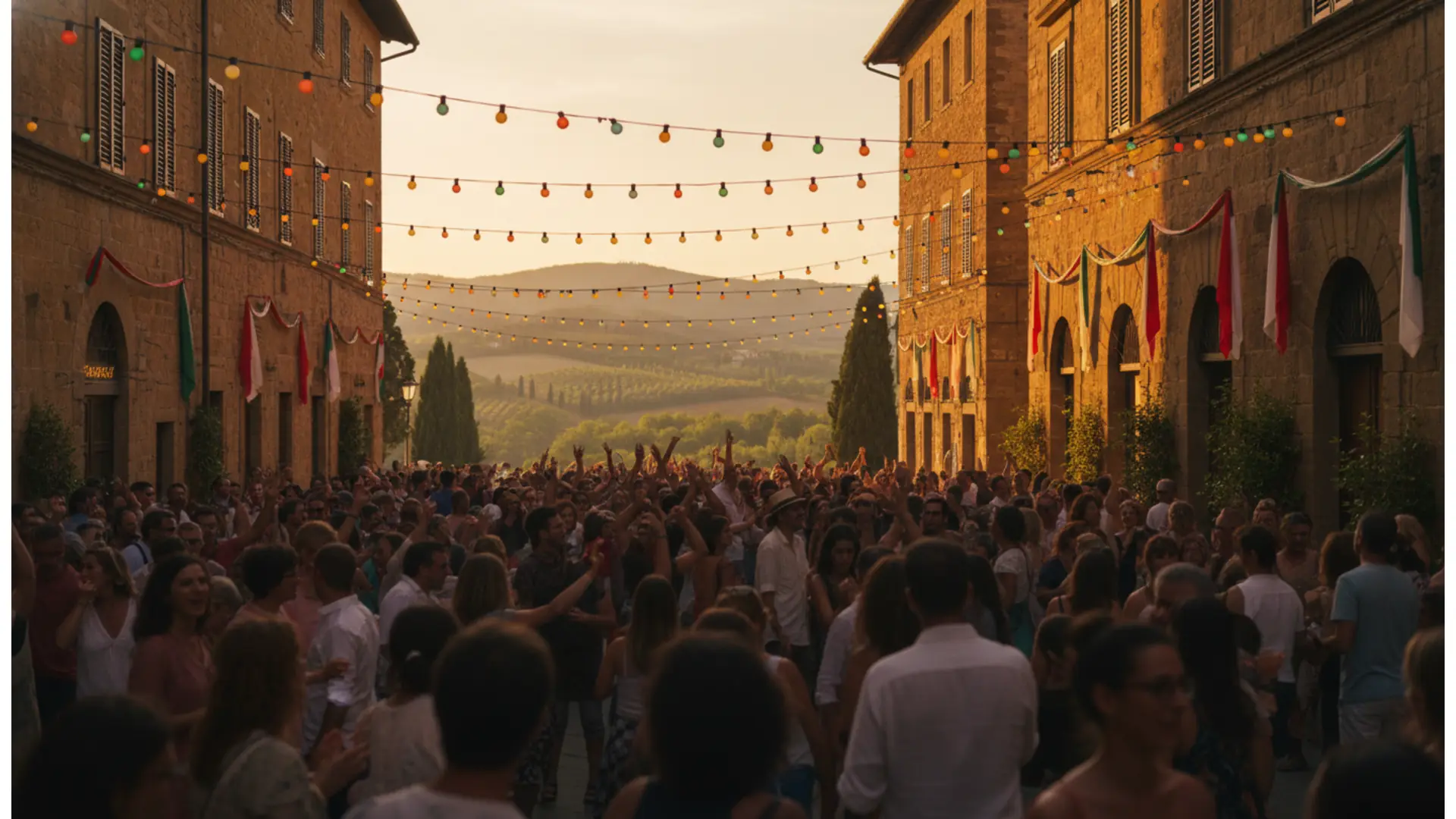
Vacunalia - Contemporary Art Festival
Contemporary art between the village and the sacred Pago woods, in the spirit of the goddess Vacuna
Edition 2026 not confirmed to date
This edition has not been confirmed by the organiser to date. We recommend checking before going.
About Vacunalia
A festival dedicated to creative leisure in Sabina
Vacunalia is a contemporary art festival held in Vacone, a village of a few hundred inhabitants perched on the slopes of Monte Cosce in the province of Rieti, Lazio. The name of the event—and the village itself—refers to Vacuna, the ancient Sabine goddess of rest and leisure after the toil of the fields, traditionally celebrated in autumn with festivals known as Vacunalia. From this mythological root, the festival draws its core theme: leisure as a fertile time, a space for imagination and freedom.
The origins: the sacred Pago woods
The first edition took place on August 20–21, 2021, in the sacred "Pago" woods, with the support of the Lazio Region and the Municipality of Vacone. Four emerging artists—Ivo Cotani, Flavio Orlando, Lorenzo Tonda, and Federico Niccolai—lived in the village as residents to create site-specific works designed to blend harmoniously with the landscape, under the curation of Niccolò Giacomazzi and Benedetta Monti.
A format that grows year by year
In September 2022, the second edition, "Il tempo scortese" (The Discourteous Time), "cordially" invaded the historic center surrounding the medieval castle once owned by the Orsini family, featuring works by Verdiana Bove, Martina Cioffi, Valerio D'Angelo, Roberto Maria Lino, Pietro Moretti, and Yuxiang Wang, which remained on display for nearly a month with free admission. In 2024, the fourth edition, "Se ti perdi m'incontri" (If You Get Lost, You'll Find Me), curated by Niccolò Giacomazzi with the non-profit Fugu Project, focused entirely on performance: seven artists—including Fabio Giorgi Alberti, Greg Jager, and Jacopo Natoli—animated spaces ranging from the sacred woods to the village's underground garages for an entire day.
Vacunalia V: "Sottosopra Sottobosco"
The fifth edition took place on Sunday, October 26, 2025, curated by Niccolò Giacomazzi and Carlota Rel, featuring an immersive journey between the village and the woods dedicated to visual art, music, dance, and cinema: the sound ritual by musician Gabriel Fischer, choreography by Serena Zaccagnini, a film festival curated by Nicholas Nahuel Turchi, and a permanent installation by Gabriele Giugni connecting the village to its woods. The festival is supported by the Fons Olei Foundation, Fugu Project, the Municipality of Vacone, and the Pro Loco Vacone.
Art and the Autumn Festival
One of Vacunalia's unique features is its coincidence with the Vacone Autumn Festival: contemporary art thus engages in a dialogue with Sabine gastronomic traditions, featuring local products, new olive oil, and village conviviality. It is a rare model in Italy, where a micro-village in the Rieti area becomes, for one day, a laboratory of diffused art that is free and open to all.
Why visit
- Site-specific works and performances designed specifically for the locations of Vacone
- The evocative sacred Pago woods, blending nature and spirituality
- An authentic Sabina village, nestled between Rieti and the Tiber Valley
- The pairing with the Autumn Festival and typical Rieti flavors
- Free admission and an intimate atmosphere, far from the mainstream circuits
Vacunalia — edition 2026
At the moment, the organizers have not yet announced the dates and theme for the sixth edition of Vacunalia. The 2024 and 2025 editions took place on the last Sunday of October, in conjunction with the Vacone Autumn Festival: it is therefore likely, though not confirmed, that the 2026 edition will follow the same schedule. We will update this page as soon as the Municipality of Vacone, the Pro Loco, or Fugu Project publish the official announcement with the program and invited artists.
Programme Vacunalia 2026
Prices Vacunalia 2026
Practical information — Vacunalia
How to get there
Vacone (RI) can be reached by car from the A1 motorway (exits Ponzano Romano-Soratte or Magliano Sabina), continuing on local roads toward the Sabina region of Rieti; the journey from Rome takes about an hour. Parking is available at the edge of the village, which is best explored on foot.
Admission
All editions of the festival have always been free of charge. The route winds through the historic center and the sacred Pago woods: comfortable shoes suitable for trails are recommended.
Contacts
Information via email ([email protected]) or on the festival's Facebook page.
Festival-goer photos
No photos yet. Share yours!
Share your photos
5 photos max, 5 MB per photo (JPG, PNG, WebP)
Noticed an error or missing information?
Help us keep this listing up to date. Every proposal is verified by our team before publication.
Festival-goer reviews
No rating yet — be the first!
No comments yet. Be the first!
Were you there?
Share your experience with the community.
Published by Valentin Contard, festival listings writer. Reviewed, corrected and approved by Christophe Contard, editor-in-chief. .
Where does it take place — Vacunalia
Centro storico e bosco sacro del Pago