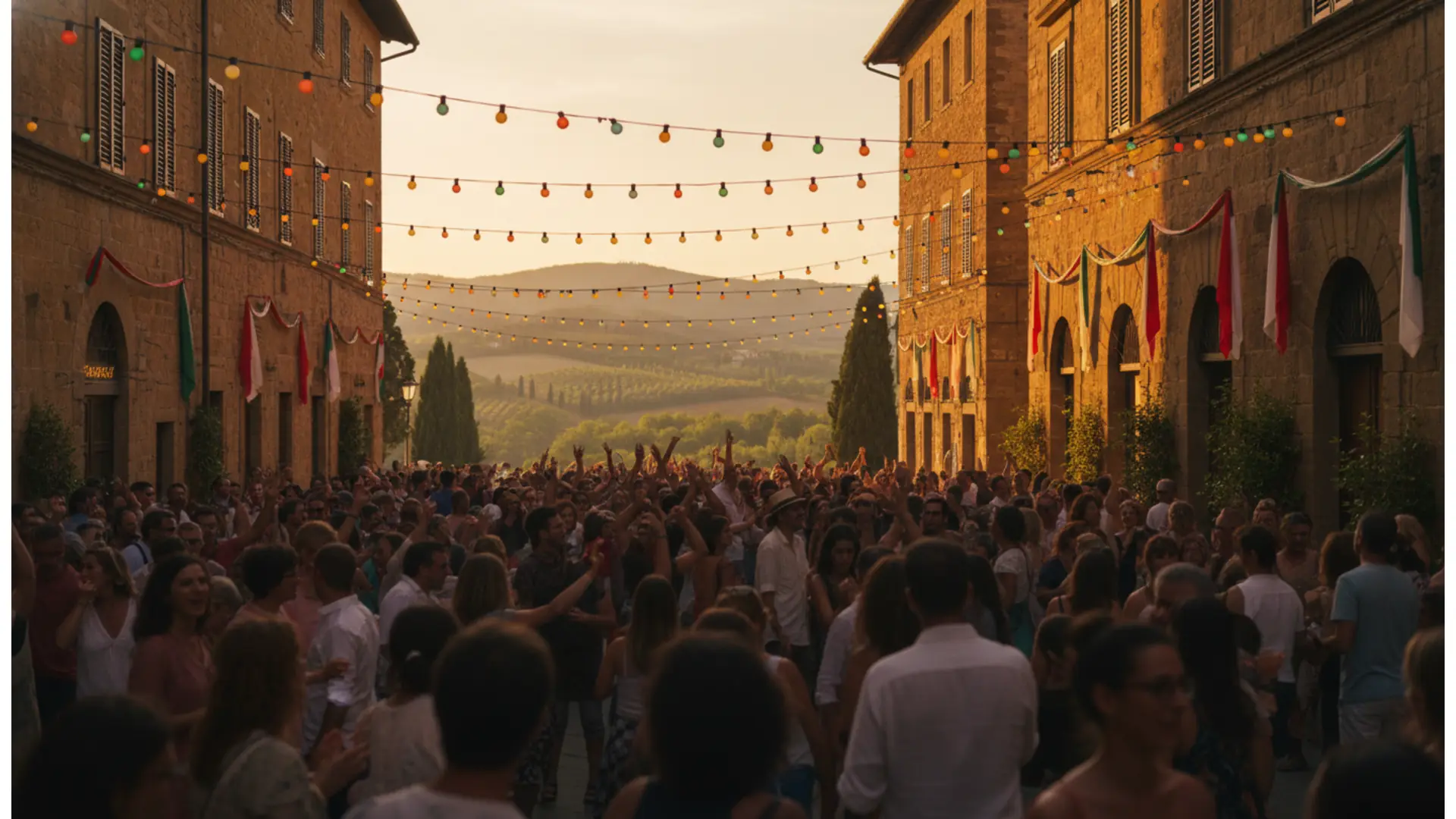
September Festival in honor of Our Lady of Sorrows
The oldest festival in Fiano Romano, blending popular devotion with Tiber Valley traditions
About September Festival
A devotion born in 1842
The September Festival in honor of Our Lady of Sorrows is the defining celebration of Fiano Romano, a town in the Metropolitan City of Rome Capital, in the Lazio region. It all began on March 24, 1842, when a wax image of the Virgin of Sorrows, dressed in satin and purchased with the offerings of the local faithful, was placed in a niche above the Holy Crucifix in the parish church of Santo Stefano. That same year, the festival in honor of the Madonna was celebrated for the first time: an organization entrusted exclusively to the women of the town, which only saw the participation of men starting in 1933.
A history interrupted and restored
In August 1879, some women of Fiano asked the parish priest of Santo Stefano, Father Stefano Meccarocci, to restore the celebration in honor of Our Lady of Sorrows to the community: the request, submitted to the diocesan bishop, was granted. After a few years of suspension, the festival resumed without further interruption starting in 1889. In the early 1960s, the organization passed to the Pro Loco Association of Fiano Romano, which gave it the name by which it is still known today: September Festival in honor of Our Lady of Sorrows. Nearly two centuries after the first edition, the progressive numbering of the years—182nd in 2024, 183rd in 2025, 184th in 2026—tells the story of this tradition's continuity better than any words.
The Sunday procession
The heart of the festival remains unchanged: the solemn procession on Sunday, when the sacred image of Our Lady of Sorrows is carried along the streets of the historic center, accompanied by the marching band and followed by confraternities, civil authorities, and a crowd that includes many locals who have returned for the occasion. The route winds through the alleys around the church of Santo Stefano and the town squares, decorated for the event. The festival is organized by the Pro Loco with the contribution of the Parish, the Pia Unione, and the Municipal Administration, and in recent years it has also seen the official participation of the Metropolitan City of Rome Capital and mayors from the Tiber, Flaminia, and Cassia territorial conferences.
Between the sacred and the profane
Surrounding the religious core is a full-fledged town festival that spans three days. Traditional festive lights create arches of light above the streets, while stalls and stands animate the historic center from the afternoon until late at night. The program usually includes:
- liturgical celebrations in the church of Santo Stefano, with the preparatory triduum;
- evening concerts and shows in the square, featuring local groups and folk music;
- traditional games and activities for children;
- tastings of typical products from the Sabina area and the Tiber Valley;
- fireworks display to conclude the event, a highly anticipated final moment.
Fiano Romano and the Tiber Valley
Nestled on a hill overlooking the countryside between the Tiber and the Sabina, about thirty kilometers from Rome, Fiano Romano preserves an ancient core gathered around the Ducal Castle Orsini, an imposing 15th-century fortress that defines the village's skyline. The September festival is the best opportunity to discover the town away from the most beaten tourist paths: the historic center, usually quiet, transforms into an open-air living room where religious and social dimensions coexist naturally, following a model of patronal festival widespread throughout Lazio but here expressed with a truly rare documentary continuity.
Why visit
Those looking for an authentic experience of Lazio tradition will find in Fiano Romano a festival not built for tourism, but lived by the community. Participation is free for most events, the atmosphere is familiar, and its proximity to Rome makes it easily accessible even for just an evening. It is also the event that ideally closes the Estate Fianese (Fiano Summer) program, the summer festival promoted by the Municipality of Fiano Romano from June to September.
September Festival — edition 2026
184th edition
The dates for the September Festival 2026 are official: from September 18 to 20, in the historic center of Fiano Romano. The festival is included in the Estate Fianese 2026 calendar published by the Municipality, which brings together shows, festivals, concerts, poetry readings, and games for all ages from June to September.
Organizers
The edition is managed by the Pro Loco Association of Fiano Romano, which has handled the event since the 1960s, together with the parish of Santo Stefano, the Pia Unione, and the Municipal Administration.
Programme September Festival 2026
Highlights September Festival 2026
- 184th edition of a tradition dating back to 1842
- Solemn procession on Sunday with the sacred image of Our Lady of Sorrows and the marching band
- Historic center of Fiano Romano decorated with traditional festive lights
- Food stands and market stalls with local products
- Closing event of the Estate Fianese 2026 program
Prices September Festival 2026
Practical information — September Festival
How to get there
By car: take the Fiano Romano exit on the A1 Milan-Naples motorway, then follow signs for the center. From Rome, you can take the Via Salaria or the Via Flaminia in about 40 minutes. During the festival, the historic center is largely closed to traffic: it is advisable to use parking areas on the outskirts and continue on foot.
By public transport
Cotral bus lines connect Fiano Romano with Rome (Saxa Rubra station on the Rome-Viterbo railway). Check evening and holiday schedules before planning your return.
Admission and costs
Participation in religious celebrations, the procession, and shows in the square is free. Only purchases at food stands and market stalls are paid.
Tips
The Sunday procession is the busiest time: it is advisable to arrive well in advance to find a spot along the route. Wear comfortable shoes for the uphill alleys of the historic center and bring a light jacket for the late September evenings.
Information
A detailed program is published on the Municipality of Fiano Romano website and on the Pro Loco channels in the weeks leading up to the event.
Festival-goer photos
No photos yet. Share yours!
Share your photos
5 photos max, 5 MB per photo (JPG, PNG, WebP)
Noticed an error or missing information?
Help us keep this listing up to date. Every proposal is verified by our team before publication.
Festival-goer reviews
No rating yet — be the first!
No comments yet. Be the first!
Were you there?
Share your experience with the community.
Published by Valentin Contard, festival listings writer. Reviewed, corrected and approved by Christophe Contard, editor-in-chief. .
Where does it take place — September Festival
Centro storico di Fiano Romano