Piccolo Festival Civico "Rehabiting the Village"
A week of workshops, installations, and community care in an Alta Tuscia village
Edition 2026 not confirmed to date
This edition has not been confirmed by the organiser to date. We recommend checking before going.
About Piccolo Festival Civico
A festival built together
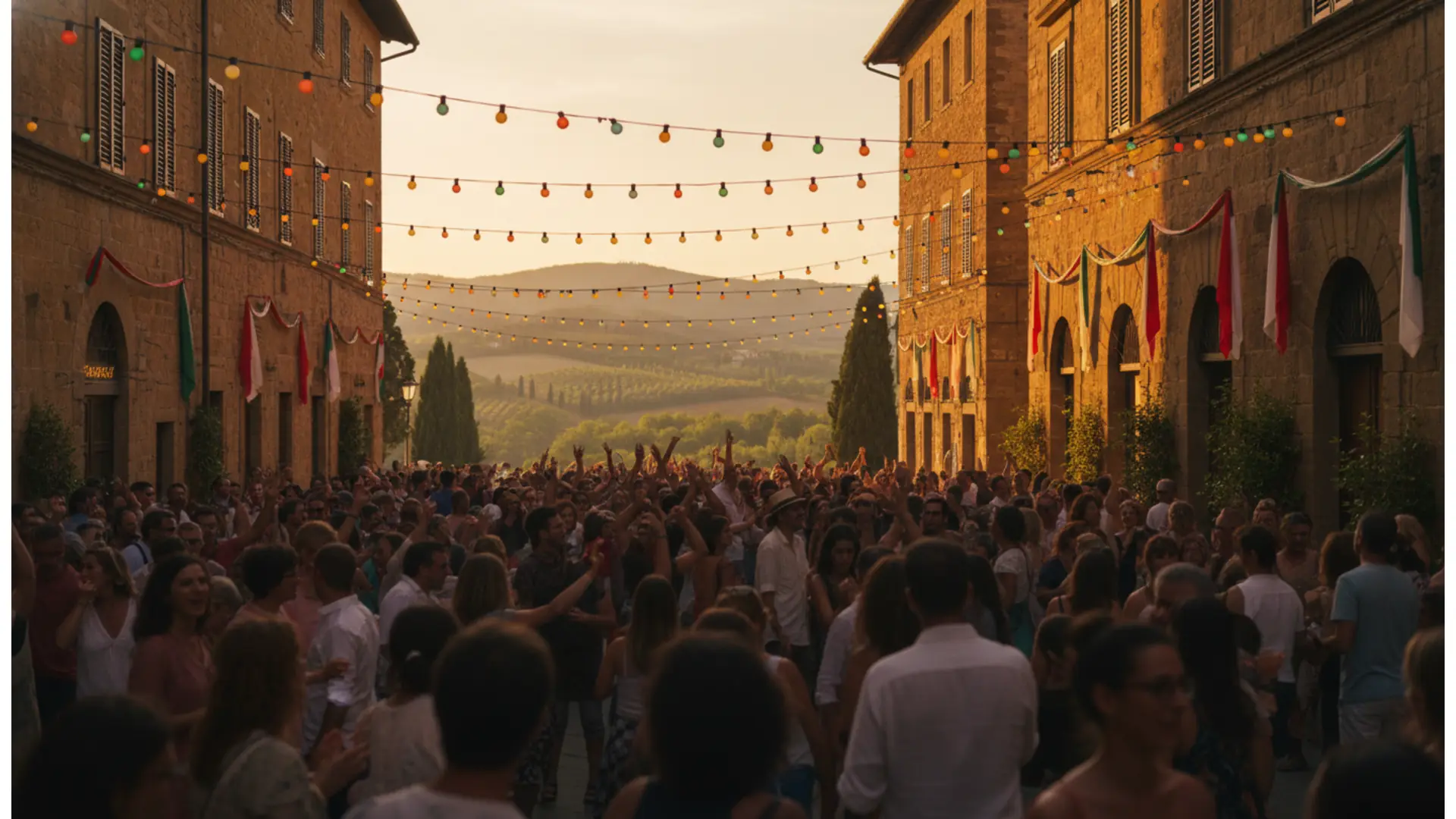
The Piccolo Festival Civico "Rehabiting the Village" is not a series of performances to watch from the sidelines, but a collective project: for one full week, the historic center of Grotte di Castro, in the province of Viterbo (Lazio), becomes a widespread laboratory where everyone can get involved. Alleys, squares, and scenic overlooks host drawing tables, craft stations, collaborative installations, and social gatherings born from the work done together in the preceding days.
The underlying concept is clear from the title: rehabiting means restoring life, meaning, and beauty to public spaces, recognizing them as communal assets for which the community is responsible. This theme is far from abstract in a village in the Alta Tuscia, just a few kilometers from Lake Bolsena.
The project behind it
The festival is the most visible part of the project "New Scenarios for Ancient Villages and Territories. A community imagines its future," funded by the Ministry of Culture through PNRR (Next Generation EU) funds dedicated to the attractiveness of historic villages. It is directed by the Semi di Rigenerazione Association, which works in the area alongside the Grotte di Castro municipal administration.
This same path led to the opening of the Community House in March 2026, a space in the heart of the historic center—formerly the podestà's residence and later an oil mill—designed for participation, creativity, and shared planning. The festival and the Community House are two sides of the same coin: one lights up the village for a week, while the other aims to sustain that energy all year round.
A typical day
The program alternates between short, recurring activities so that no one feels pressured to commit for the entire week. Past editions have featured:
- Design and manual arts workshops — drawing, lantern making, wreaths, and decorative motifs for the village
- Community Education courses — cooking for children, crochet, and other skills passed down by local experts
- Collective drawing stations open in the square, where works grow day by day
- Exploratory walks to discover the hidden corners and history of the old town
- Collective games and a toy library on the weekend, featuring temporary urban installations
- Self-managed social lunch on Sunday, followed by a closing walk
No special skills or complicated registration are required: activities are free, designed for all ages, and structured so that visitors can join in without feeling like outsiders.
Grotte di Castro and the Alta Tuscia
Grotte di Castro sits on a tuff spur overlooking the basin of Lake Bolsena, in a part of northern Lazio that preserves the Etruscan and medieval imprint of the old Duchy of Castro. It is a town of a few thousand inhabitants, also known for its potato cultivation and its historic mid-August festival: a context where the issues of depopulation and the reuse of space are not theoretical exercises, but daily realities.
This is why the Piccolo Festival Civico has a different character from large summer festivals: small by choice, civic by vocation. Visitors won't find a stage and an audience, but a village that works on itself for a few days—and gladly accepts an extra pair of hands.
What to expect
A cozy, informal atmosphere, the slow pace of the Tuscia villages, and the chance to truly get to know the locals. The works created during the week remain on display in the village as visible traces of the community's passage. For those seeking a participatory travel experience far from crowded tourist circuits, this is a rare opportunity in the Lazio region.
Piccolo Festival Civico — edition 2026
2026 Edition: Information updating
As of the writing of this page, no official dates have been released for a third edition of the Piccolo Festival Civico "Rehabiting the Village" in Grotte di Castro, in the province of Viterbo. The PNRR project "New Scenarios for Ancient Villages and Territories," of which the festival is a part, did see the opening of the Community House in the historic center in March 2026, a sign that the work of the Semi di Rigenerazione Association with the Municipality continues.
If confirmed, the edition should take place, like the previous ones, in the latter part of August, with the well-established formula: art and design workshops spread throughout the village, Community Education courses, games and collective installations, walks, and social gatherings, all with free admission.
For updated information, it is best to contact the Municipality of Grotte di Castro directly (+39 0763 797173) or the Semi di Rigenerazione Association at [email protected].
Programme Piccolo Festival Civico 2026
Highlights Piccolo Festival Civico 2026
Prices Piccolo Festival Civico 2026
Practical information — Piccolo Festival Civico
How to get there
By car: Grotte di Castro can be reached from the Orvieto exit of the A1 motorway (approx. 30 km) or via the Via Cassia road along Lake Bolsena. By train: Orvieto station on the Rome-Florence line, then local bus or taxi. The most convenient airport is Rome Fiumicino (approx. 150 km).
Admission and bookings
Festival activities are free and open to everyone, with no prior experience needed. Reservations are required for the Sunday social lunch.
Contacts
Municipality of Grotte di Castro: +39 0763 797173. Semi di Rigenerazione Association: [email protected].
Tips
The historic center is entirely uphill and paved with stone: comfortable shoes are essential. In August, it is advisable to book accommodation in advance near Lake Bolsena or in the village, as the area is very popular. Recommended nearby: local Etruscan necropolises, the Sanctuary of Maria SS. del Suffragio, and a day on the shores of the lake.
Festival-goer photos
No photos yet. Share yours!
Share your photos
5 photos max, 5 MB per photo (JPG, PNG, WebP)
Noticed an error or missing information?
Help us keep this listing up to date. Every proposal is verified by our team before publication.
Festival-goer reviews
No rating yet — be the first!
No comments yet. Be the first!
Were you there?
Share your experience with the community.
Published by Valentin Contard, festival listings writer. Reviewed, corrected and approved by Christophe Contard, editor-in-chief. .
Where does it take place — Piccolo Festival Civico
Centro storico di Grotte di Castro