Agorà - Theatre and Music at the Roots
The traveling festival bringing theatre, music, and circus to the outskirts of Rome and the villages of Lazio
Edition 2026 not confirmed to date
This edition has not been confirmed by the organiser to date. We recommend checking before going.
About Agorà
A widespread agora between Rome and Lazio
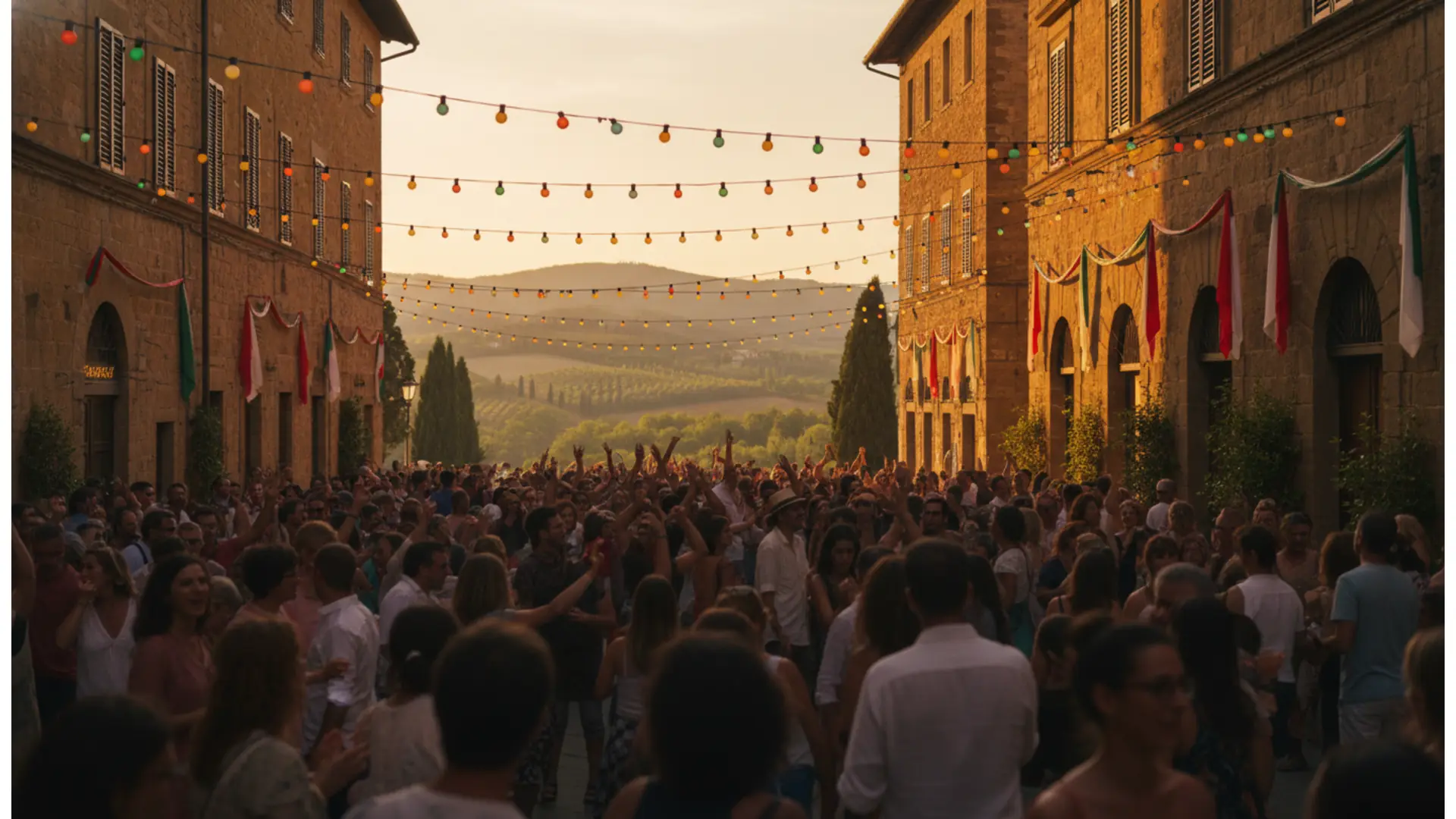
Agorà - Theatre and Music at the Roots is not a festival confined to a single square: it is a traveling event that, every year between late August and November, crosses the Municipality of Rome and a dozen small towns in the Lazio Region. The idea is simple yet radical: to bring live performance where it usually doesn't reach, namely to the peripheral neighborhoods of the capital and the inland villages, restoring to the square — the agora, indeed — its original function as a meeting place.
The event is conceived and produced by the association Il NaufragarMèDolce and is curated by the artistic direction of Chiara Casarico. Born as a small neighborhood festival, it has grown over the years to exceed thirty appointments per edition, with a stable structure consisting of evening shows, morning workshops, and afternoon urban interventions.
The Roman stages: Casal de' Pazzi and Ostia
In Rome, the festival has two recognizable homes. The first is the Casal de' Pazzi Museum, in the north-east quadrant of the city (Municipality IV): a museum-housed paleontological site that becomes a stage for a few evenings, with the audience sitting next to a hundred-thousand-year-old river deposit. The second is the Teatro del Lido in Ostia, a cultural stronghold of the Roman coast and a long-time reference point for the festival, where the most structured performances and training projects with local high schools are concentrated.
The villages of Lazio
Outside Rome, Agorà touches small towns often far from the major circuits: recent editions have involved Formello, Cervara di Roma, Percile, Palombara Sabina, Vetralla (Viterbo), Montopoli di Sabina and Collevecchio (Rieti), Ripi (Frosinone), and Fondi (Latina). Municipal theatres, gardens, senior centers, courtyards, and parish spaces become halls from time to time: it is a geography that changes every year and is an integral part of the artistic project.
What to see
The programming is deliberately multidisciplinary and alternates very different registers:
- Contemporary theatre and auteur dramaturgy, with national premieres and new productions;
- Folk and singer-songwriter music, from Mediterranean repertoire to jazz contaminations;
- Contemporary circus and clowning, often on civil themes such as gender-based violence;
- Shows for children and families, with narratives drawn from children's literature;
- Participatory workshops and urban theatrical interventions with free admission.
Artists who have participated in the festival include names such as Saverio La Ruina, Maria Moramarco, the group Radicanto, Rita Superbi, Riccardo Massai, and Antonella Caldarella, alongside companies from all over Italy.
A declared social vocation
Agorà does not hide its approach: inclusion, hospitality, and dialogue are recurring words in the festival's presentations, and they translate into concrete choices — the free nature of most events, workshops open to residents, and projects with schools. The festival is supported by the Lazio Region as part of its live performance initiatives and has received contributions over the years from the Otto per Mille of the Waldensian Church, in addition to recognition from Roma Capitale for live performances outside the City Center.
Why it's worth the trip
Those looking for a major blockbuster event will not find monumental stages here. Agorà is something else: a community-sized festival, where you might happen to see a contemporary circus show in a village garden or a Southern Italian folk music concert inside a Roman paleontological museum. For those visiting Lazio in the low season, it is also a non-touristy and very authentic way to get in touch with the villages of the provinces of Viterbo, Rieti, Frosinone, and Latina.
Agorà — edition 2026
2026 Edition: what we know
The return of Agorà - Theatre and Music at the Roots in 2026 is supported by the Lazio Region, which has admitted the project by the Il NaufragarMèDolce association for the contribution provided by the Live Performance Interventions for 2026. As of the update of this entry, however, the organization has not yet released either the exact dates or the program.
Based on previous editions, it is reasonable to expect a schedule distributed between the end of August and the second half of November, with the usual Roman stages at the Casal de' Pazzi Museum and the Teatro del Lido in Ostia, accompanied by appointments in the municipalities of the provinces of Viterbo, Rieti, Frosinone, and Latina.
How to stay updated
The program is usually announced a few weeks before the start, on the website ilnaufragarmedolce.it and on the Teatri in Comune channels of Roma Capitale. For information: [email protected], WhatsApp +39 351 9073887.
Programme Agorà 2026
Highlights Agorà 2026
Prices Agorà 2026
Practical information — Agorà
How to get there
The Roman stages are accessible by public transport: the Casal de' Pazzi Museum (via Egidio Galbani 6) can be reached from the Rebibbia Metro B station by surface bus; the Teatro del Lido in Ostia (via delle Sirene 22) is a few minutes' walk from the Lido Centro station of the Rome-Lido railway. For the stages in the villages of Viterbo, Rieti, Frosinone, and Latina, a car is recommended: many towns are served only by regional Cotral bus lines with limited evening runs.
Tickets
Most events are free of charge. For some shows, the ticket is approximately €10 full price and €8 reduced. Booking is recommended because capacities are often limited.
Information and bookings
Official website: ilnaufragarmedolce.it — email [email protected] and [email protected] — phone and WhatsApp +39 351 9073887. Online bookings via Eventbrite.
Tips
Shows often take place outdoors between September and November: bring a jacket for autumn evenings. Always check the exact location of the individual stage, which changes from evening to evening.
Festival-goer photos
No photos yet. Share yours!
Share your photos
5 photos max, 5 MB per photo (JPG, PNG, WebP)
Noticed an error or missing information?
Help us keep this listing up to date. Every proposal is verified by our team before publication.
Festival-goer reviews
No rating yet — be the first!
No comments yet. Be the first!
Were you there?
Share your experience with the community.
Published by Valentin Contard, festival listings writer. Reviewed, corrected and approved by Christophe Contard, editor-in-chief. .
Where does it take place — Agorà
Museo di Casal de' Pazzi e Teatro del Lido di Ostia (rassegna itinerante)